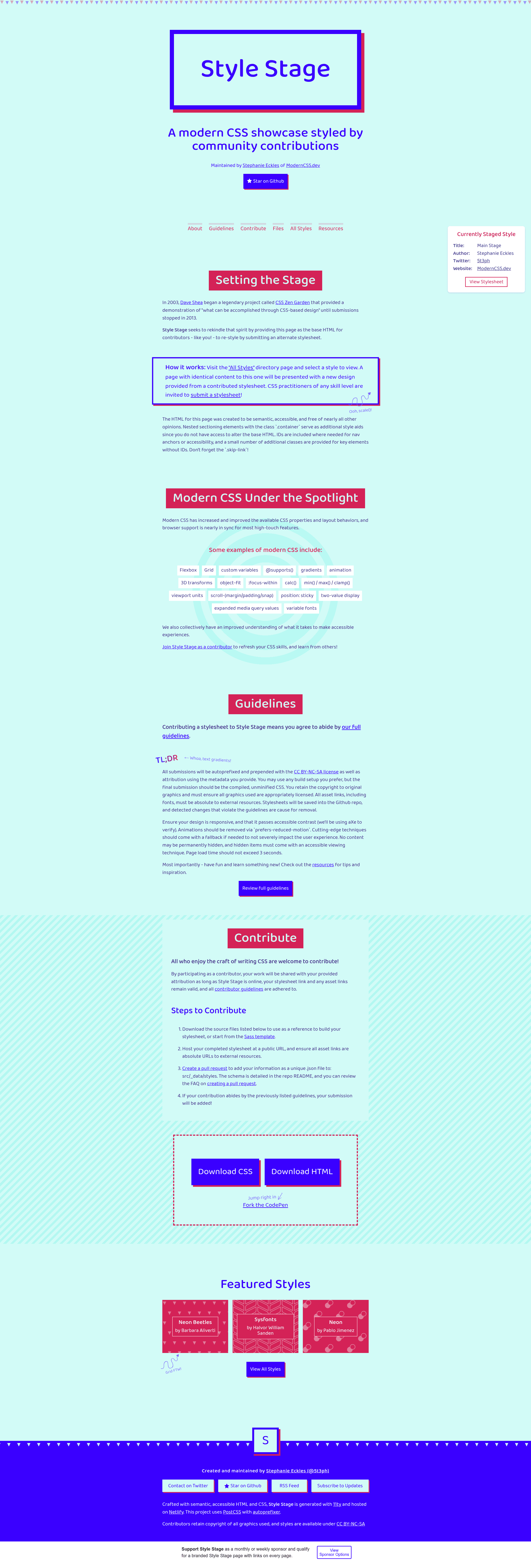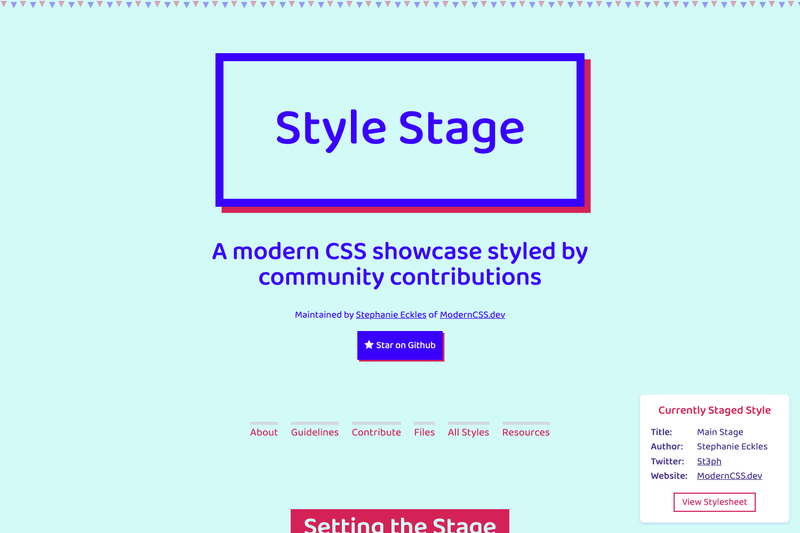
Style Stage is a community-driven modern CSS showcase where developers submit stylesheets that restyle a shared HTML page, created by Stephanie Eckles and hosted at stylestage.dev.
What is Style Stage?
Style Stage is a gallery of alternate visual designs for a single, fixed HTML document. It takes community-authored CSS files as input and renders the same semantic HTML in each contributor's unique style on the stylestage.dev website. The project is built on the Eleventy static site generator (11ty) and is open source on GitHub. Visitors can browse all submitted styles, and contributors can add their own stylesheet through a pull request.
Key Features
- Fixed HTML, unlimited CSS — You may not modify the HTML or add classes; only the stylesheet changes, so every style must work with the same markup.
- Four starter options — Download the source files, use the Sass template with Browsersync hot-reload, fork the full source CodePen, or start from the minimal Style Stage Skeleton Starter CodePen.
- Simple submission process — Add a unique JSON file to
src/_data/styleswith title, author, stylesheet URL, and optional Twitter/website info, then open a pull request. - Automated processing — Style Stage autoprefixes submitted CSS and prepends the CC BY-NC-SA license plus author attribution based on the JSON metadata.
- Any build setup allowed — You can use Sass, PostCSS, or plain CSS; the only requirement is that the final submitted CSS is unminified.
- Community showcase index — The repository maintains an index of all stylesheets (StylesIndex.md) so you can see the range of submissions.
Who is it for?
Style Stage is for CSS developers who want to demonstrate their styling skills without touching markup. It also serves web designers looking for creative inspiration from a wide range of modern CSS techniques. And it's a useful learning resource for anyone studying how different CSS approaches affect the same HTML structure.
What can you do with it?
- CSS crafters: Submit your own stylesheet and see it featured on the public gallery with your name and website attached.
- Front-end learners: Study the submitted stylesheets to understand how colors, typography, layout, and CSS features change the look of identical content.
- Open-source contributors: Participate during Hacktoberfest or any time by creating a style and submitting a pull request to the repo.
How does Style Stage work?
First, choose a starter: download the source files from the files section, grab the Sass template, fork the CodePen, or use the Skeleton Starter. Next, write your own stylesheet following the guidelines found at stylestage.dev/guidelines (no HTML changes, no added classes). Finally, submit a pull request containing a unique JSON file in src/_data/styles with your title, author, and stylesheet URL; the project then autoprefixes and licenses your CSS before it appears on the site.
FAQ
Can I modify the HTML on Style Stage?
No. The guidelines explicitly state that you may not modify the HTML or add classes. Every style must work with the exact same semantic markup provided, which challenges you to style purely with CSS.
What license applies to submitted styles?
Style Stage processing prepends the CC BY-NC-SA license to your submitted stylesheet along with attribution using the metadata you provide. This means your work is shared under that license and credited to you.
Are there any costs to participate?
No. Style Stage is an open-source project, and both viewing the gallery and contributing a stylesheet are free. You only need to submit a pull request to the GitHub repository with your CSS file.
What file format should the final CSS be?
The final submission must be unminified CSS, but you can use any build setup during development. Style Stage will autoprefix your styles during processing, so you don't need to worry about vendor prefixes.