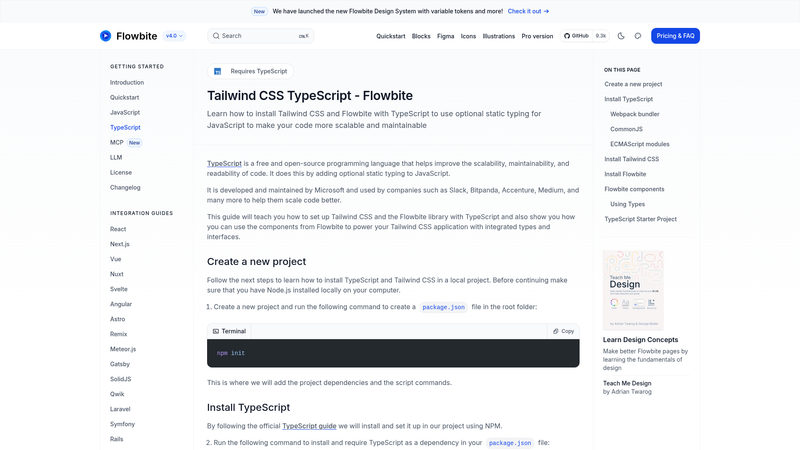
Tailwind CSS + TypeScript + Flowbite Starter is an open-source boilerplate that demonstrates how to initialize Flowbite UI components programmatically with TypeScript inside a Tailwind CSS project.
What is the Tailwind CSS + TypeScript + Flowbite Starter?
It is a free and open-source starter repository that combines the utility-first Tailwind CSS framework, the Flowbite component library, and TypeScript. The starter takes plain HTML, a Tailwind input stylesheet, and TypeScript source files as inputs, and produces a compiled output.css and app-bundle.js that you can open directly in a browser via index.html. It is published under the MIT license and is part of the Flowbite ecosystem.
Key Features
- Tailwind CSS via CLI — The project uses the Tailwind CLI to compile
src/input.cssintodist/output.css, with a watch mode command for continuous development. - Flowbite components with TypeScript types — Flowbite's TypeScript definitions (like
ModalOptionsandModalInterface) are imported directly, giving type safety when creating components. - Webpack bundling for TypeScript — TypeScript source files in
src/are compiled and bundled into a singleapp-bundle.jsusingnpx webpack --watch. - Programmatic component initialization — The included
modal.tsexample creates a Modal instance, configures placement, attaches a click listener, and shows it — demonstrating the pattern for any Flowbite component. - Simple local preview — Open
index.htmllocally to see a list of components initialized by the TypeScript files, with no build server required. - Minimal dependencies — Only Node.js is required; everything else is installed with a single
npm installcommand. - Open-source license — The project is released under the MIT license, so it can be freely used and modified.
Who is it for?
- Frontend developers who want to use Flowbite components in a TypeScript project and need a working reference setup with Tailwind CSS.
- Tailwind newcomers who want to see how to structure a simple HTML/CSS/TS project that compiles to static assets.
- Flowbite users who prefer TypeScript over plain JavaScript and want type-safe component initialization patterns.
- Build tool learners who want a minimal example of combining the Tailwind CLI with Webpack for a browser-ready bundle.
What can you do with it?
- Set up a Tailwind + Flowbite + TypeScript project: Clone the repo, run
npm install, and you have a working environment that compiles CSS and TS with two watch commands. - Learn Flowbite's programmatic API: The modal example shows how to instantiate a Flowbite component with options, attach event listeners, and control visibility via methods like
show()andtoggle(). - Customize the design with Tailwind utility classes: Edit
src/input.cssand the HTML directly to build any layout using Tailwind's utility classes while keeping Flowbite's prebuilt components. - Extend the starter with new components: Add new TypeScript files following the same pattern to initialize dropdowns, modals, tooltips, and other Flowbite widgets.
How does it work?
The workflow is command-line driven. After running npm install, start the Tailwind watcher with npx tailwindcss -i ./src/input.css -o ./dist/output.css --watch and start the TypeScript bundler with npx webpack --watch in a second terminal. Then open index.html in a browser to view the components; each TypeScript file in src/ attaches to an element by selector and initializes the corresponding Flowbite component.
FAQ
Is this starter free?
Yes, the project is open-source under the MIT license, so you can use, modify, and redistribute it without cost.
What do I need to run it?
You need Node.js installed on your machine. After that, the npm install command installs all dependencies including Tailwind CSS, Flowbite, and Webpack.
Does it include TypeScript definitions for Flowbite?
Yes, the code imports both the Flowbite component classes and their TypeScript types, such as ModalOptions and ModalInterface, so type checking works during development.
Is there a build script for production?
The repository only documents watch commands for development; a production build command is not shown. You would add your own build script to produce optimized assets for deployment.