Newsletter
Join the Community
Subscribe to our newsletter for the latest news and updates

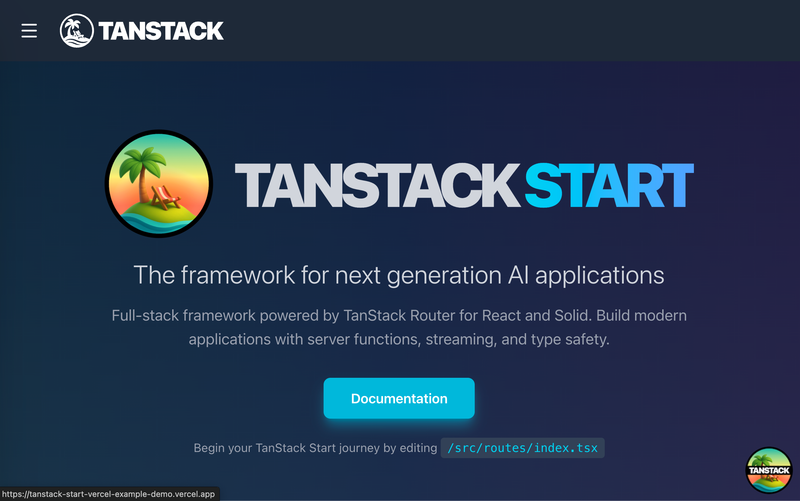
Full-stack React starter built on TanStack Start with file-based routing, route loaders, TanStack Query, TanStack Store, Tailwind CSS, and Vitest.
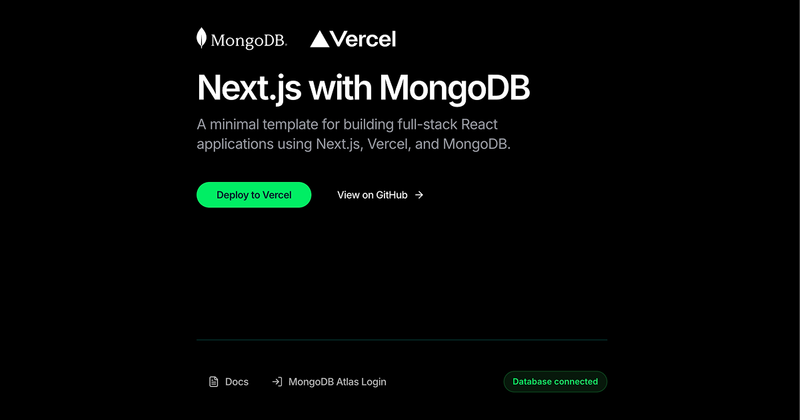
Minimal full-stack starter pairing the Next.js 16 App Router with MongoDB Atlas, TypeScript, Tailwind CSS, shadcn/ui and one-click Vercel deploy.

Starter that installs an Elysia API with Bun, previews it locally through the Vercel CLI on port 3000, and deploys it to Vercel.
An example Express.js server in the AI SDK repo that generates and streams AI text and objects over HTTP endpoints.
A Turborepo monorepo starter pairing a Hono API app with a Next.js web app and shared TypeScript, ESLint, and Prettier configs.
TanStack Start on Vercel is a full-stack React boilerplate built on TanStack Start that bundles file-based routing, route-level data loaders, TanStack Query, TanStack Store, Tailwind CSS, and Vitest into one runnable project. The documentation doubles as onboarding: install with pnpm install, start the dev server with pnpm dev, build for production with pnpm build, and run the test suite with pnpm test.
It is a starter project for building full-stack React applications with the TanStack toolchain, distributed as source files you clone or scaffold rather than as a hosted service. Routes are managed as files under src/routes, styling comes from Tailwind CSS, and tests run through Vitest. The README is the entry point of the project and links out to the TanStack Router, TanStack Query, and TanStack Store documentation for the deeper API details.
src/routes becomes a route, and TanStack Router generates the route file contents automatically; you move between routes with the Link component imported from @tanstack/react-router and a to prop such as /about.src/routes/__root.tsx wraps every route, so a shared header and nav mount once and the matched route content renders wherever the Outlet component is placed.loader function defined on a route fetches data before the component renders, and the component reads the result through the route's useLoaderData hook, so fetching logic lives next to the route rather than inside the component.@tanstack/react-query plus @tanstack/react-query-devtools, creating a QueryClient, and wrapping the RouterProvider in a QueryClientProvider enables the useQuery hook with query keys, with optional ReactQueryDevtools mounted in the root route.@tanstack/store provides a Store class consumed through the useStore hook, and the Derived class computes state from other stores and requires calling its mount method before derived values start updating.pnpm test command.demo exist only as working examples and can be removed safely once you start building your own screens.src/routes, point each loader at an API endpoint, and render the response with useLoaderData or useQuery.src/routes/__root.tsx so it persists across every route.pnpm install.pnpm dev for local development, or pnpm build to produce a production build.src/routes; TanStack Router picks them up and generates the route scaffolding.pnpm test to execute the Vitest suite.It includes TanStack Router with file-based routing under src/routes, route loaders, an optional TanStack Query setup with devtools, TanStack Store for state, Tailwind CSS for styling, and Vitest for tests. Demo-prefixed files are included as editable examples and can be deleted.
It is the standard TanStack Start app scaffold, and its README points to the official TanStack Router, Query, and Store documentation for API reference. The code uses published packages such as @tanstack/react-router, @tanstack/react-query, and @tanstack/store.
Create a new file inside the src/routes directory; TanStack Router generates the route file content for you. Then import the Link component from @tanstack/react-router and point its to prop at the new path, for example /about.
No. TanStack Query is presented as an addition or alternative to route loading, and the README shows both approaches. Route loaders fetch data before rendering, while useQuery handles keyed requests and caching when you need it.
Yes. The TanStack Router devtools component is optional and can be dropped from the root layout, and React Query devtools are only added if you install that package and mount it in the root route.