The Vercel AI SDK useObject Example is an AI starter template from Vercel Labs that shows how to stream structured object generation to a browser client using the useObject hook from the Vercel AI SDK inside a Next.js app.
What is the Vercel AI SDK useObject Example?
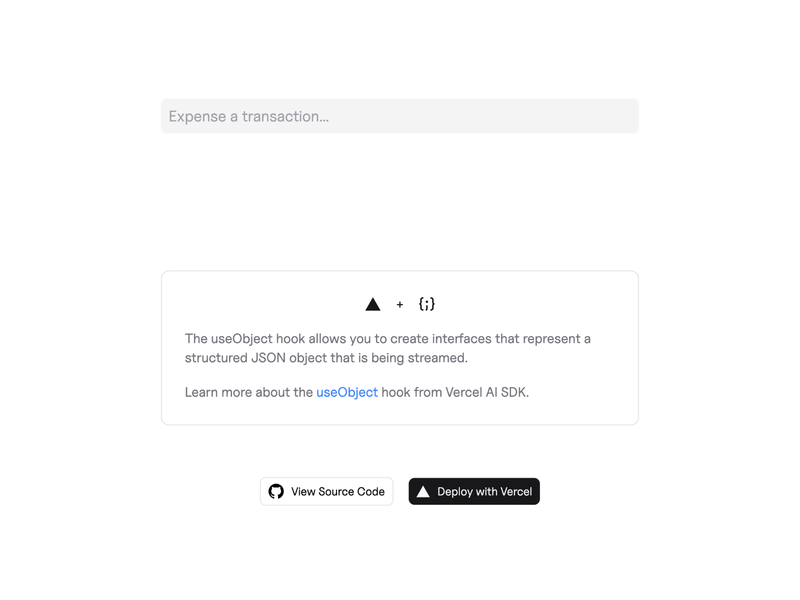
This example pairs the Vercel AI SDK with Next.js to stream structured object generation from a language model directly to the client through the useObject hook, using the AI provider of your choice. As input it takes a prompt and a schema-driven object shape processed server-side, and it outputs a progressively streamed object that renders as it is generated in the client. The repository lives at vercel-labs/ai-sdk-preview-use-object on GitHub and is published by Vercel Labs as a preview of the AI SDK's object streaming capability.
What makes it stand out?
- useObject hook — streams structured object generation to the client incrementally, so the object renders while it is still being produced rather than arriving all at once.
- Next.js framework — the example is a full Next.js app bootstrapped with create-next-app, running on a standard npm run dev development server.
- Provider-agnostic AI backend — works with whatever AI provider you configure, with OpenAI and Anthropic named as examples in the setup instructions.
- Environment-based API keys — provider credentials are read from a .env file, mirroring the keys listed in the included .env.example file (for example OPENAI_API_KEY).
- One-click Vercel deploy — a Deploy with Vercel button clones the repository at vercel-labs/ai-sdk-preview-use-object and prompts for the required API key environment variables.
- Multi-package-manager bootstrap — documented install commands for npm, Yarn, and pnpm create-next-app variants.
- Linked learning resources — points to the Vercel AI SDK docs, Vercel AI Playground, and the Next.js documentation.
How does the Vercel AI SDK useObject Example work?
You sign up with an AI provider, obtain an API key, and copy the required variables from .env.example into a new .env file. After running npm install and npm run dev, the Next.js app starts and the useObject hook streams the generated structured object into the client interface.
Who should use the Vercel AI SDK useObject Example?
- Next.js developers evaluating the AI SDK: clone it to see how useObject streams a typed object into a React client without hand-rolling streaming logic.
- AI app builders prototyping structured outputs: reuse the server plus client pattern to generate forms, summaries, or other schema-shaped data from a prompt.
- Developers comparing AI providers: swap the configured provider and API key to test how different models handle the same object-streaming task.
- Vercel users: deploy the repo straight from the Deploy button to get a hosted demo with environment variables wired up.
Use cases
- Structured data extraction: turn a text prompt into a shaped object that appears piece by piece in the UI as the model produces fields.
- Live AI-editing interfaces: drive form fields, cards, or dashboards that fill in progressively from a streamed object.
- Provider benchmarking: run the same object-generation request against OpenAI or Anthropic to compare streaming behavior and output shape.
FAQ
What does the Vercel AI SDK useObject Example do?
It demonstrates streaming structured object generation from a language model to a browser client. The useObject hook from the Vercel AI SDK renders the object as it streams, inside a Next.js application, using whichever AI provider you configure with an API key.
Who made this example?
It is published by Vercel Labs in the ai-sdk-preview-use-object repository on GitHub, and it is built on the Vercel AI SDK and the Next.js framework. The repository is a preview demonstrating the AI SDK's object-streaming hook.
Do I need an OpenAI API key?
You need an API key for at least one AI provider. The deploy flow specifically requests an OPENAI_API_KEY, and the setup instructions tell you to obtain keys for providers such as OpenAI or Anthropic and place them in a .env file.
How do I run it locally?
Bootstrap the project with create-next-app using npm, Yarn, or pnpm and the example repository URL, then install dependencies with npm install and start it with npm run dev after adding your provider API keys to .env.
Is it free?
The example code itself is an open repository you can clone and self-host. Running it incurs whatever costs your chosen AI provider charges for API usage, since you supply your own provider keys.