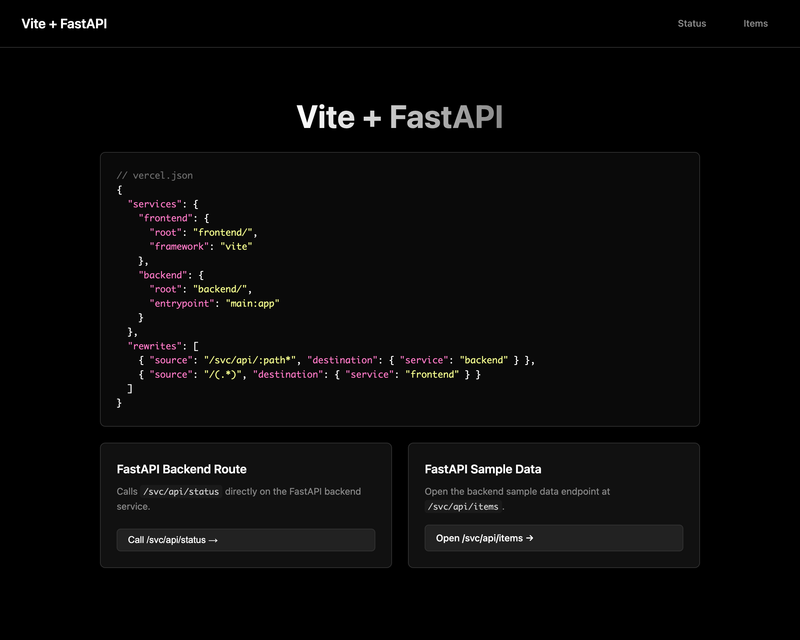
The Vite + FastAPI Starter is a boilerplate example from Vercel's vercel/examples GitHub repository that pairs a Vite-powered frontend with a Python FastAPI backend in a single monorepo.
What is the Vite + FastAPI Starter?
The Vite + FastAPI Starter is a minimal full-stack template that takes a Vite frontend and a FastAPI backend and wires them into one deployable project, producing static frontend files plus a Python serverless function when deployed to Vercel. Vercel maintains it as one of many examples in the public vercel/examples repository, whose overall codebase is written primarily in TypeScript and had 5,147 stars at the time this entry was written. It is part of Vercel's curated examples collection, which is intended as a base for building your own full-stack applications.
Key Features
- Monorepo layout — the project separates the client and server into distinct directories within one repository, so the full stack shares a single version-control history.
- Vite frontend — the client side uses Vite as its dev server and build tool, with React and TypeScript as the default combination, matching the repository's stated primary language of TypeScript.
- FastAPI backend — the server side is a Python FastAPI app that Vercel deploys as a serverless function, so production needs no dedicated server process.
- Local API proxy — the Vite dev server forwards requests under /api to the locally running FastAPI server, so local routing mirrors what Vercel does in production.
- Single-command development — the project's dev script launches the Vite dev server and the FastAPI server (via uvicorn) together, letting you edit the API and the UI in one workflow.
- Deployment configuration included — the example ships with the Vercel configuration needed to route requests between the static frontend and the Python function, which is the core pattern the template teaches.
Who should use the Vite + FastAPI Starter?
Developers who want to run a JavaScript frontend and a Python API under one Vercel project are the primary audience. A React developer can use the template to add a FastAPI service without learning a separate deployment setup. A Python developer can use it to see how an existing FastAPI app fits into a Vercel project alongside a static frontend. Teams moving a full-stack app to Vercel can use the example as a reference for the proxy and serverless-function pattern.
What can you do with the Vite + FastAPI Starter?
- Full-stack prototyping: scaffold a working Vite React client that can call FastAPI endpoints through the /api proxy on day one, then replace the sample code with your own.
- Serverless Python deployment: deploy a FastAPI API to Vercel without provisioning a server, keeping it in the same repository as the frontend.
- Learning reference: study how the example wires Vite, FastAPI, and Vercel together and reuse that wiring in your own projects.
How does the Vite + FastAPI Starter work?
The example is structured as a monorepo with a frontend folder and a backend folder. In local development you install the frontend npm dependencies and the backend Python requirements, then run the project's dev script; the Vite dev server starts and proxies /api requests to the FastAPI server running locally via uvicorn. When you push the repository to Vercel, the frontend builds to static files and the FastAPI app is deployed as a serverless function that handles the /api traffic.
Alternatives
For a full-stack JavaScript-only setup on the same platform, create-next-app generates a Next.js app with built-in API routes and no separate Python backend. For a frontend-only Vite project, create-vite scaffolds just the Vite client that this example extends.
FAQ
Is the Vite + FastAPI Starter free?
Yes, the example is open source inside the vercel/examples repository, so you can copy the code without paying for the template itself. Deploying the resulting project uses Vercel's platform, which has its own free tier and paid plans that are separate from the example code.
What does the Vite + FastAPI Starter do?
It combines a Vite frontend and a FastAPI backend into one monorepo that you can deploy to Vercel. The frontend is served as static files, while the FastAPI app runs as a serverless function, with /api requests proxied to it in both local development and production.
Which frameworks does it use?
The frontend uses Vite with React and TypeScript, and the backend uses FastAPI, a Python web framework. TypeScript is also the stated primary language of the overall vercel/examples repository.
Do I run the frontend and backend separately?
No, the starter includes a dev script that starts both the Vite dev server and the FastAPI server together, so you can work on the API and UI with one command. Locally, Vite proxies /api calls to the FastAPI server.