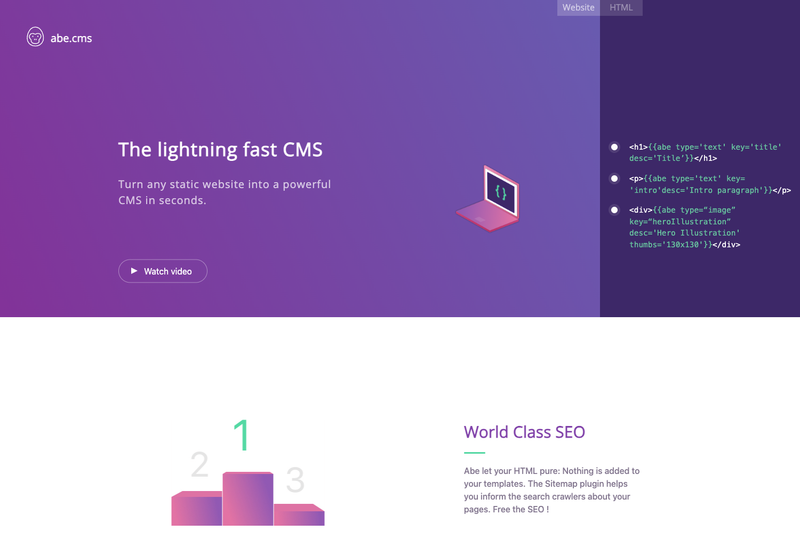
AbeCMS is an open-source, API-first content management system and static site generator that auto-generates its back-office editor from annotated HTML templates.
What is AbeCMS?
AbeCMS is an open-source CMS built on Node.js that combines an API-first REST server with a static site generator. It takes HTML templates marked up with special tags and produces a fully functional back-office editing interface plus deployable static sites. Created by a community around the abecms GitHub project, it is distributed as an npm package and licensed under MIT.
Key Features
- Self-descriptive templates — Mark up plain HTML with AbeCMS-specific tags and the back-office editor is generated automatically.
- API-first REST server — Content is stored as JSON documents and served through a REST API, so the same data can drive web pages, mobile apps, or emails.
- Static site generator — Export the site as static files and deploy to Surge, AWS S3, GitHub Pages, or any SFTP server.
- Workflow and permissions — Built-in validation, user management, and an authorization engine based on oAuth2.
- Real WYSIWYG editor — Users get a clean editing experience instead of form fields.
- Multi-language and multi-locale support — Create complex site structures across languages without extra plugins.
- Plugin ecosystem — Extend with official plugins like abe-algolia and abe-elasticsearch, or write your own in JavaScript with hot reload.
Who is it for?
- Web agencies — Build client sites faster than with WordPress or Drupal by letting the CMS generate the admin UI from the HTML integration.
- JavaScript full-stack developers — Use the Node.js API stack and plugin system to build content-driven applications with hot reload for both templates and plugins.
- Content teams — Manage posts through a single dashboard, a manager page for listing/searching, a WYSIWYG editor, and a user-management page.
What can you do with AbeCMS?
- Corporate magazine sites — AccorHotels magazine is built with AbeCMS, with multi-language support and many contributors.
- E-commerce store locators — Gemo uses AbeCMS across multiple country domains to manage store location content.
- Marketing sites — Sites like Sofitel destinations and Thai Kitchen are powered by AbeCMS with static deployment.
How does AbeCMS work?
- Install globally with
npm install -g abecms. - Run
abe initto launch a wizard that creates your website structure. - Run
abe serve -ito start the site locally on port 3000 with live editing.
Alternatives
- WordPress — a PHP-based CMS with a large plugin ecosystem, but without automatic admin generation from HTML templates.
- Drupal — a heavyweight PHP CMS with complex configuration.
- Hugo — a static site generator written in Go, focused on speed and simple templating, but without a built-in back-office.
FAQ
Is AbeCMS free?
Yes, AbeCMS is open-source software released under the MIT license. You can use it for personal and commercial projects without paying licensing fees, and you can install it globally via npm.
What is the difference between AbeCMS and a static site generator?
AbeCMS combines both worlds: it can serve content as a REST API and generate static sites, while also providing a full back-office interface for content editors. Static site generators like Hugo only output HTML files without an editing UI.
Can I deploy AbeCMS sites to my own server?
Yes, AbeCMS supports deployment to Surge, AWS S3, GitHub Pages, or any web server via SFTP. You can also run it as a Node.js server that serves dynamic content.
What languages does AbeCMS support?
AbeCMS supports multi-language and multi-locale websites out of the box. The documentation and roadmap cover creating complex multilingual site structures without additional plugins.