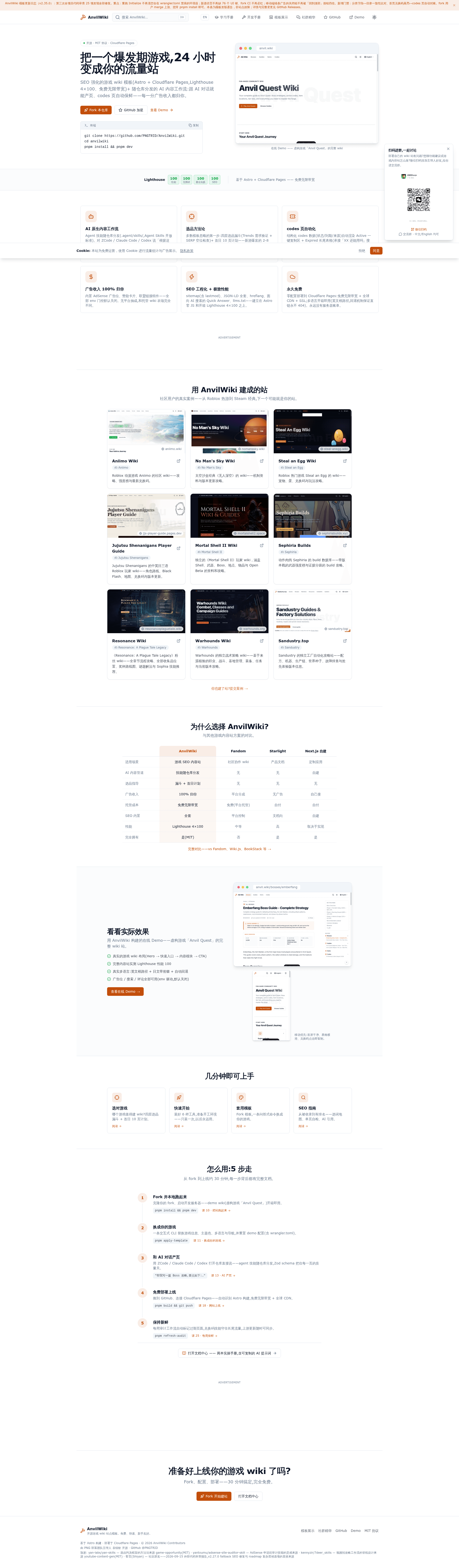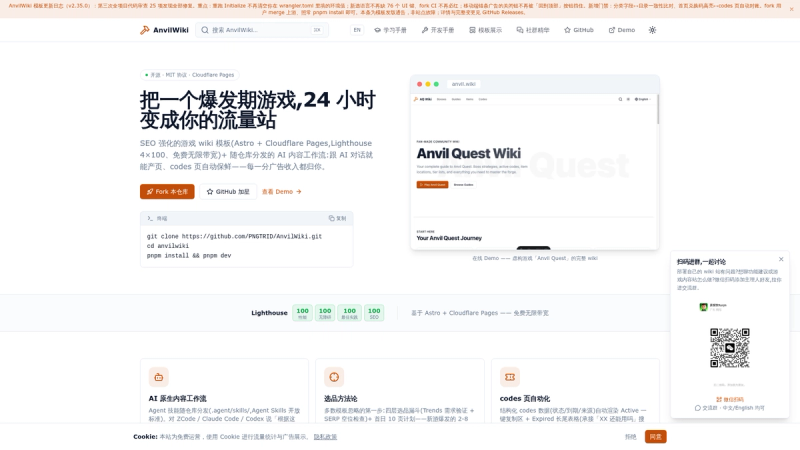
AnvilWiki is an MIT-licensed, open-source game wiki template that turns a fork of its Astro repository into an SEO-driven, ad-monetized content site for a single game, with 100% of the ad revenue kept by the site owner.
What is AnvilWiki?
AnvilWiki is a website template for building a wiki around one game — a Roblox experience, a Steam release, or similar — that attracts search traffic and monetizes it with advertising. The input is a game and its notes; the output is a static wiki site with boss guides, codes pages, tier lists, and item pages, deployed to Cloudflare Pages. It runs on Astro 7 (static output) with Tailwind CSS 3, MDX 8, astro-icon/lucide, the Content Layer API with Zod schemas, and Pagefind search, on pnpm 11 and Node.js 22.13 or newer. The project is maintained by PNGTRID and licensed under MIT.
What makes AnvilWiki stand out?
- Astro plus Cloudflare Pages stack — pure static output with no adapters, free unlimited bandwidth, global CDN and SSL; optional features are env-gated and off by default, so a fresh fork ships zero-JS and zero-cookie.
- AI-native content workflow — six skills ship inside the repository for Claude Code, Codex, Cursor or ZCode:
anvil-find-keywords,anvil-new-article,anvil-batch-articles,anvil-update-codes,anvil-refreshandanvil-adsense-audit. Agents self-check withpnpm check-content && pnpm build; batches run through a PR-gated pipeline with eight quality gates. - Two bilingual manuals — a Learning Manual (6 stages, 29 lessons plus 3 appendices) and a Development Manual (9 lessons) in Chinese and English, each step a SOP with a copy-paste AI prompt.
- Monetization trio — three AdSense slots, an affiliate link component and end-of-article suggestion cards, plus sandboxed Adsterra slots including a mobile bottom anchor, all driven by config and environment variables.
- SEO engineering — sitemap with lastmod, a JSON-LD suite, hreflang tags, Quick Answer summary blocks and llms.txt, all generated automatically.
- Wiki-grade page types — boss stat cards, tap-to-copy redemption codes, tier lists, item pages, TOC scroll-spy, gallery lightbox and Giscus comments (off by default).
- Production tooling —
pnpm template-auditscores how cleanly a site can be copied into the next game's,pnpm bulk-new-postsscaffolds inner-page drafts from a keyword list, andpnpm gen-coversoutputs 1200×675 covers with automatic CJK font pairing. - Multi-site operations — the
anvilwiki-opspackage (npx plus MCP) lets an assistant pull Google Search Console and Cloudflare data, rank optimization actions, and track AI referral traffic from ChatGPT and Perplexity.
Who should use AnvilWiki?
- Non-programmers starting a side income: follow the Learning Manual's "Install the 6 Tools" and "Run Your Site" lessons, then hand all coding work to an AI assistant.
- Community creators: paste notes or YouTube transcripts into
anvil-new-articleto produce MDX guides that pass content checks. - Indie hackers running several games: use
template-audit,bulk-new-postsand the ops toolkit to template the first site into the next one. - Astro developers: extend layouts, components and content schemas via the Development Manual and
docs/PRD.md.
Use cases
- Roblox or Steam wiki owners: launch a boss-guide and codes wiki for a game that just broke out, with tier lists and item pages in place on day one.
- SEO operators: batch-generate inner pages from a keyword list, then track Search Console impressions and AI referral traffic from one toolkit.
- AdSense applicants: run the 22-item pre-application audit skill to check policy compliance and see evidence for items the template already handles.
- Multi-game publishers: fork once per game and merge upstream template updates without losing game configuration or articles.
How does AnvilWiki work?
- Fork the repository, clone your fork, then run
pnpm installandpnpm devto preview the demo game at localhost:4321. - Run
pnpm apply-template, a guided question-and-answer command that sets game name, theme color, domain and locales, and writes SITE_URL into the[vars]block ofwrangler.toml. - Push the changes, then create a Cloudflare Pages project connected to the Git repository; build command
pnpm buildand output directorydistare auto-detected, with NODE_VERSION=22 added as an environment variable. A no-terminal path exists too: run the "Initialize AnvilWiki" GitHub Actions workflow and merge the pull request it opens.
Pricing
AnvilWiki is free and open source under the MIT license. Hosting on the Cloudflare Pages free tier costs nothing and has no bandwidth cap; the only required spend is a domain name, which AdSense approval requires. Advertising and comment features are disabled by default and enabled through configuration.
Alternatives
Fandom is a hosted wiki platform where the platform takes a share of ad revenue, while AnvilWiki keeps 100% with the site owner. Self-hosted wiki engines including Wiki.js, BookStack, MediaWiki, DokuWiki and Docmost are documented in AnvilWiki's comparison table, alongside a section on when not to choose AnvilWiki. A hand-rolled Next.js site is the other common route.
FAQ
Is AnvilWiki free to use?
Yes. The template is MIT-licensed and the Cloudflare Pages free tier provides unlimited bandwidth, a global CDN and SSL at no cost. The only required expense is a domain name, needed for AdSense approval.
Do I need to know how to code?
No. The Learning Manual is written for complete beginners, and every step states what you will see. Code work is delegated to an AI assistant using with the six skills shipped in the repository.
How long before a new wiki earns ad revenue?
The documented golden window is 2 to 8 weeks after a game breaks out, and zero income during the first 1 to 2 weeks is normal. The manual's "First-Week Numbers" and "Thirty Minutes Weekly" lessons cover running expectations.
Will template updates overwrite my articles?
No. A three-layer separation of code, configuration and content keeps your game settings and articles intact when merging upstream changes, as described in the repository's staying-up-to-date documentation.
Does AnvilWiki support multiple languages?
Yes. English pages live at the root path for SEO, translations are added per locale, and missing content automatically falls back to English so direct links never return a 404.