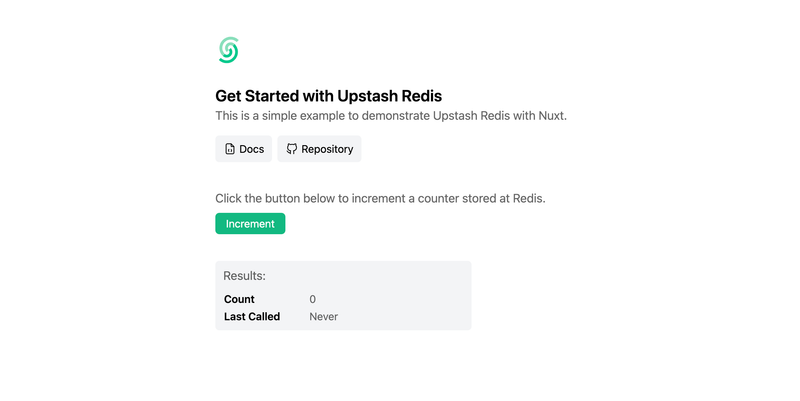
Nuxt App Caching with Upstash Redis is a JavaScript example repository from Upstash that shows how to put a Redis cache in front of a Nuxt application, with Vercel listed as the target platform.
What is Nuxt App Caching with Upstash Redis?
This is a caching example published inside Upstash's examples repository, a collection whose stated purpose is showing how to use Upstash with various tech stacks. It pairs two named ingredients: the Nuxt framework as the application layer, and Upstash Redis as the cache that stores data outside the app process. The code is JavaScript, the platform field points at Vercel, and the listed use case is caching. It is not a published npm package or a CLI tool you install — you read the source, point it at your own Upstash Redis database, and reuse the caching pattern in your own Nuxt project.
Key Features
- Nuxt framework example — the caching code is written for Nuxt, the Vue-based framework, rather than for a generic Node server.
- Upstash Redis as the cache store — cached values live in a serverless Redis database instead of the Nuxt process memory, so the cache survives restarts and is shared across instances.
- JavaScript codebase — the example is plain JavaScript, with no TypeScript-only setup required.
- Vercel deployment target — the platform metadata lists Vercel, matching the serverless execution model that a managed Redis cache is meant to complement.
- Upstash Console link — the README points to console.upstash.com, where the Redis database backing the cache is created and inspected.
- Documentation and community links — docs.upstash.com, the Upstash blog, and the Upstash Discord are linked directly from the README for setup and troubleshooting.
- Small, self-contained sample — the repository is a single-purpose example within a 42-star examples collection, so it stays short enough to read end to end.
Who is it for?
- Nuxt developers adding a cache layer — copy the Redis read/write pattern into an existing Nuxt route or server handler to cache expensive responses.
- Developers deploying Nuxt to Vercel — the example matches a serverless deployment where per-instance in-memory caching is not reliable.
- Teams evaluating Upstash Redis — see the minimum wiring needed to connect a JavaScript app to Upstash Redis before committing to it.
What can you do with Nuxt App Caching with Upstash Redis?
- Cache slow API calls: wrap an upstream fetch in a Redis lookup so repeated requests return the stored value instead of re-fetching.
- Share cache across serverless instances: because the cache lives in Upstash Redis rather than Nuxt process memory, separate Vercel instances read the same values.
- Prototype a Nuxt plus Upstash setup: use the example as the starting point for a new Nuxt project that needs a managed Redis database from day one.
FAQ
What stack does this example use?
It combines Nuxt as the framework, Upstash Redis as the caching product, and JavaScript as the language, with Vercel listed as the deployment platform. The example sits in Upstash's repository of samples for using Upstash with different technologies.
Do I need an Upstash account to run it?
Caching with Upstash Redis means the data lives in an Upstash Redis database, so a database from the Upstash Console is required. The README links to console.upstash.com, along with the Upstash documentation, blog, and Discord, for creating and managing that database.