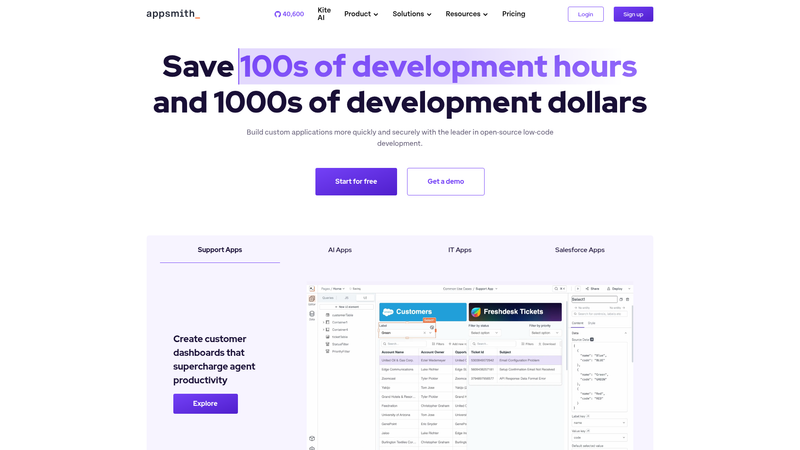
Appsmith is an open-source low-code platform for building internal tools such as admin panels, dashboards, and workflow automations, and it is available both as a hosted cloud service and as a self-hosted application.
What is Appsmith?
Appsmith is an open-source low-code platform that lets teams build custom applications like dashboards, admin panels, customer 360 views, IT automation, and service management tools. It takes data from 25+ databases and any REST API as input and produces deployable web apps with a drag-and-drop UI builder. The platform is developed by Appsmith Inc. and can be run on Appsmith Cloud or installed on your own infrastructure via Docker, Kubernetes, or an AWS AMI.
Key Features
- Open-source core — The entire platform source is available on GitHub with an active contributor community.
- Database and API integrations — Connects to over 25 databases and any REST API, so data can be pulled from existing systems.
- Drag-and-drop UI builder — Build interfaces by dragging widgets onto a canvas; the page mentions building dashboards, admin panels, and customer 360 views.
- Self-hosting options — Official installation guides for Docker, Kubernetes, and AWS AMI, with Docker marked as recommended.
- Appsmith Cloud — A hosted option to get started without managing your own infrastructure.
- Appsmith Agents — An agentic AI platform that brings AI models to business data and automations inside the tools teams already use.
- Community support — Active Discord server and community portal for help and collaboration.
- Developer-friendly stack — Built with Java and JavaScript (React, TypeScript), indicating it is designed for developer extensibility.
Who is it for?
- Internal tool developers — Build custom admin panels and dashboards quickly without spinning up a separate frontend and backend.
- IT and operations teams — Create automation and service management interfaces that connect to existing databases and APIs.
- Product teams — Spin up customer 360 views or internal CRUD apps to manage customer information.
- Developers who want self-hosting — Deploy on Docker, Kubernetes, or AWS AMI to keep data in their own infrastructure.
What can you do with Appsmith?
- Build dashboards: Connect to databases and APIs to visualize key metrics in a custom web app.
- Create admin panels: Manage users, content, or operations with CRUD interfaces generated from your data sources.
- Automate workflows: Build internal tools that trigger actions and integrate with your existing systems.
- Deploy on your own infrastructure: Use the Docker, Kubernetes, or AWS AMI guides to run Appsmith in your own environment.
Alternatives
Appsmith competes with other low-code internal tool platforms such as Retool, a commercial product, and Budibase, another open-source option.
FAQ
Is Appsmith open source?
Yes, the Appsmith platform is open source, and its codebase is hosted on GitHub with contributions from a large community of developers.
Does Appsmith support databases?
Yes, Appsmith integrates with over 25 databases and any REST API, allowing you to connect to your existing data sources.
How can I install Appsmith?
You can use the official Docker installation guide (recommended), deploy with Kubernetes, or launch an AWS AMI. Alternatively, you can start on Appsmith Cloud without managing your own infrastructure.
What is Appsmith Agents?
Appsmith Agents is an agentic AI platform that connects AI models to your business data and automations inside the tools you already use, without requiring model fine-tuning or complex RAG implementations.