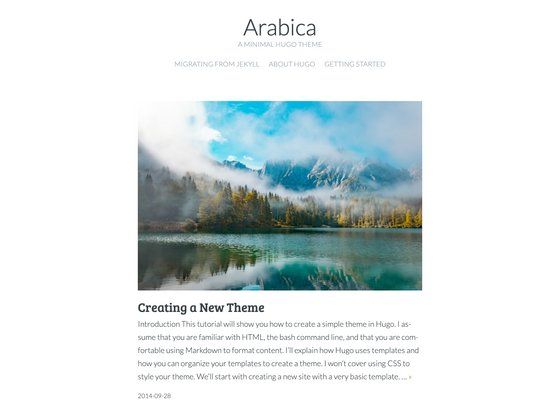
Arabica is a Hugo theme that ports the Ghost Arabica design to the Hugo static site generator, allowing you to run a minimal blog from Markdown content.
What is Arabica?
Arabica is a free, open-source Hugo theme created as a direct port of the Ghost Arabica theme by slunsford, adapted for Hugo by nirocfz. It takes Markdown post files and a config.toml site configuration as input and outputs a static blog website that can be hosted on any static host such as Netlify.
The theme includes an exampleSite folder with a working configuration and sample content so you can preview it locally with a single command. The live demo is hosted at https://arabica.netlify.com, and the source is available on GitHub under the repository nirocfz/arabica.
What makes Arabica stand out?
- Ghost-to-Hugo port — brings the visual design and layout of the popular Ghost Arabica theme to Hugo, expanding its ecosystem.
- Minimal configuration — theme activation is a single line (theme = "arabica") in config.toml, with a small set of optional parameters.
- Custom date format — the dateFormatToUse parameter lets you control how post dates appear, e.g. 2006-01-02.
- Google Fonts replacement — the replaceGoogleFonts parameter swaps the default Google Fonts URL for a mirror domain, useful in regions where Google Fonts is unavailable.
- Social links — twitter and facebook parameters place links in the theme's template.
- Pagination control — the paginate parameter in Hugo's config sets how many posts appear per page.
- Image support — posts can declare an image in front matter, which the theme renders in the post layout.
- Example site included — a prebuilt exampleSite with sample posts and config lets you start immediately.
Who should use Arabica?
Bloggers who want a clean, minimal writing-focused layout without visual clutter will find Arabica a straightforward starting point. Developers familiar with Hugo can clone the theme and modify it directly, since it is a small codebase. Former Ghost users who want to migrate to a static site generator can keep a familiar aesthetic through this port.
What can you do with Arabica?
- Personal bloggers: publish Markdown posts to a static site hosted on Netlify or any static host.
- Hugo learners: use the exampleSite to study how a minimal Hugo theme structures templates and configuration.
- Theme developers: fork the repository and build a custom theme on top of the Arabica base.
How does Arabica work?
To install, clone the repository into your Hugo site's themes folder with git clone https://github.com/nirocfz/arabica. Then add theme = "arabica" to your config.toml file. To preview the example site, navigate to the exampleSite directory and run hugo server with the themes directory pointed two levels up.
FAQ
Is Arabica free?
Arabica is open source under the license included in its repository. You can download, modify, and use it without paying for a license.
Does Arabica support post images?
Yes. You can add an image field to a post's front matter, and the theme will display the image in the post layout, as shown in the example post in the repository.
What does replaceGoogleFonts do?
It replaces the default Google Fonts URL with an alternative mirror domain. This is useful when the default Google Fonts endpoint is blocked or slow in your region.
Does Arabica work with Hugo's built-in features?
Yes, it leverages standard Hugo configuration such as baseURL, title, author, and paginate, and it uses the usual content and template structure, so it works with any standard Hugo site.