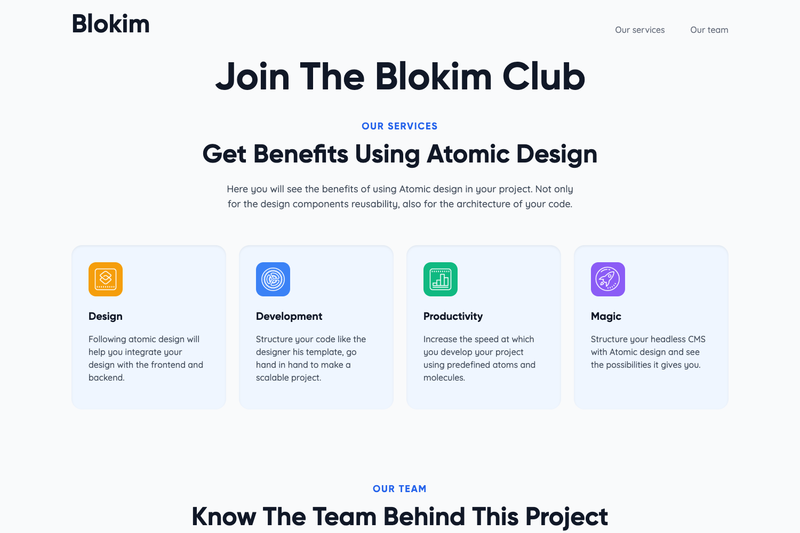
Atomic Design Storyblok is a boilerplate project for Nuxt.js that demonstrates how to organize a Storyblok CMS dashboard using Atomic Design principles, with utility styling from Tailwind CSS.
What is Atomic Design Storyblok?
Atomic Design Storyblok is a GitHub repository that provides a pre-configured Nuxt.js application intended as a learning resource and starting point. It takes a bare Nuxt.js setup and adds the Storyblok headless CMS integration along with a component structure based on Atomic Design levels: atoms, molecules, organisms, templates, and pages. The project's output is a structured boilerplate that you can run locally and adapt into a full website. It currently has 7 stars and lists Nuxt, Tailwind, Storyblok, and Atomic Design as its main topics.
Key Features
- Nuxt.js foundation — The project runs on Nuxt.js, enabling server-side rendering, static site generation, and a hot-reload development server.
- Atomic Design organization — Components are meant to be split into atoms, molecules, organisms, templates, and pages, matching Storyblok's nested block structure.
- Storyblok CMS integration — The boilerplate is designed around Storyblok's headless CMS so you can structure your dashboard to reuse the same components across content types.
- Tailwind CSS styling — Tailwind is included for utility-first styling, so you can rapidly build interfaces without writing custom CSS.
- Standard Yarn commands — The repository includes scripts for
yarn install,yarn dev(serve with hot reload at localhost:3000),yarn build,yarn start, andyarn generate(static project export). - Nuxt documentation pointer — The project links to the official Nuxt.js docs for detailed explanations of how Nuxt works.
Who should use Atomic Design Storyblok?
- Nuxt.js developers who want a starting template that already wires up Storyblok and Tailwind, saving setup time.
- Front-end teams adopting Atomic Design who need a concrete example of mapping atomic components to a CMS dashboard.
- Storyblok users who want to organize their component library according to a scalable design system approach.
- Technical learners who want to study how a Nuxt project integrates with a headless CMS and utility CSS framework.
What can you do with Atomic Design Storyblok?
- Set up a new Nuxt + Storyblok site: clone the repository, run
yarn installandyarn dev, and you have a working environment at localhost:3000. - Learn Atomic Design in practice: examine the project structure to see how atoms, molecules, organisms, templates, and pages relate to Storyblok components.
- Generate a static site: use
yarn generateto export the project as static HTML for deployment on any hosting service.
How does Atomic Design Storyblok work?
The repository ships with a Nuxt application and its dependencies listed in package.json. After installing dependencies with yarn install, you start development with yarn dev, which serves the site with hot reload at localhost:3000. To build for production you run yarn build and then yarn start, or you can run yarn generate to produce a fully static version of the site that needs no Node.js server at runtime.
FAQ
What is the purpose of this boilerplate?
Its purpose is to demonstrate the benefits of using Atomic Design when structuring a Storyblok dashboard. By organizing components into atomic levels, you can create a more maintainable and reusable component library for your Nuxt.js site.
Which technologies are used?
The boilerplate is built with Nuxt.js as the framework, uses Tailwind CSS for styling, and integrates with Storyblok as the headless CMS. The design pattern is Atomic Design.
How do I run the project locally?
Clone the repository, then run yarn install to install dependencies, followed by yarn dev to start the development server with hot reload at localhost:3000. For production, use yarn build and yarn start, or yarn generate for a static output.
Is this boilerplate free to use?
The project is hosted as a public GitHub repository, so you can freely use, fork, and modify it. It currently has 7 stars, indicating community interest.
What documentation is available?
The repository points to the official Nuxt.js documentation for a detailed explanation of the framework's behavior. The boilerplate itself does not include separate documentation files beyond the README content shown in the source.