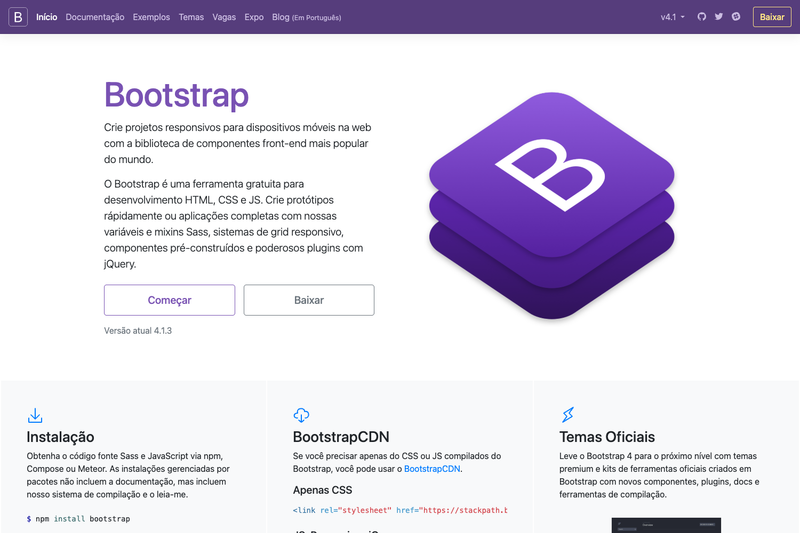
Bootstrap is an open-source front-end framework for building responsive, mobile-first web projects, created by Mark Otto and Jacob Thornton and maintained by the Bootstrap team on GitHub. It provides HTML, CSS, and JavaScript assets that developers include in their pages to rapidly construct layouts and interface components.
What is Bootstrap?
Bootstrap is a free front-end framework that turns plain HTML markup into a responsive, mobile-first design system. It takes simple HTML structure as input and outputs styled, cross-browser-compatible pages when you link its CSS and JavaScript files. The framework runs entirely on the client side, works with any backend, and is developed on GitHub under the MIT License. The project was created by Mark Otto and Jacob Thornton at Twitter.
Key Features
- Compiled and minified assets — The download includes bootstrap.css and bootstrap.min.css, plus bootstrap.js and bootstrap.min.js, with source maps for browser debugging.
- Grid and reset styles — Separate bootstrap-grid.css and bootstrap-reboot.css files let you include only the grid or the CSS reset.
- Bundled JavaScript — bootstrap.bundle.js packages Popper for positioning tooltips and popovers, but jQuery is intentionally not included.
- Multiple installation methods — Install via npm, yarn, Composer, NuGet, or download the release archive directly from GitHub.
- Jekyll-built documentation — The full docs are generated with Jekyll, hosted at getbootstrap.com, and can be run locally on localhost:9001.
- Community support — The project offers an official Slack room, IRC channel at irc.freenode.net, Twitter account, and a Stack Overflow tag.
Who is it for?
- Front-end developers — Build responsive page layouts using the mobile-first grid system and prebuilt utility classes.
- Web designers — Use bootstrap-reboot.css to normalize default browser styling and focus on visual design.
- Development teams — Standardize UI patterns and speeds up prototyping with a consistent, well-documented foundation.
What can you do with Bootstrap?
- Responsive layout builders — Implement multi-column layouts that adapt across breakpoints by including bootstrap-grid.css.
- Project scaffolding — Use the file structure (dist/css and dist/js folders) as a ready-to-deploy starting point for a static site.
- JavaScript interactions — Add interactive behaviors like dropdowns and tooltips via the bundled bootstrap.bundle.js file.
Pricing
Bootstrap is free to use under the MIT License. The code and documentation are available without cost, and the source code is public on GitHub.
Alternatives
- Foundation — Another responsive front-end framework with similar goals.
- Bulma — A modern CSS framework based on Flexbox, focused purely on styling.
- Tailwind CSS — A utility-first CSS framework that provides low-level classes for custom designs.
FAQ
Is Bootstrap free?
Yes. Bootstrap is released under the MIT License, meaning you can use, modify, and distribute it freely in commercial and personal projects.
Does Bootstrap include jQuery?
Bootstrap's bundled JavaScript files include Popper but not jQuery. If you use components that require jQuery, you must include jQuery separately in your page.
How do I install Bootstrap?
You can install Bootstrap via npm with npm install bootstrap, via yarn with yarn add [email protected], via Composer with composer require twbs/bootstrap:4.1.3, or via NuGet. A direct download of the latest release is also available.
What does the Bootstrap download include?
The download contains dist folders with compiled and minified CSS and JavaScript, source maps, and bundle files. The grid and reboot styles are provided as separate files so you can include only what you need.
What license is Bootstrap under?
The code is licensed under the MIT License, while the documentation is released under the Creative Commons license.