BTC RPC Explorer is a self-hosted Bitcoin blockchain explorer that connects directly to your own Bitcoin Core node over JSON-RPC, giving you a database-free, web-based view of blocks, transactions, addresses, and node capabilities.
What is BTC RPC Explorer?
BTC RPC Explorer is an open-source Node.js application created by janoside. It runs on Node.js 18 or newer (22 recommended) and queries your own Bitcoin Core daemon via RPC calls, requiring no external database. It produces a web UI that defaults to http://127.0.0.1:3002/ and can be configured with environment variables or CLI arguments. The core input is a Bitcoin Core node with the RPC server enabled (server=1); the output is a browsable explorer interface plus a JSON REST API.
Key Features
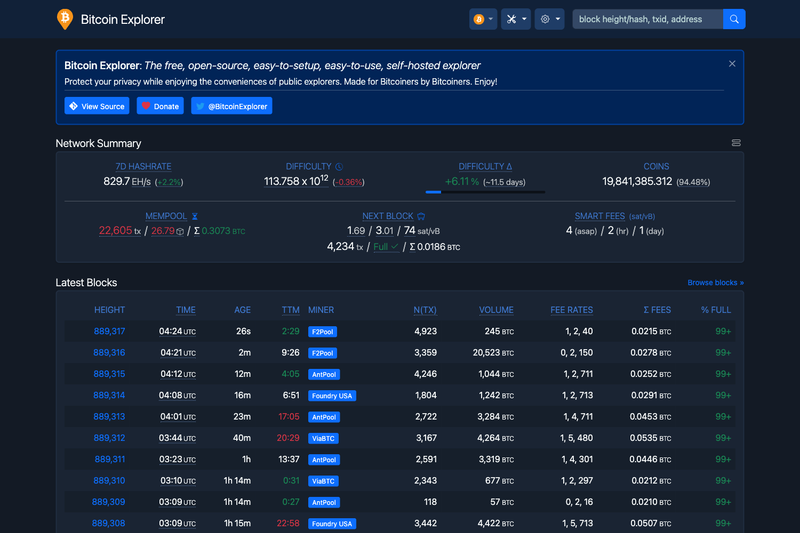
- Network Summary dashboard — Shows current chain height, network difficulty, mempool size, and recent block/transaction activity on a single page.
- Block, transaction, and address views — Displays full details for any block (by height or hash), transaction (by txid), and address (by address string), including raw JSON from bitcoind used to generate each page.
- Search by multiple identifiers — Accepts transaction IDs, block hashes/heights, and addresses from the search box.
- Optional address history — Pulls transaction history for addresses from Electrum-protocol servers (Electrs, ElectrumX) or from blockchain.com, blockchair.com, or blockcypher.com when configured.
- Mempool explorer — Provides a mempool summary with fee, size, and age breakdowns for unconfirmed transactions.
- JSON REST API — Exposes blockchain data programmatically for custom tools and integrations.
- RPC command browser and terminal — Lets you browse and send arbitrary commands to your node through the web interface.
- SSO authentication — Supports single sign-on via a token file (set BTCEXP_SSO_TOKEN_FILE), similar to ThunderHub and RTL.
Who is it for?
- Bitcoin full-node operators who want to explore everything their local node knows — not just the blockchain database but also node functional capabilities.
- Privacy-conscious users who prefer a self-hosted explorer over third-party services that track queries.
- Developers building Bitcoin tools who need a JSON REST API and raw RPC responses to debug transactions and blocks.
- Power users running pruned or partially indexed nodes who still want to search mempool, recently confirmed, and wallet transactions (with limitations).
What can you do with it?
- Nightly network research: Generate stats on blocks, transactions, and miner activity using the built-in analysis tools.
- Transaction debugging: Click through to see the raw JSON bitcoind returns for any tx or block, and use the RPC terminal to run commands directly.
- Address tracking: Connect Electrum-protocol servers to get full address transaction history, something the base node RPC alone doesn't provide.
- Self-hosted API backend: Use the JSON REST API to serve block data to your own apps without exposing your node RPC port.
How does it work?
After running npm install -g btc-rpc-explorer and launching btc-rpc-explorer, the app reads connection settings from environment variables (like BTCEXP_HOST and BTCEXP_PORT) or CLI flags (like --port and --bitcoind-port). It then makes JSON-RPC calls to bitcoind. For address history you must set BTCEXP_ADDRESS_API to an external provider. A Docker image can be built from the repository with docker build and run with docker run.
Pros and cons
- Pros: Database-free, so no schema or maintenance; connects to your own node for privacy; works with Bitcoin Core v0.21+ even with pruning/txindex disabled (some features limited); active community around the project.
- Cons: Some pages fail while Bitcoin Core is still synchronizing; pruned or txindex-less nodes lose address/amount details, block transaction lists, and block stats; the project relies on external APIs for full address history.
Note: These cons are from the page's documented limitations.
Pricing
BTC RPC Explorer is open source and free to use. Donations are accepted via BTC Pay Server and a Lightning address.
Alternatives
Mempool.space, which offers both a hosted explorer and a self-hostable open-source stack. Other options include blockchair.com and blockcypher.com as third-party API providers.
FAQ
Do I need txindex=1 to run BTC RPC Explorer?
No. With Bitcoin Core v0.21 or newer you can run without txindex and with pruning enabled, but some data will be incomplete. For full functionality, enable txindex=1 and disable pruning.
Can I use it while my node is still syncing?
You can, but some pages may fail until the node finishes synchronizing with the Bitcoin network.
How do I configure it?
Configuration can be done via environment variables in a file like ~/.config/btc-rpc-explorer.env or in a .env file in the working directory, or via CLI arguments such as --port 8080 --bitcoind-cookie ~/.bitcoin/regtest/.cookie.
What is the default port?
The app serves on port 3002 by default.
How do I enable SSO authentication?
Set BTCEXP_SSO_LOGIN_REDIRECT_URL to your provider's URL, ensure BTCEXP_BASIC_AUTH_PASSWORD is not set, and point BTCEXP_SSO_TOKEN_FILE to a file both your SSO provider and btc-rpc-explorer can access.