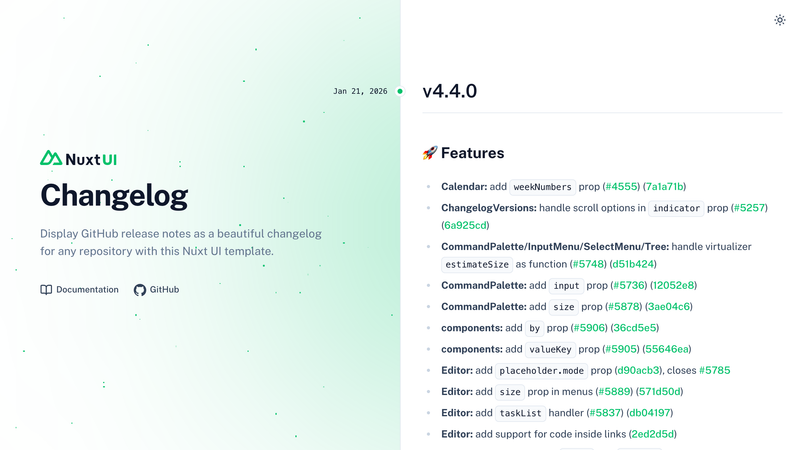
The Nuxt Changelog Template is a boilerplate project that creates a changelog website automatically synced to GitHub Releases, built on Nuxt with the Nuxt UI component library. It reads release notes from a configured repository and renders them as a styled timeline using Nuxt MDC, so you never maintain a changelog manually.
What is the Nuxt Changelog Template?
This template is part of the nuxt-ui-templates set of starter projects for publishing product updates. You give it a GitHub repository slug, and it outputs a public changelog page listing every release with version numbers, titles, and the markdown body of each release note. The project runs on Nuxt and uses Nuxt UI for its interface, and it is configured entirely in a single app config file.
Key Features
- GitHub Releases integration — Set the repository key in
app/app.config.ts(for example, to a repo likenuxt/uiorfacebook/react), and the template fetches all releases from that repo's GitHub Releases feed. - Nuxt UI design system — The changelog uses Nuxt UI components, with support for light and dark color schemes, as shown in the template's two included screenshots.
- One-command scaffolding — Start a new project with
npm create nuxt@latest -- -t ui/changelog; the command clones the template into a fresh Nuxt app. - One-click Vercel deployment — A "Deploy with Vercel" button is included that clones the repo and sets up deployment, with a live demo at changelog-template.nuxt.dev.
- Nuxt MDC rendering — Release bodies are parsed and rendered with Nuxt MDC (Markdown Components), allowing rich markdown content inside your release notes.
- Renovate integration — The template ships with configuration for the Renovate bot, so dependency updates are automated from day one.
- Standard Nuxt tooling — Commands use pnpm:
pnpm install,pnpm devfor the development server at localhost:3000,pnpm buildfor production, andpnpm previewto locally preview the production build.
Who is it for?
The template suits anyone who ships software versions and wants a changelog page without building from scratch. Open source maintainers can point it at their GitHub repo and get a clean release history; SaaS teams can host it as a public product-updates page; Nuxt developers can use it as a reference for wiring Nuxt UI, Nuxt MDC, and external API data.
What can you do with it?
- Product teams: Publish a new version on GitHub and the changelog updates automatically — no manual HTML editing.
- Maintainers: Turn the template into a docs-branded changelog by customizing the config and theme.
- Developers: Learn how a Nuxt UI app integrates the GitHub Releases API by reading through the template's app structure.
How does it work?
The template is a standard Nuxt application. After scaffolding, you edit the repository value inside the app config file, then run the dev server. On each page load, Nuxt fetches the release list from GitHub for that repository, and Nuxt MDC compiles each release's markdown into Vue components styled by Nuxt UI. When you later run pnpm build, you get a static site ready for any host.
FAQ
Can I use the Nuxt Changelog Template with any GitHub repository?
Yes, the template only needs a public GitHub repository's releases to be enabled. Update the repository key in the app config to any GitHub repository slug.
Does the template handle private repositories?
The template reads releases from public GitHub repositories by default; using it with a private repository would require a GitHub token or authenticated API access, which the default template does not configure.
Is there a live demo?
Yes, the template lists a live demo at changelog-template.nuxt.dev where you can see the default nuxt/ui repository's release notes rendered as a changelog.
How do I deploy the Nuxt Changelog Template?
Click the "Deploy with Vercel" button on the template page, or build the project locally with pnpm build and host the generated static files on any static hosting service.