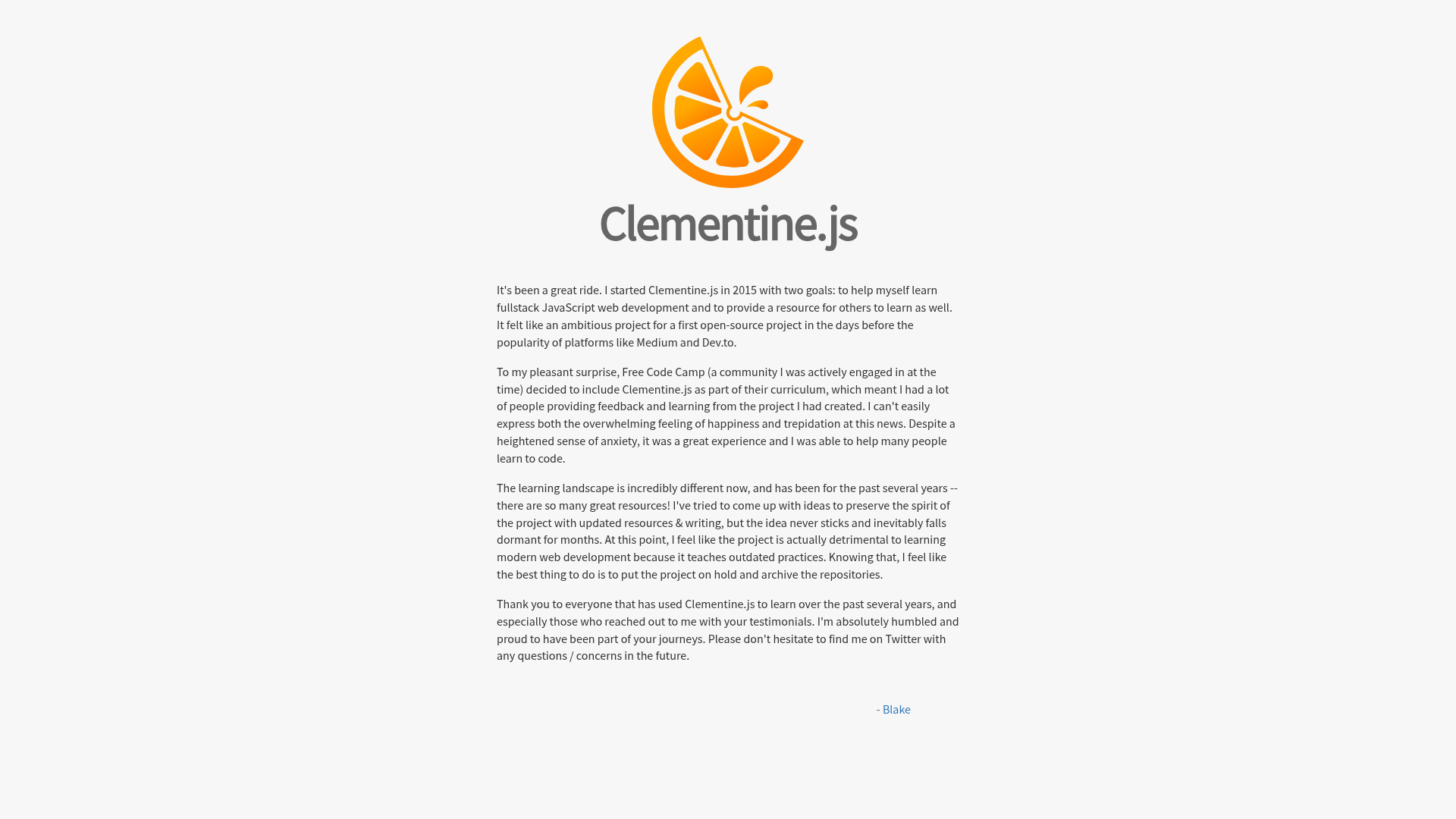
Clementine.js is a full-stack JavaScript boilerplate project hosted on GitHub that describes itself as "The elegant and lightweight full stack JavaScript boilerplate," but the repository is not currently maintained and contains only a placeholder project and website.
What is Clementine.js?
Clementine.js is a boilerplate for full stack JavaScript applications, meaning it was designed to give developers a starting structure for both the front end and back end of a web project. The project's description emphasizes elegance and lightweight design, but the current repository page provides no source code, documentation, or installation instructions. The repository has 318 stars and no listed topics, and the maintainer has marked it as unmaintained. A visitor today will see only a placeholder project and website.
What makes Clementine.js stand out?
The visible page offers almost no feature detail, so the following items are the only concrete facts available:
- Full stack coverage — The boilerplate targets JavaScript applications across the entire stack, not just a single layer, according to its description.
- Lightweight claim — The description explicitly calls the boilerplate lightweight, suggesting a minimal footprint, though no specific dependencies or build steps are shown.
- Elegant design claim — The project positions itself as elegant, but the placeholder page does not display any actual UI or architecture.
- GitHub presence — The project is distributed through a public GitHub repository with 318 stars, indicating some prior community interest.
- Unmaintained status — The repository states it is not currently maintained and contains only a placeholder, so no functional template is available.
Who should use Clementine.js?
The intended users, based on the description, are JavaScript developers who want a preconfigured starting point for a full stack web application. However, because the repository is unmaintained and holds a placeholder, no developer should use it for active development. Researchers studying JavaScript boilerplates or abandoned open source projects might examine the repository for its metadata, but there is no useable code to run.
Pros and cons
Clementine.js has a few clear strengths and one critical drawback.
- Pro: Clear positioning — The description tells you exactly what the project aims to be: a lightweight full stack JavaScript boilerplate.
- Pro: Community visibility — With 318 stars, the project has received some attention from the developer community, which can be useful for evaluating its concept.
- Con: Not maintained — The repository explicitly states it is not currently maintained, meaning bugs and security issues are unlikely to be fixed.
- Con: Placeholder only — The repo contains only a placeholder project and website, so there is no functional code, documentation, or installation path.
FAQ
Is Clementine.js still maintained?
No. The repository's own description states: "This project is not currently maintained and just contains a placeholder project & website for now." Visitors should not expect updates, bug fixes, or new releases.
What does Clementine.js do?
According to its description, it is a full stack JavaScript boilerplate intended to be elegant and lightweight. In practice, the current repository does not provide any working code; it only shows a placeholder project and website.
Does Clementine.js work with Next.js?
The current page does not mention Next.js or any other framework, and the repository topics are empty. The source hints list Next.js as a tag, but that is not confirmed by the content itself, so no framework affiliation is verified.
How many stars does Clementine.js have?
The repository metadata shows 318 stars. There is no information about forks, watchers, or contributors on the page.
Can I install Clementine.js?
There are no installation instructions or downloadable packages visible on the page. Since the repository is a placeholder, you cannot use it as a dependency or scaffold a project from it.