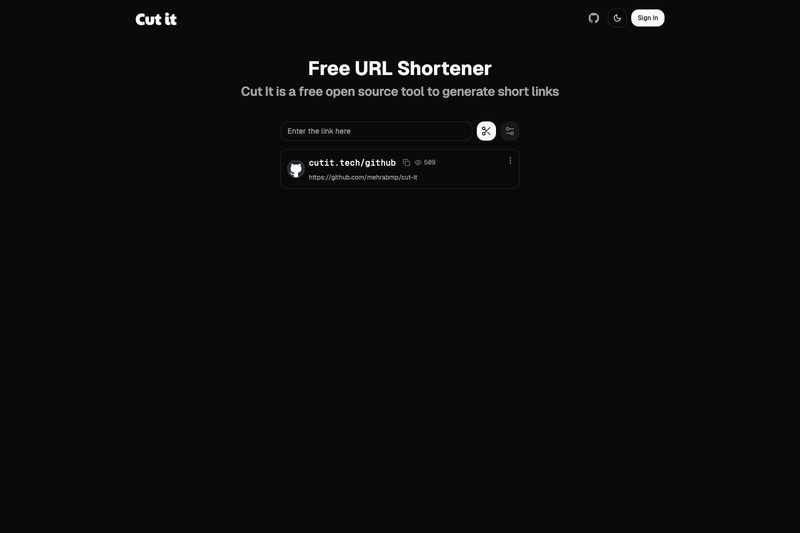
Cut It is a free, open-source URL shortener built with Next.js App Router, Drizzle ORM, Turso, and NextAuth.js that turns long URLs into customizable short links.
What is Cut It?
Cut It is a free, open-source link-shortening web application that takes a long URL as input and produces a short, shareable link as output. It runs on the Next.js App Router with Server Actions, uses Turso (a libSQL database) with Drizzle ORM for persistence, and NextAuth.js for authentication. The project is authored by mehrabmp and is inspired by Dub.
Key Features
Cut It ships with a focused set of features for shortening and managing links, all built on a modern TypeScript stack.
- URL Shortening — Shorten any long URL with a single action, producing a compact link ready to share.
- Customizable URLs — Customize the alias of each shortened link so the final URL matches your preference.
- User-Friendly Interface — The UI is assembled with shadcn/ui components and styled with Tailwind CSS for quick link management.
- Analytics — Link click analytics and statistics are planned and listed as "soon" in the README, so the feature is not yet available.
- Next.js App Router — The template uses the modern App Router and Server Actions for efficient data fetching and mutations.
- Drizzle ORM & Turso — Database operations are handled by Drizzle ORM on Turso, a lightweight libSQL database.
- NextAuth.js Authentication — User accounts and link ownership are managed through NextAuth.js.
- Upstash Redis — Redis is listed among the technologies, though the exact role in the app is not described in the README.
Who is it for?
Cut It is aimed at developers, teams, and open-source contributors who need a free, self-hostable link shortener.
- Developers who want a free, modern link-shortener codebase to deploy, customize, or learn from can use Cut It as a starting point.
- Teams and marketers looking for a self-hosted alternative to commercial shorteners will find a simple interface to create and manage branded short links.
- Open-source contributors can extend the project by adding the planned analytics or improving the UI, since contributions are welcomed via the contributing guide.
What can you do with Cut It?
With Cut It, you can create short links for sharing, deploy the app to your own infrastructure, and build on the codebase.
- Content creators: Shorten lengthy URLs for social media posts, emails, or bios to keep links clean and trackable once analytics ship.
- Developers: Deploy the template to Vercel or a Docker container and integrate it with your own authentication or storage.
- Organizations: Set up a self-hosted shortener to keep links under your own domain and control the data.
How does Cut It work?
The README provides a local setup workflow: clone the repository, install dependencies with pnpm, copy the .env.example to .env and update variables, run pnpm run dev for the development server, and push the database schema with pnpm run db:push. For production, deployment guides for Vercel and Docker are linked.
Pros and cons
Cut It has a few clear advantages and some limitations visible from the current README.
- Pros: Free and open source under the MIT License; built with a modern stack including Next.js, Turso, Drizzle, and Tailwind; straightforward setup for local development and Vercel deployment.
- Cons: Analytics are not yet implemented (marked "soon"); local deployment requires configuring environment variables and pushing the database schema.
Pricing
Cut It is free and open source, released under the MIT License. No paid tiers or usage limits are mentioned in the README.
Alternatives
- Dub — the commercial link management platform that explicitly inspired Cut It and offers more advanced features.
FAQ
Is Cut It free?
Yes, Cut It is free and open source under the MIT License. You can deploy it yourself without paying for a subscription.
What technologies does Cut It use?
It uses Next.js with the App Router, Drizzle ORM, Turso as the database, NextAuth.js for authentication, Upstash Redis, Tailwind CSS, and shadcn/ui components.
Can I customize the shortened URLs?
Yes, customizable URLs is listed as a feature, letting you set your preferred alias for each short link.
Is analytics available?
Analytics is not yet available; the README marks the feature as "soon". The codebase does not currently include tracking statistics.
How do I deploy Cut It?
You can follow the deployment guides for Vercel and Docker referenced in the README. For local development, run pnpm run dev after setting up your environment variables and pushing the database schema.