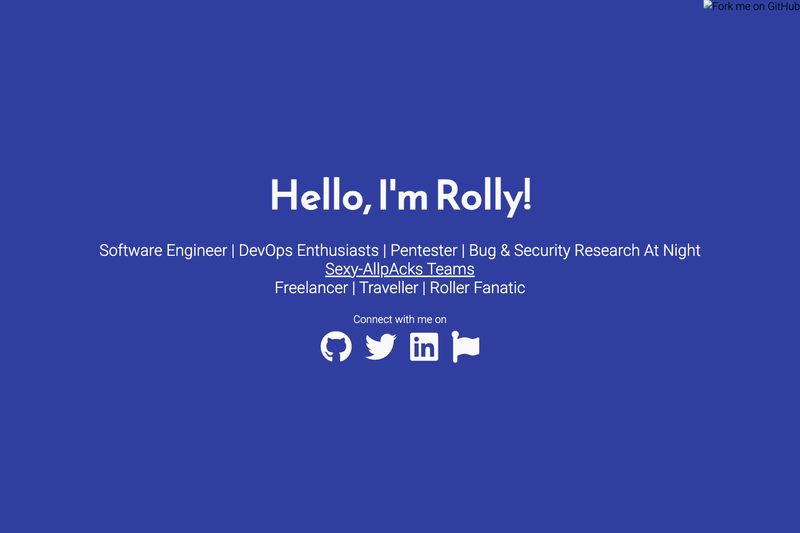
Dev Landing Page With Jekyll is a minimal single-page portfolio template for developers, built with Jekyll and Sass, that generates a static personal landing page for GitHub Pages without any JavaScript.
What is Dev Landing Page With Jekyll?
Dev Landing Page With Jekyll is a free, open-source Jekyll template that turns a developer's profile data into a single-page landing site. You provide your name, skills, and social platform links in YAML files and _config.yml; the template outputs a static HTML page with Font Awesome icons and material design styling. It was created by Rolly Sanchez and is inspired by Flexdinesh's dev-landing-page.
Key Features
- 12 material themes — Choose from theme names like green-white, indigo-white, yellow-black, and more by setting the
theme_customvariable in _config.yml; the default is indigo-white. - No JavaScript — The entire landing page renders with pure HTML and Sass, which keeps it lightweight and fast (99/100 Google PageSpeed on desktop, 92/100 on mobile).
- Data-driven content — Edit
skills.ymlto list your skills andplataforms.ymlto add social links; both files use a simple YAML format. - Background image support — Set
theme_name_backgroundandtheme_extension_backgroundin _config.yml to use any image uploaded to /assets/image/. - Docker support — A one-line Docker command runs the Jekyll server locally with live reload; a docker-compose.yml is also included for
docker-compose up. - Customizable intro and fork button — Override the default "Hello, I'm ..." message with
title_intro, and optionally show a "Fork me" GitHub button via theforkmeandforkme_linkvariables. - Custom favicon — Replace the default favicon at /assets/image/favicon.ico with any generated icon.
Who is it for?
- Developer freelancers — Showcase your skills and social links on a one-page site that you can host for free under your GitHub Pages username.
- Job-seeking programmers — Point recruiters to a clean landing page that links to your GitHub, LinkedIn, Twitter, Stack Overflow, and other profiles without building a full portfolio from scratch.
- Open-source contributors — Fork the project, customize it, and push to a new repository named username.github.io to get a live site quickly.
- Students learning Jekyll — The project is a compact example of how Jekyll, Sass, and YAML data files combine to produce a static site.
What can you do with Dev Landing Page With Jekyll?
- Host a personal landing page on GitHub Pages: Fork the repo, rename it to username.github.io, edit the settings, and push your changes to publish at https://username.github.io.
- Run the site locally for development: Install Ruby and Bundler, run
bundle install, thenbundle exec jekyll sto serve at http://127.0.0.1:4000/. - Set up a custom domain: Follow GitHub's custom-domain guide to serve your landing page at a domain like username.com.
How does Dev Landing Page With Jekyll work?
The template uses Jekyll to build a static page from YAML data files. After forking, you edit _config.yml to set your name, intro, theme, and platform title. Then you update skills.yml and plataforms.yml with your own content, commit, and push — the Jekyll build process outputs a ready-to-publish HTML site.
Pricing
The template is free and open source under the Beerware license, which allows you to use and modify it as long as you keep the license notice.
Alternatives
- dev-landing-page by Flexdinesh — The original project that inspired this one; it is a plain HTML/CSS template rather than a Jekyll-based one.
FAQ
Is Dev Landing Page With Jekyll free?
Yes, the template is free to use and modify under the Beerware license. You can do whatever you want with it as long as you retain the license notice, and the author asks only for a beer if you meet in person.
Does the landing page use JavaScript?
No. The template explicitly states "No JS" and relies on HTML and Sass. This contributes to high Google PageSpeed scores (99/100 desktop, 92/100 mobile).
How do I deploy it to GitHub Pages?
Fork the repository, rename it to username.github.io, enable GitHub Pages in the repo Settings, clone the fork locally, customize _config.yml and the YAML data files, then git push to publish.
Can I use my own background image?
Yes. Set theme_name_background in _config.yml to the image file name (for example, background.jpg), keep theme_extension_background matching the file extension, and upload the image to the /assets/image/ folder. If you leave the value as false, no background image is used.