Flask API is a Python library that extends Flask to serve browsable, content-negotiated web APIs, letting view functions return lists and dictionaries that render as JSON or an interactive HTML page.
What is Flask API?
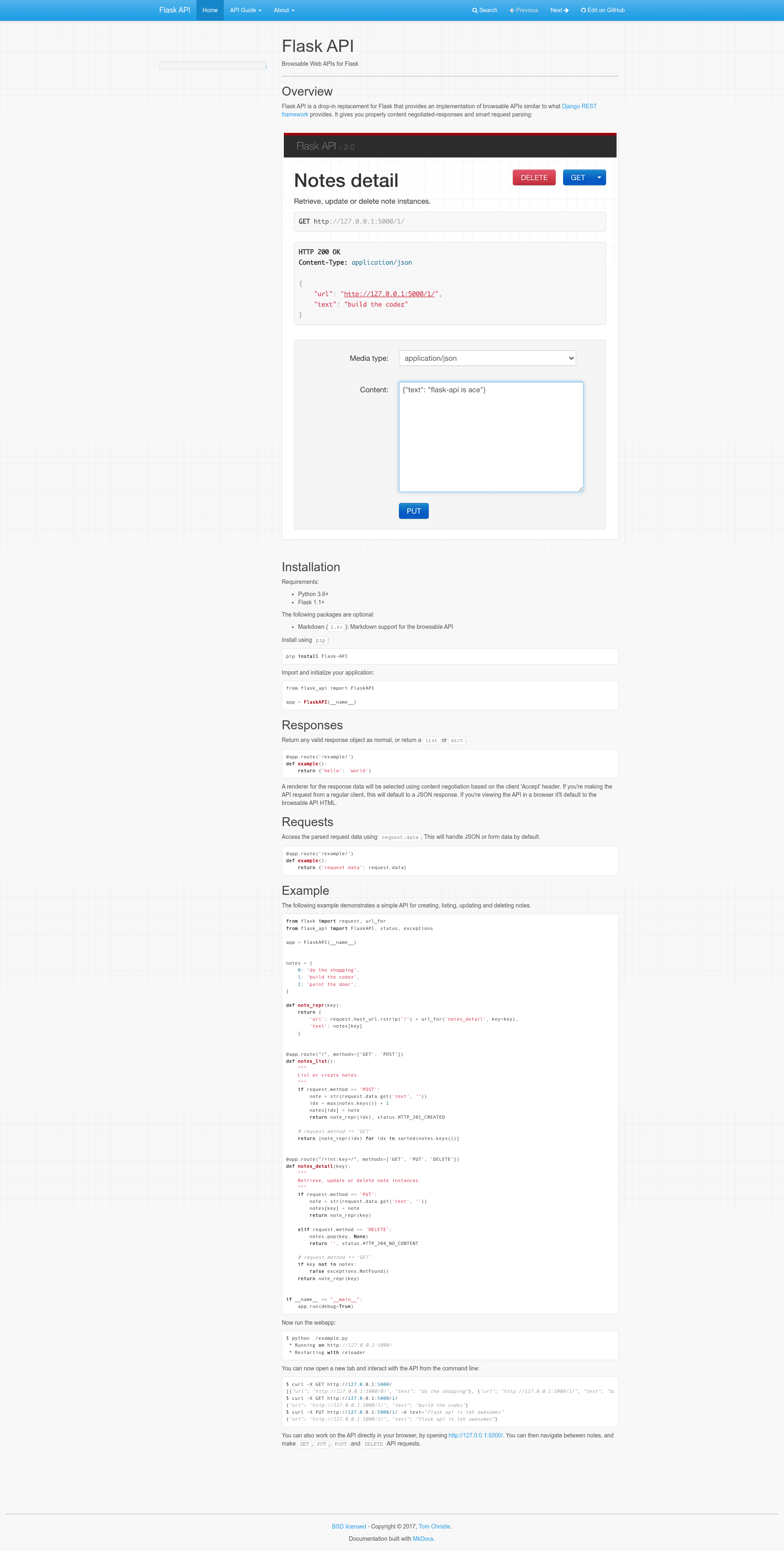
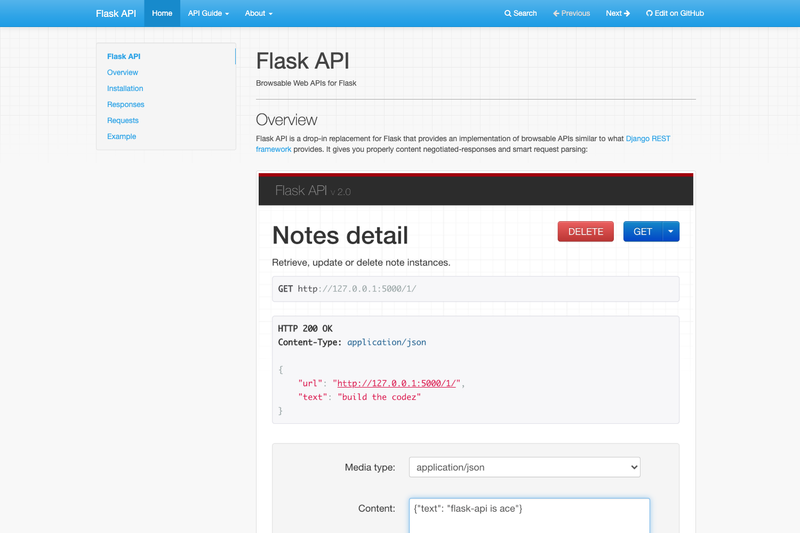
Flask API is a drop-in replacement for Flask that provides an implementation of browsable APIs similar to what Django REST framework offers. It accepts the same routing and view function patterns as Flask, but adds automatic response rendering based on the client's Accept header. The library requires Python 3.6+ and Flask 1.1+, and is distributed on PyPI as Flask-API. It was created by Tom Christie, and is currently maintained by Jace Browning in maintenance mode.
Key Features
- Drop-in replacement — Swap
app = Flask(__name__)withapp = FlaskAPI(__name__)to enable API behavior without rewriting existing route logic. - Content-negotiated responses — The renderer is selected by the Accept header: regular clients get JSON, browsers get an interactive HTML browsable API.
- Smart request parsing —
request.dataautomatically parses JSON and form-encoded bodies, so view functions read cleanly from one attribute. - Direct data structure returns — A view can return a Python
listordictdirectly; Flask API serializes it to the negotiated format. - Status codes and exceptions — Includes
statusconstants (e.g.,HTTP_201_CREATED,HTTP_204_NO_CONTENT) and aNotFoundexception to map HTTP errors. - Django REST framework patterns — Mirrors the browsable API and content-negotiation approach of Django REST framework, minus the full framework overhead.
Who is it for?
- Flask developers — Teams already using Flask who want to add a REST API layer with zero migration cost.
- API designers — Developers who want a browsable, interactive API surface for prototyping and testing without building a separate front end.
- Microservice builders — Projects that need lightweight request parsing and response formatting without adopting a heavy framework.
What can you do with Flask API?
- Create a full CRUD service — The included notes example demonstrates listing, creating, updating, and deleting resources with the correct HTTP status codes.
- Integrate with command-line clients — Tools like curl receive clean JSON responses by default, as shown in the documented examples.
- Provide interactive API documentation — When opened in a browser, endpoints render as navigable HTML pages that support GET, PUT, POST, and DELETE interactions.
How does Flask API work?
Install via pip install Flask-API, then import FlaskAPI and initialize with app = FlaskAPI(__name__). Define routes with the normal Flask decorator, and return a list or dict from the view — content negotiation automatically determines whether to serialize as JSON or render the browsable HTML interface.
Alternatives
- Django REST framework — The full-featured framework for Django whose browsable API design inspired Flask API.
- API Star — The successor project that original author Tom Christie shifted focus to when Flask API entered maintenance mode.
FAQ
Is Flask API free?
Flask API is a free, open-source package distributed on PyPI, installable with pip. No pricing tiers or usage limits are mentioned in the project documentation.
How do I install Flask API?
Run pip install Flask-API. The package requires Python 3.6 or newer and Flask 1.1 or newer to function.
Can I use Flask API with existing Flask code?
Yes, it is a drop-in replacement. Only the app initialization changes to FlaskAPI, while existing @app.route views continue to work. Returning a list or dict automatically gets serialized.
What does request.data return?
request.data returns the parsed request body, supporting both JSON and form-urlencoded payloads by default. This removes the need to manually parse incoming data in each view.
Why is Flask API in maintenance mode?
The original author has moved on to API Star, but the maintainer Jace Browning still reviews and accepts passing pull requests. Expect slower feature development but continued bug-fix support.