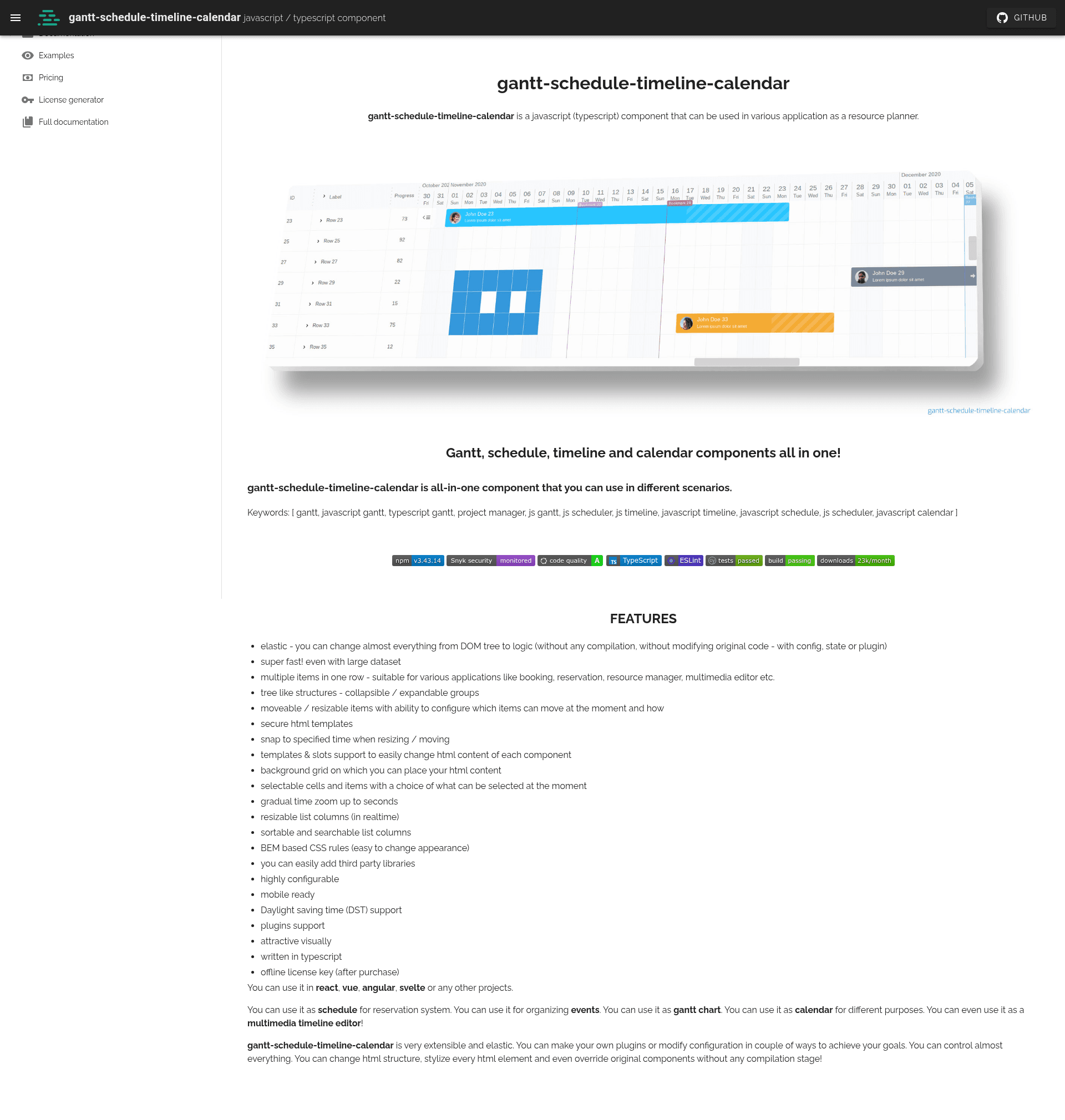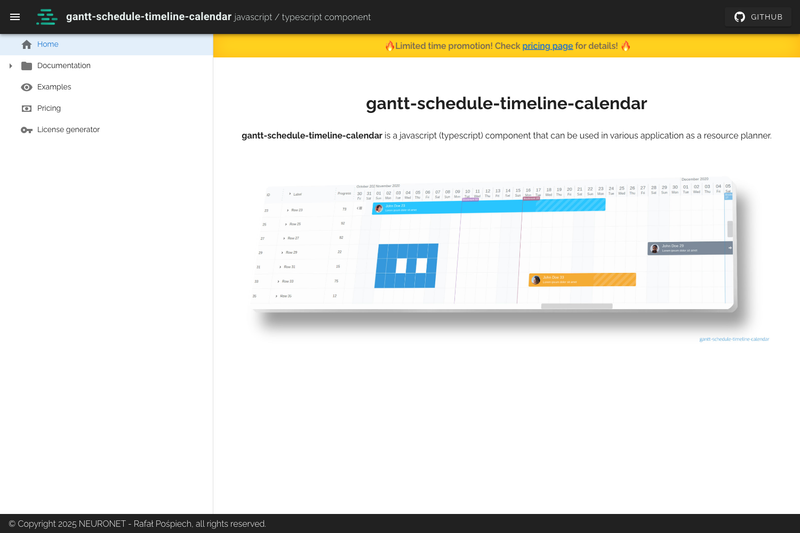
gantt-schedule-timeline-calendar is a TypeScript-based, framework-agnostic UI component that renders Gantt, schedule, timeline, and calendar views from the same data model, with virtual scrolling for very large datasets.
What is gantt-schedule-timeline-calendar?
gantt-schedule-timeline-calendar (GSTC) is an open-source component created by Neuronet that takes a flat or tree-structured array of tasks/items and renders an interactive time-based grid in the browser. The output is a DOM-based interface where items can be moved, resized, selected, and organized into collapsible groups, and the left-side list columns can be sorted, searched, and resized in real time. It is written in TypeScript and requires no framework, but includes official usage examples for React, Next.js, Angular, Vue, Vue 3 with Vite, and Svelte.
Key Features
- Virtual scroll performance — Renders large datasets with hundreds of thousands of items without losing responsiveness.
- Framework-agnostic — Works with React, Vue, Angular, Svelte, or vanilla JavaScript; official example repos exist for each integration.
- Elastic customization — You can override any DOM element or change behavior at runtime through config, state, or plugins, without recompiling the source.
- Multiple items per row — Each row can hold multiple tasks, making it useful for booking, reservation, and resource-manager layouts.
- Tree structures — Collapsible/expandable groups for hierarchical task lists.
- Moveable and resizable items — Configure which items can move or resize at any moment, with snap-to-time-grid when dragging.
- Time zoom and DST support — Gradual zoom down to seconds and Daylight Saving Time handling are built in.
- Secure HTML templates and slots — Change the HTML content of each component through templates, with BEM-based CSS classes for styling.
Who is it for?
- Frontend developers building project-management, booking, or scheduling interfaces in React, Vue, Angular, or Svelte who need a timeline/gantt component that can be customized deeply.
- Product teams creating reservation systems, event calendars, or multimedia timeline editors that need multiple items per row and move/resize behavior.
- Enterprise ERP, MES, and APS developers who need high-performance scheduling with custom rules for task updates and support for hundreds of thousands of items.
- Startups and individual developers who want a free/trial license for prototyping, with commercial licensing available later.
What can you do with it?
- Project management apps: show tasks on a timeline, group them into collapsible trees, drag to reschedule, and resize durations with snap-to-grid.
- Booking and reservation systems: display multiple bookings in a single resource row, set per-item move rules, and hide non-working hours/days via configuration.
- Multimedia timeline editors: place clips or events on tracks, zoom down to seconds, and allow precise resizing.
- Calendar and background-grid views: attach custom HTML content to cells on the time grid for dashboards or operational views.
Pricing
The component is available under NEURONET Free / Trial License terms, and you can generate a free or trial license key from the GSTC site. A full commercial license requires a purchase through the pricing page; the page does not list specific dollar amounts.
FAQ
Is gantt-schedule-timeline-calendar free?
The component is free to try — you can generate a free or trial license key from gstc.neuronet.io/free-key. Commercial use requires a paid commercial license, with pricing available on the official pricing page.
Can I use it with React, Vue, or Angular?
Yes. The project provides official usage examples for React, Next.js, Angular, Vue, Vue 3 with Vite, and Svelte, and the component itself is framework-agnostic.
How large datasets can it handle?
It is designed to handle hundreds of thousands of items by using virtual scroll, and the README states it is faster than competitors for high-performance Gantt charts.