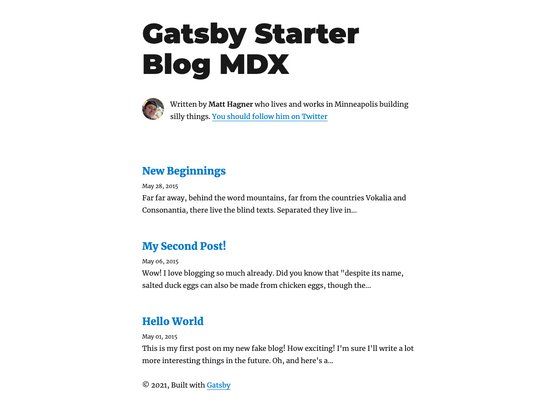
Gatsby Starter Blog Mdx is a Gatsby blog boilerplate starter that adds MDX support to the classic Gatsby blog starter, letting you embed JSX components directly inside Markdown posts and build a static blog on the React-based Gatsby framework. The starter lives in the hagnerd/gatsby-starter-blog-mdx GitHub repository and connects to the official Gatsby starters collection for alternative starting points.
What is Gatsby Starter Blog Mdx?
Gatsby Starter Blog Mdx is a blog starter for Gatsby, the React-based static site generator, that ships with the main Gatsby configuration files needed to run a blog and adds MDX rendering through the gatsby-mdx plugin by ChristopherBiscardi. It takes Markdown and MDX files as content input and produces a statically generated blog site via the standard Gatsby development and build commands. The README positions it as the Gatsby blog starter with additional MDX capability rather than a fully custom theme.
Key Features
- MDX blog posts — Write blog content in MDX, a format that combines Markdown with JSX, so React components can be rendered inline within an article body.
- gatsby-mdx plugin integration — Uses the gatsby-mdx plugin, described in the README as the plugin that makes this blog possible.
- Standard Gatsby configuration — Ships with the main Gatsby configuration files you need to get up and running, so the project structure is the familiar Gatsby layout.
- One-command project creation — Create a new site with
npx gatsby new my-blog-starter https://github.com/hagnerd/gatsby-starter-blog-mdx. - Real-time development server —
gatsby developruns the site at localhost:8000 and updates the browser live when you edit files such assrc/pages/index.js. - GraphiQL data explorer — A second localhost URL,
localhost:8000/___graphql, opens GraphiQL for experimenting with queries against your site's data. - Netlify one-click deploy — Includes a Deploy to Netlify button wired to the Gatsby blog starter repository to publish the site without manual build configuration.
Who is it for?
- React developers — Start a blog where posts can contain working React components, not just static Markdown content.
- Technical writers — Publish articles that embed live JSX examples, making it easier to demonstrate code inside the prose.
- Developers new to Gatsby — Use the preconfigured boilerplate to learn the standard Gatsby file structure and the GraphiQL tool without building a project setup from scratch.
What can you do with Gatsby Starter Blog Mdx?
- Component documentation: Write MDX pages that render a React component and its usage notes in the same file, which is a natural fit for documenting component libraries.
- Interactive blogging: Publish posts where readers can interact with embedded React demos directly in the article.
- Quick site launches: Scaffold a new Gatsby blog in one command and publish it through the one-click Netlify deploy flow.
How does Gatsby Starter Blog Mdx work?
Create a site with the Gatsby CLI command npx gatsby new my-blog-starter https://github.com/hagnerd/gatsby-starter-blog-mdx, then type gatsby develop to start the local server. Edit src/pages/index.js to see real-time browser updates, and use the Netlify deploy button when you are ready to publish.
FAQ
Is Gatsby Starter Blog Mdx free?
Gatsby is an open-source framework and this starter is published on GitHub, so the boilerplate itself carries no license cost. You only pay for whatever hosting service you choose; the README offers a one-click Netlify deployment path.
What is MDX?
MDX is a content format that lets you use JSX inside Markdown. With this starter you can write blog posts in MDX and embed React components directly in the file, which is easier than keeping code examples separate from the written content.
Which plugin enables MDX in this starter?
The gatsby-mdx plugin by ChristopherBiscardi powers MDX support; the README credits it as the plugin that makes the blog possible.
What commands do I need to run?
Run npx gatsby new my-blog-starter https://github.com/hagnerd/gatsby-starter-blog-mdx to create the site, then gatsby develop to start the development server at localhost:8000.
Where can I experiment with GraphQL queries?
The development server exposes GraphiQL at localhost:8000/___graphql, a second link shown when you start the site, which lets you practice querying your site's data as covered in the Gatsby tutorial.