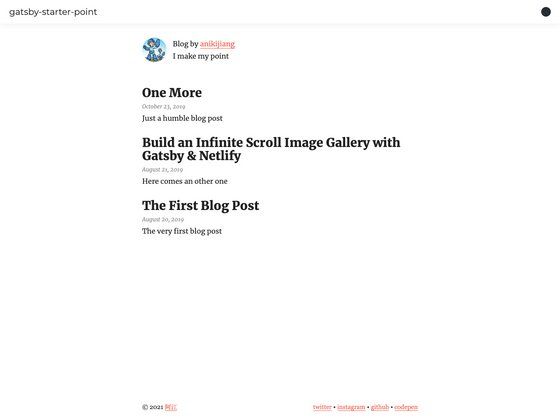
Gatsby Starter Point is a Gatsby starter for personal blogs that adds animated page transitions and performance optimizations, built on React with SCSS styling.
What is Gatsby Starter Point?
Gatsby Starter Point is a free Gatsby starter template for creating personal blogs with the Gatsby static site generator. It provides a pre-configured blog layout, page-transition animations, and an SCSS-based styling system, so you can focus on writing content instead of setting up tooling. The starter is published on the Gatsby Starters library under the teaware account, and it runs entirely on the Gatsby build pipeline, producing static HTML, CSS, and JavaScript.
Key Features
- Fancy page transitions — animated transitions between pages give the blog an app-like feel.
- Perfect Performance — the README highlights a performance screenshot, indicating attention to fast loading.
- SCSS styling — styles are written in SCSS, so you can customize colors, fonts, and layout using variables and nested rules.
- React components — the blog is built with React, letting you edit layout, posts, and navigation through JSX component files.
- Personal blog focus — built specifically for personal blogging, so the project structure already supports a main page and article posts.
- Simple developer workflow — install dependencies with
npm installand start developing withgatsby develop; Gatsby handles hot reloading during development.
Who is it for?
- Personal bloggers who want a blog with smooth page transitions without hand-building a frontend or animations.
- Gatsby newcomers who want a minimal, readable codebase to learn how a Gatsby blog is organized and how page transitions are wired.
- Frontend developers who want a performance-oriented starting point that already includes SCSS and React patterns, so they can customize it quickly.
What can you do with it?
- Launch a personal blog: clone the starter, install dependencies, and write posts that Gatsby renders into static pages.
- Customize the design: edit SCSS files to change the visual theme, and adjust the React components to alter page structure and navigation.
- Study page-transition patterns: inspect how the starter animates route changes and reuse that technique in other Gatsby or React projects.
How does it work?
The starter's basic guide lists only two steps: run npm install to fetch dependencies, then run gatsby develop to start a local development server. From there, you write content and adjust components; when you are ready to publish, Gatsby can generate a static production build.
FAQ
Is Gatsby Starter Point free?
Yes, it is a free Gatsby starter that you can install and use for any personal blog. There is no cost to clone the repository or run the starter locally.
What commands do I need to run?
You need npm install to install the project dependencies, followed by gatsby develop to launch the development server. These are the only commands shown in the README.
Does it use SCSS?
Yes, the starter uses SCSS for styling. The repository's topics include scss, and the file structure supports Sass-based styling with variables and nesting.
What does 'perfect performance' mean?
The README claims the starter has perfect performance and shows a performance screenshot. This indicates the template is optimized for fast loading, though actual results depend on your content and hosting environment.