Newt Starter Nextjs Contact is a TypeScript starter template that pairs the Newt headless CMS with a Next.js App Router contact form, providing a working form, success page, and error page in one deployable project.
What is Newt Starter Nextjs Contact?
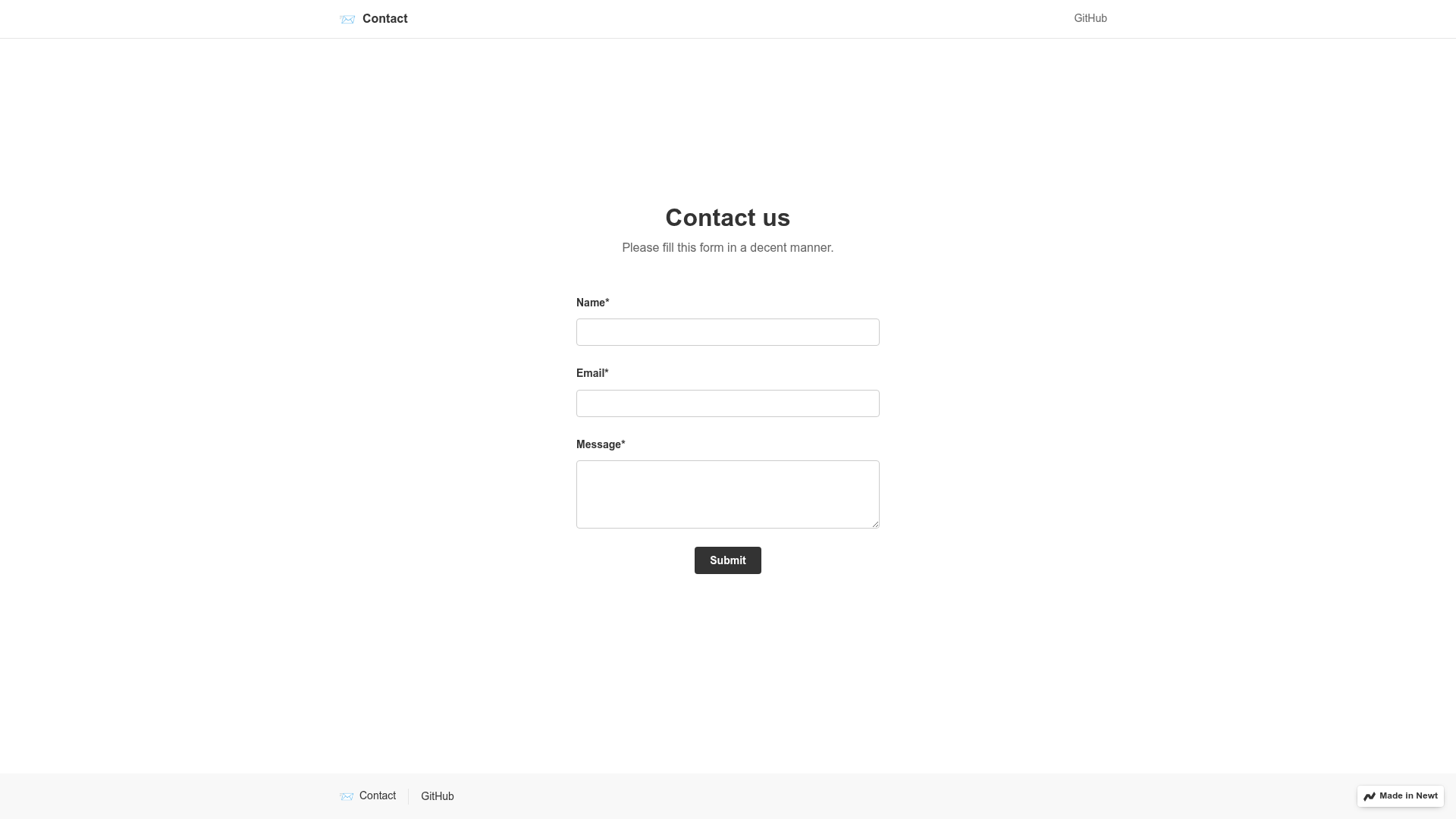
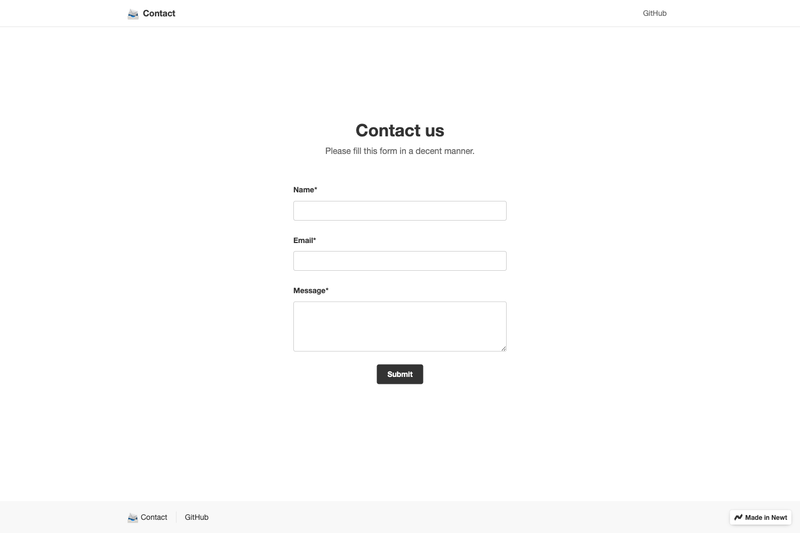
Newt Starter Nextjs Contact is a starter repository from Newt Inc. that demonstrates how to build a contact form using the Newt headless CMS and Next.js's App Router. It takes a Newt form API endpoint as its only configuration input and produces a publicly accessible contact form at the root path, plus a /thanks page for successful submissions and an /error page for failures. The template runs on Next.js with TypeScript and can be deployed to Vercel with a single click.
Key Features
- Next.js App Router — Built on the App Router with a page.tsx structure, using the latest Next.js conventions for routing and server components.
- Newt CMS integration — Connects to a Newt space via a form App created from the Contact template, reading the API endpoint from an environment variable.
- TypeScript — The starter is written in TypeScript, giving typings for the form and page props.
- Success and error pages — Includes pre-built /thanks and /error routes to handle form submission outcomes.
- One-click Vercel deployment — A Deploy with Vercel button clones the repository and sets up the project for immediate deployment.
- Simple environment configuration — Only one environment variable, NEXT_PUBLIC_NEWT_FORM_ENDPOINT, is needed to point the app at a Newt form.
- MIT license — The source is freely available under the MIT License for personal or commercial use.
Who is it for?
- Next.js developers — Those learning the App Router can study a minimal, real-world form example with two additional routes.
- Newt CMS users — Teams already using Newt can copy this starter to add a contact page to their site without building form handling from scratch.
- Rapid prototypers — Anyone who needs a working contact form quickly can deploy the starter to Vercel and replace the endpoint with their own Newt form.
What can you do with Newt Starter Nextjs Contact?
- Launch a contact form: Deploy the starter to Vercel, create a Newt space, add the Contact form template, and copy the API endpoint into the environment variable to have a live form.
- Learn App Router patterns: Study how the contact page, async submission, and client-server interaction are structured in a Next.js App Router project.
- Customize the form UI: Edit the page.tsx file to change fields, styling, or validation while keeping the Newt submission logic intact.
How does it work?
The template's setup flow is documented in the README: create a Newt space and note the space UID, add a Form App from the Contact template, create a form, and copy its API endpoint. Then create a .env.local file based on .env.local.example and set NEXT_PUBLIC_NEWT_FORM_ENDPOINT to that endpoint. Finally, install dependencies with yarn install or npm install and start the dev server with yarn dev or npm run dev on localhost:3000.
FAQ
Is Newt Starter Nextjs Contact affected by the Newt end-of-life?
Yes. Newt Inc. has announced that the Newt headless CMS service will be retired on 2026-11-24. After that date, both the Newt admin console and API will stop working, which means this template's form submission functionality will no longer function without replacing the backend.
What environment variables does this template need?
Only one: NEXT_PUBLIC_NEWT_FORM_ENDPOINT. You set it to the API endpoint copied from your Newt Form App's setup page. The .env.local.example file shows the required variable name.
What pages are included?
The template includes three routes: the contact form at /, a success page at /thanks, and an error page at /error. Each maps to a separate file under the app directory in the Next.js App Router structure.
Can I use this without Newt?
No, the form submission logic is tied to the Newt Form API. You would need to rewrite the submission handler to use a different backend, since the template itself has no alternative email or database storage built in.
Is the template free to use?
The source code is released under the MIT License, so you are free to use, modify, and distribute it. The template itself is free, but using the Newt CMS service is subject to Newt's own terms and the upcoming service retirement.