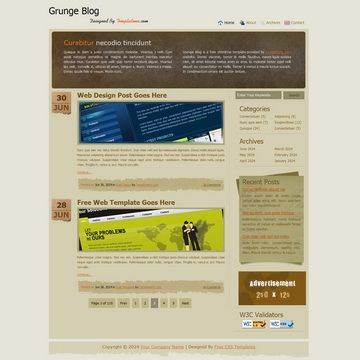
Grunge Blog Template is a free 2-column XHTML/CSS blog layout from TemplateMo that provides paging buttons and a grunge visual style for building simple blog websites.
What is Grunge Blog Template?
Grunge Blog Template is a free HTML/CSS website template distributed by TemplateMo (templatemo.com). It implements a 2-column blog layout with paging buttons, built on XHTML and CSS. The template was added to TemplateMo's collection on 09 July 2009, and its public page records 43,087 views and 10,071 downloads. It is delivered as a ZIP file that users can download, edit, and publish on their own sites for either commercial or non-commercial purposes. TemplateMo also provides a live preview and a full-size screenshot so you can see the layout and grunge styling before committing to the download.
Key Features
- Two-column layout — The template places content in a main column and a sidebar, a standard structure for blog posts and navigation.
- Paging buttons — Includes pagination controls for breaking blog entries across multiple pages, letting visitors move through older posts.
- XHTML/CSS implementation — The template is coded in XHTML with CSS styling, which keeps markup and presentation separate for easier editing.
- Grunge visual style — The design uses a textured, worn grunge aesthetic that gives the page a hand-made, alternative look.
- Free to download and edit — TemplateMo allows anyone to download, edit, and reuse the template for commercial or non-commercial sites with no stated restrictions.
- ZIP package download — The full template files are bundled into a single ZIP archive, simplifying download and deployment to a web server.
Who should use Grunge Blog Template?
- Personal bloggers — Anyone who wants a grunge-styled blog with a simple two-column layout and pagination can use this template as a ready-made starting point.
- Web design students — Learners can study the XHTML and CSS structure to understand how a classic blog layout is assembled and how paging works.
- Small-site owners — People building a small static website or portfolio that matches a grunge, indie, or alternative aesthetic can adapt the template with their own content.
What can you do with Grunge Blog Template?
- Publish a personal blog — Set up a blog with posts split across pages using the built-in paging buttons, then customize the CSS to adjust colors and textures.
- Build a static portfolio — Use the two-column layout to feature projects in the main area and add an about or link sidebar.
- Learn HTML/CSS — Reverse-engineer the XHTML structure and stylesheet to practice coding and see how a complete template is put together.
Pricing
Grunge Blog Template is 100% free. TemplateMo offers it for download without charge, and users may edit and use it for commercial or non-commercial projects.
Alternatives
- Tooplate — Another free HTML template provider linked from TemplateMo, offering a different catalog of website layouts.
- Other TemplateMo templates — TemplateMo hosts dozens of free templates, such as the Fruit Template (119) and Block 3D Template (118), each with its own layout and color scheme.
FAQ
Is Grunge Blog Template free?
Yes, Grunge Blog Template is 100% free to download from TemplateMo. You can use, edit, and repurpose it for both commercial and non-commercial websites without paying a fee.
Can I use Grunge Blog Template for commercial projects?
Yes. The template's download page states that users are allowed to download, edit, and use the layout for commercial or non-commercial sites. No license fee or attribution is mentioned.
What does the template include?
The template is a 2-column XHTML/CSS layout with paging buttons. It is distributed as a ZIP file that includes the HTML and CSS files for the blog design. The page also links to a live view so you can see the template in action.
How do I download Grunge Blog Template?
Visit the template's page on templatemo.com and click the Download button to receive the ZIP file. The page also offers a Live View link to preview the template and a full-size screenshot for closer inspection.
Is the template responsive or modern?
The template was added on 09 July 2009, so it was built for the web standards of that time. It uses XHTML and CSS, and the page does not mention responsive design, mobile support, or JavaScript-based enhancements.