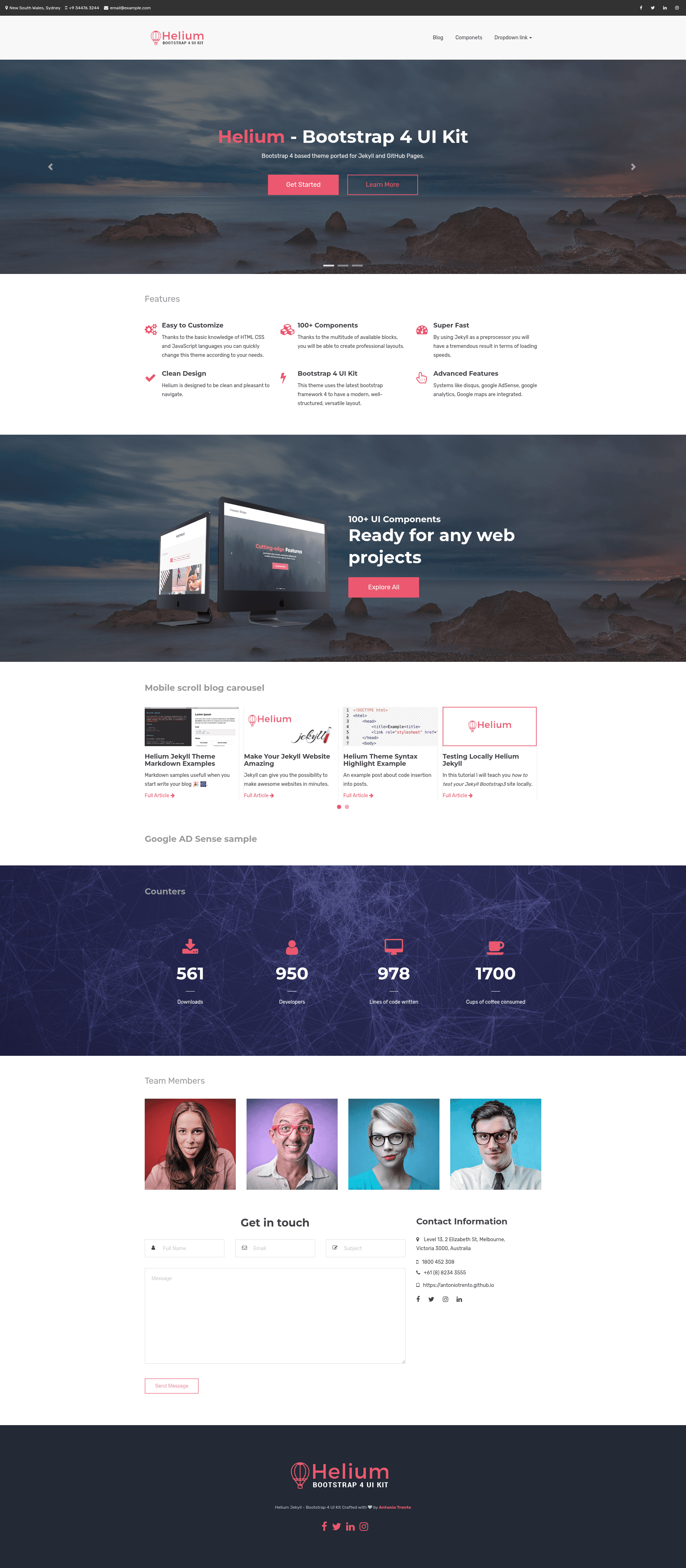
Helium is a free, open-source Jekyll theme built on Bootstrap 4 that produces responsive blog and landing-page sites with hero images, a live theme switcher, and Jekyll-native integrations like Disqus and Google Analytics. This no-longer-maintained theme is distributed under the MIT license and works with Jekyll 3.x and GitHub Pages.
What is Helium Jekyll?
Helium Jekyll is a Bootstrap 4-based theme for the Jekyll static site generator, originally created by Antonio Trento as a near-total rewrite of the sentenza Jekyll theme. It takes standard Jekyll markdown posts and pages as input and outputs a responsive static website with a blog layout, landing page samples, tag pages, and link posts. The theme runs on Jekyll 3.x and GitHub Pages, requiring only a clone of the repository and a jekyll serve command to run locally.
Key Features
- Bootstrap 4 framework — The theme is built on Bootstrap 4 (alpha at the time) and Font Awesome, giving responsive grid layouts and icon support out of the box.
- Live theme switcher — Visitors can switch colour schemes on the fly without reloading the page.
- Hero images with colored overlays — Blog posts display prominent hero images with overlay colors, animated via a custom Liquid script in
include/utils/hero.html. - SEO optimized — Includes metadata and structure for search engine optimization by default.
- Google Analytics and AdSense support — Configure tracking and ad units through
_config.yml. - Disqus comments — Add comment threads to posts by enabling the Disqus integration.
- Tags and tag pages — Full tag functionality built on Jekyll's native collections feature.
- 100+ UI blocks — The theme bundles over 100 UI components from the Helium UI Kit, covering navigation, cards, forms, and more.
Who is it for?
- Jekyll bloggers — Set up a personal blog with hero images, tags, and comments by editing
_config.ymland adding markdown posts. - GitHub Pages users — Fork the repository, rename it to yourusername.github.io, and publish a free static site with no build configuration beyond Jekyll.
- Developers learning Jekyll — Study the code, including the Liquid hero-image logic and partials structure, to learn how to build configurable themes.
What can you do with Helium Jekyll?
- Personal blogs: Write markdown posts with YAML front matter that sets hero images and overlay colors, and publish a responsive blog with tags, search-engine-friendly URLs, and Disqus comments.
- Landing pages: Use the included landing page samples to create a simple product or personal intro page using the Bootstrap UI blocks.
- Link posts: Create link-style posts that point to external URLs, a common pattern for link blogs.
- Emoji support: Paste emoji characters directly into content, supported by the theme's rendering.
How does Helium Jekyll work?
Clone or download the repository, then run jekyll serve locally. For GitHub Pages, fork the repo, rename it to yourusername.github.io, and edit _config.yml with your GitHub address and social links. Posts are written as markdown files with front matter that sets a hero image and overlay color; the Liquid script in include/utils/hero.html reads that front matter and renders the image with animation.
Pricing
Helium Jekyll is free and open source under the MIT license.
Alternatives
- Minimal Mistakes — A popular Jekyll theme with more extensive configuration options and documentation.
- Hydejack — A Jekyll theme known for its layout flexibility and featured post styles.
FAQ
Is Helium Jekyll free?
Yes, Helium Jekyll is released under the open-source MIT license, so it is free to use and modify for any purpose.
Is Helium Jekyll still maintained?
No, the project is no longer maintained, as stated on the project page. This means updates and support from the original author are not available, though the MIT license allows anyone to fork and continue development.
How do I install Helium Jekyll?
Clone or download the repository, install Jekyll, and run jekyll serve to preview locally. For GitHub Pages, fork the repo, rename it to yourusername.github.io, and update the _config.yml file with your details.
Does Helium Jekyll support comments?
Yes, Helium Jekyll includes Disqus comments support, so you can enable comment threads on your blog posts by configuring your Disqus shortname.
Can I use Helium Jekyll with GitHub Pages?
Yes, the theme is fully compatible with Jekyll 3.x and GitHub Pages. Fork the repository and follow the rename instructions to publish a live site.