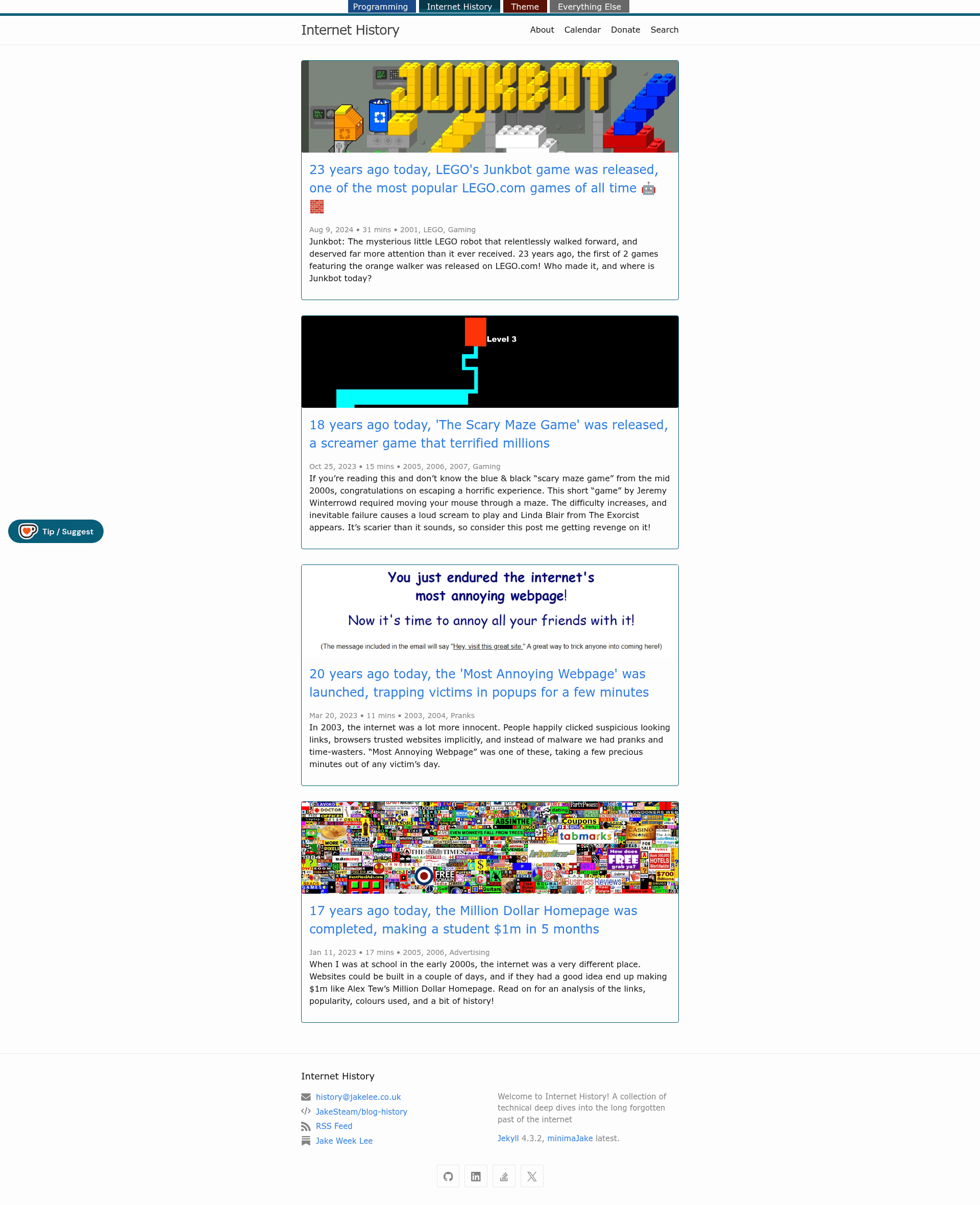
Internet History is a Jekyll blog repository built with the Minima theme that publishes deep-dive articles tracing the history of the internet, with all source code publicly available on GitHub.
What is Internet History?
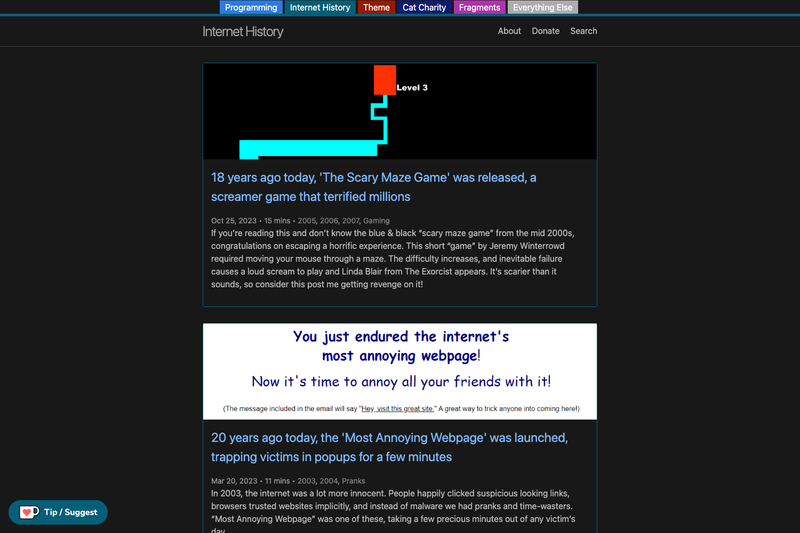
Internet History is a static blog site generated by Jekyll using the default Minima theme. The repository contains both the blog posts about internet history and the complete source code needed to rebuild the site. It is hosted on GitHub Pages, which means content is written in Markdown and published as a static website with no backend. The repository owner makes the entire project available on GitHub for anyone to read or reuse.
Key Features
- Jekyll static site — Uses the Ruby-based Jekyll generator with the Minima theme, so blog posts are authored in Markdown and compiled into plain HTML, CSS, and JavaScript.
- GitHub Pages hosting — Configured for GitHub Pages, so pushing new Markdown posts to the repository automatically rebuilds and publishes the site on GitHub's free static hosting.
- Giscus comments — Integrates giscus, a comment system powered by GitHub Discussions, allowing readers to leave comments on posts without a separate database.
- Lunr search — Includes Lunr, a client-side JavaScript search engine, so visitors can search across posts entirely in the browser without server-side dependencies.
- Open source content — All posts and theme source code are committed to the repository, making it possible to inspect every article's history and fork the project for reuse.
Who is it for?
- Internet history enthusiasts — Read in-depth articles that trace how the internet developed, covering technical and cultural milestones.
- Jekyll bloggers — Use the repository as a working example of a Minima-based blog integrated with giscus and Lunr on GitHub Pages.
- GitHub Pages learners — Study a minimal real-world setup that combines Jekyll, GitHub Pages, giscus, and Lunr without additional services.
What can you do with it?
- Publish long-form history essays: Write new Markdown posts in the standard Jekyll
_postsdirectory, commit them, and let GitHub Pages build the site automatically. - Fork a minimal blog starter: Copy the repository and reuse its configuration to bootstrap a new Jekyll blog with comments and search already wired up.
- Study Jekyll integrations: Inspect the codebase to see exactly how giscus and Lunr are added to a Minima-based site for a simplified learning example.
FAQ
What is Internet History?
Internet History is a blog repository powered by Jekyll with the Minima theme, devoted to deep dives into the history of the internet. It contains both the published articles and the complete source code of the site.
Does Internet History use Jekyll?
Yes, the repository is built with Jekyll and uses the default Minima theme. Posts are written in Markdown and are served as static files via GitHub Pages.
How are comments handled on the blog?
Comments are handled through giscus, which uses GitHub Discussions as the backend. This means each post can have a comment thread without requiring a dedicated commenting service.
Is there a search feature?
Yes, the site includes Lunr, a client-side search library. Visitors can search post content directly in the browser without any server-side processing.
Can I use this repository for my own blog?
Yes, the repository's source code is openly available on GitHub, so you can fork it or copy its setup to create a similar Jekyll blog with comments and search.