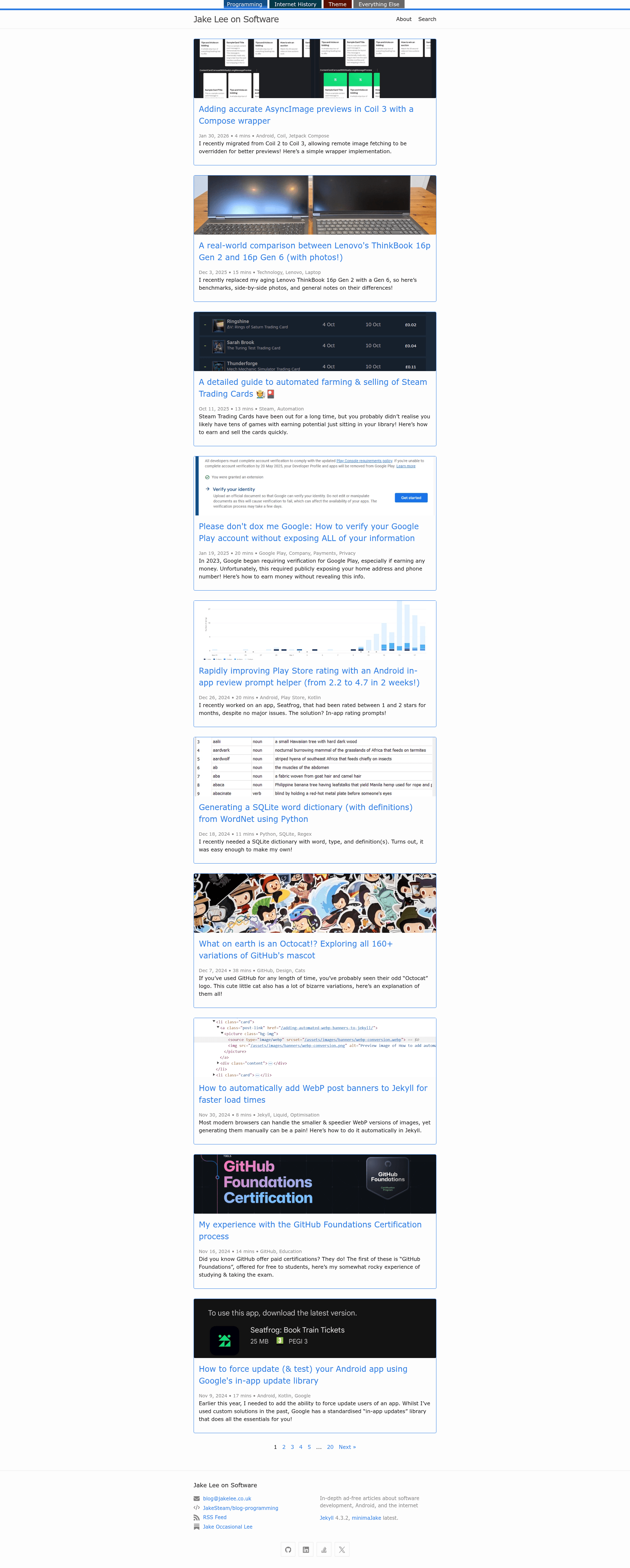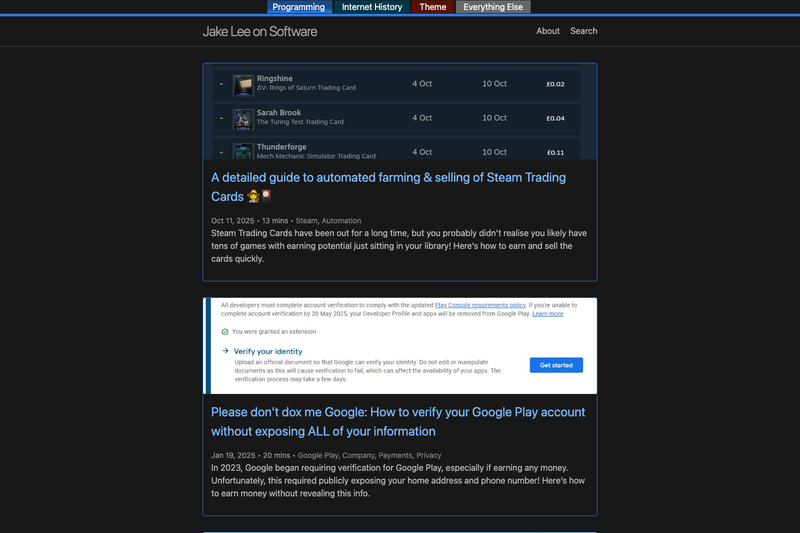
This is the Jekyll source repository behind blog.jakelee.co.uk, a programming blog built on the custom minimaJake theme and hosted on GitHub Pages.
What is this Jekyll blog template?
This repository contains the entire Jekyll site for Jake Lee's programming blog, a static blog that takes Markdown posts and renders them into a complete website using the custom minimaJake theme. The site is built by Jekyll, a Ruby-based static site generator, and deployed on GitHub Pages. The repository is public on GitHub with 4 stars, and it is part of a setup where the same shared Jekyll theme is reused across multiple Jekyll sites, as documented in Jake Lee's post about merging multiple Jekyll codebases into one.
Key Features
- MinimaJake theme — A custom Jekyll theme maintained by Jake Lee that is shared across multiple of his Jekyll sites, reducing duplication in site design and structure.
- GitHub Pages hosting — The repository includes github-pages as a topic, meaning the site is designed to be served directly from a GitHub repository at no cost for public projects.
- Giscus-based comments — The repository lists giscus as a topic, indicating that the blog uses giscus (a GitHub Discussions-powered comment system) for reader comments.
- Programming blog content — The site is focused on programming topics, with the repository described as the "Jekyll (w/ minimaJake) repo for my programming blog."
- Jekyll standard tooling — As a Jekyll site, it supports Markdown for writing, Liquid templates for layout, and YAML front matter for post metadata.
Who is this for?
This is for developers who want to run a personal programming blog on GitHub Pages using a Jekyll setup with a custom theme. It is also for Jekyll users who want to see how a shared theme can be reused across multiple Jekyll codebases, and for anyone looking for a real-world example of a Jekyll blog that integrates giscus for comments.
What can you do with this Jekyll blog?
- Developers: Start a programming blog by forking this repository, writing posts in Markdown, and deploying via GitHub Pages.
- Jekyll theme users: Study how the minimaJake theme is structured and how it is shared across different sites to maintain consistent design.
- Comment-system integrators: Learn how to wire up giscus to a Jekyll blog for GitHub-Discussions-based comments.
How does this Jekyll blog work?
The repository works by using Jekyll to build a static site from Markdown and Liquid templates, with the design provided by the minimaJake theme. Because the theme is shared, changes to the theme can be applied across multiple Jekyll sites from one place. The compiled site is then served via GitHub Pages.
Alternatives
- minima — The default Jekyll theme, which serves as a simpler starting point for Jekyll blogs.
- Hugo — A different static site generator that builds sites from a single binary rather than requiring Ruby and the Jekyll gem.
FAQ
What is minimaJake?
MinimaJake is the custom Jekyll theme used by this repository. It is authored by Jake Lee and shared across multiple Jekyll codebases to maintain a consistent design across his sites.
Does this blog template require Ruby to run?
Yes, as a Jekyll site it requires Ruby and the Jekyll gem to build. However, when deployed on GitHub Pages, the build process is handled automatically by GitHub, so you only need to commit Markdown and template files.
Can I use this repository for my own blog?
The repository is public on GitHub, so you can fork it and adapt the content and structure for your own use, following Jekyll's conventions.
Does the blog support comments?
Yes, the repository lists giscus as a topic, indicating that the blog is set up to use giscus, which powers comments via GitHub Discussions. You would need to configure your own giscus setup for a new repo.
Where can I see the live site?
The live site is at https://blog.jakelee.co.uk.