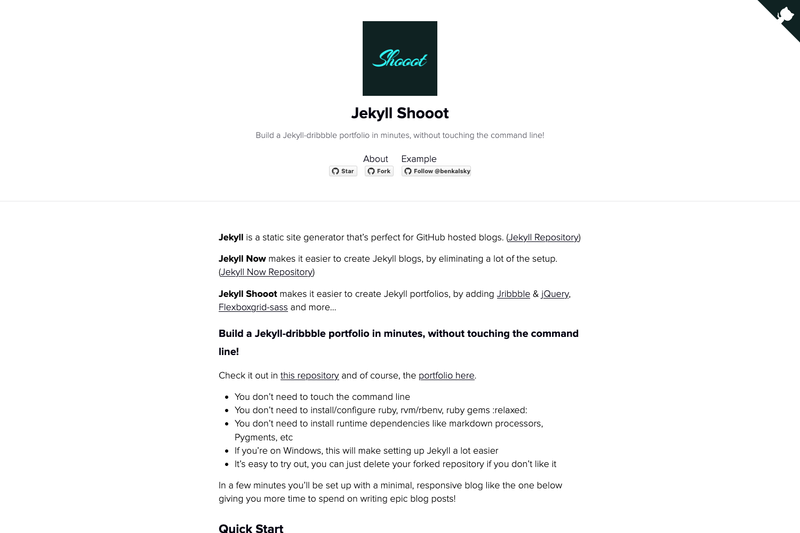
Jekyll Shooot is a Jekyll portfolio theme for GitHub Pages that builds a Dribbble-powered portfolio site and blog in minutes without command-line setup. It is a fork of the popular Jekyll Now starter by Barry Clark, extended with Jribbble (a JavaScript client for the Dribbble API), jQuery, and the Flexboxgrid-sass responsive grid. You provide a GitHub repository and a few config values, and it outputs a static portfolio website with animated Dribbble shots and a blog section.
Created and maintained by Ben Kalsky (repository: benkalsky/jekyll-shooot), it runs entirely on GitHub Pages' free hosting using its built-in Jekyll build system.
Key Features
- Zero command-line setup — Fork the repository, rename it to username.github.io, edit config in the browser, and GitHub Pages publishes the site automatically; no Ruby, rvm/rbenv, or gem installations are needed.
- Dribbble portfolio integration — Uses Jribbble to fetch your shots via a Client Access Token (and optional username) entered in _config.yml, rendering them in a responsive grid.
- Built-in Jekyll blog — Publish posts by placing files in the _posts folder with front matter and the YYYY-MM-DD-title.md or .html naming format; includes a sample Hello World post.
- Configured Google Analytics and Disqus — Turn on tracking and commenting by flipping flags in _config.yml; social icons are also configurable there.
- Responsive Flexboxgrid-sass layout — Uses the Flexboxgrid-sass grid system and jQuery for a mobile-friendly, minimal design inherited from Jekyll Now.
- Works on Windows — Avoids common Jekyll setup pain points on Windows because everything can be done through the GitHub web interface or Prose.io.
- Easy to undo — If you don't like the result, simply delete the forked repository from your GitHub account; there is no local footprint.
Who is it for?
- Dribbble designers — Want a minimal portfolio that auto-updates with their latest shots by plugging in a Dribbble API token.
- Windows users — Who have struggled with installing Jekyll locally and want a GitHub-hosted site entirely through the browser.
- Students and freelancers — Needing a fast, free, code-free way to spin up a personal portfolio and blog on GitHub Pages.
- Jekyll beginners — Who want to learn Jekyll by editing files in GitHub's web editor rather than managing a local environment.
What can you do with Jekyll Shooot?
- Showcase Dribbble work: Add your Client Access Token and optionally your Dribbble username to _config.yml to generate a portfolio grid of your latest shots.
- Start a blog: Edit the sample Hello World post or add new markdown posts directly in the GitHub browser to publish articles alongside your portfolio.
- Customize the site: Change site name, description, avatar, social links, Google Analytics, and Disqus in _config.yml without touching code.
- Develop locally if desired: Install github-pages gem, clone the repo, run jekyll serve, and view at http://127.0.0.1:4000/ for local preview.
How does Jekyll Shooot work?
The workflow is entirely repo-based. First, fork the repository and rename it to your GitHub Pages address (username.github.io). Second, edit _config.yml to set site metadata and add your Dribbble Client Access Token. Third, push changes (or edit in the browser) and GitHub Pages rebuilds the Jekyll site automatically, usually visible within minutes. For posts, create files in _posts with the required front matter and date-prefixed filename.
Pros and cons
- Pros: No local setup or dependencies; free hosting on GitHub Pages; integrated Dribbble API; works on Windows; easy to delete and start over.
- Cons: Requires a Dribbble Client Access Token for portfolio generation; design is intentionally minimal; Dribbble API rate limits may affect very active accounts; no built-in search or advanced blog features.
Pricing
Jekyll Shooot is free and open source. The template itself costs nothing, and hosting a public repository on GitHub Pages is free. You only need a GitHub account and a Dribbble account.
Alternatives
- Jekyll Now — The original starter template this project forks; it's a general-purpose Jekyll blog without the Dribbble portfolio integration.
- Other Jekyll themes — Jekyll's theme gallery offers many portfolio and blog themes, though most require local Ruby setup or a different GitHub workflow.
FAQ
Do I need to install Ruby or Jekyll to use Jekyll Shooot?
No. For the quick start, all you need is a GitHub account. Fork the repo, edit files in the GitHub web interface, and GitHub Pages runs Jekyll for you. Local development is optional and only requires Ruby if you want to preview the site on your computer.
How do I get my Dribbble shots to appear?
Create a Dribbble application to obtain a Client Access Token. Then add that token, and optionally your Dribbble username, to the _config.yml file in your repository. The Jribbble library will fetch and display your shots.
Can I use Jekyll Shooot on Windows?
Yes. The whole setup process is designed to avoid installing Ruby and Jekyll on your own machine. Everything can be done through GitHub.com in the browser, which makes it much easier for Windows users.
Is Jekyll Shooot free?
Yes. The theme is open source and free to use. Hosting a public GitHub Pages site is also free, so you can run a portfolio and blog without any hosting costs.
How do I publish a blog post?
Create a new file in the _posts folder of your repository. The filename must start with the date in YYYY-MM-DD format and include a title, for example 2017-3-1-Hello-World.html. Each post needs to start with front matter containing at least a title and layout.