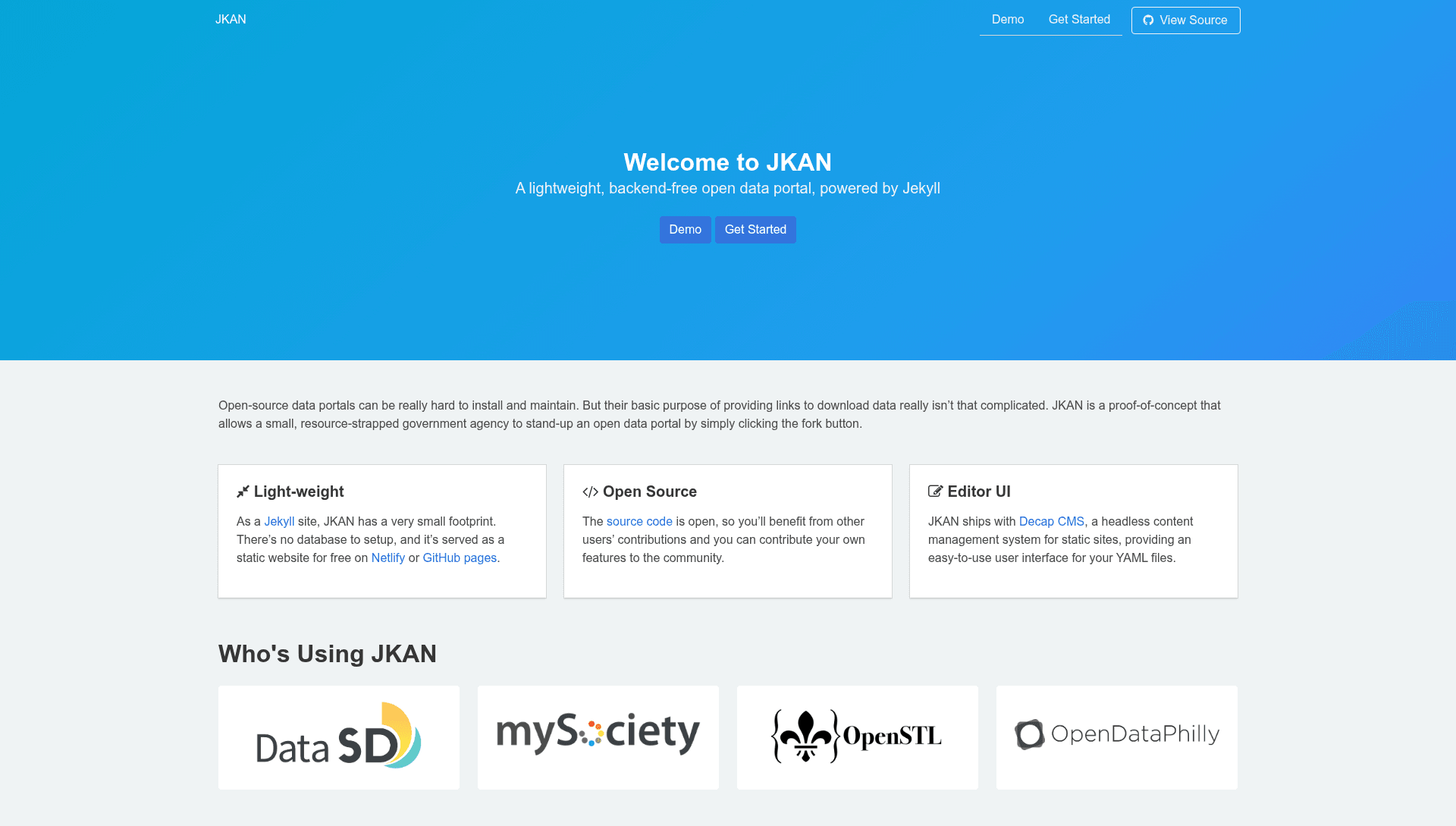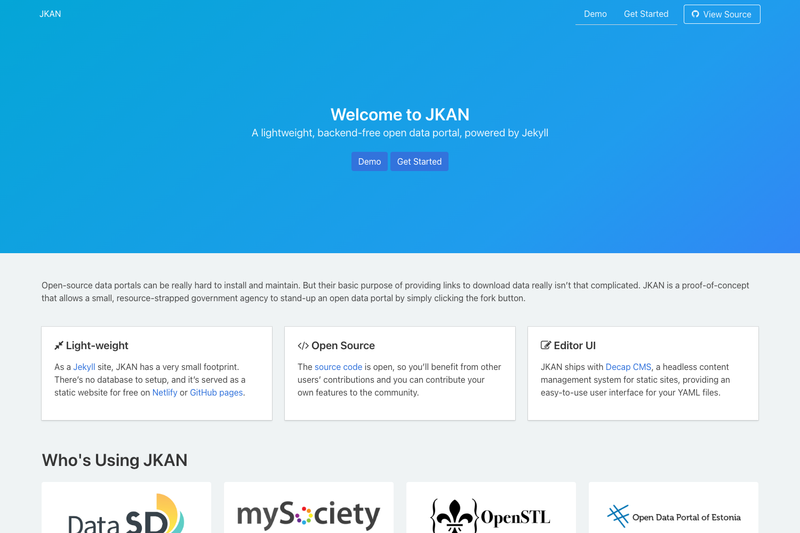
JKAN is a lightweight, backend-free open data portal powered by Jekyll that lets small agencies publish downloadable datasets by forking a GitHub repository.
What is JKAN?
JKAN is a Jekyll-based, backend-free open data portal developed as a proof-of-concept to make open data portals easy to deploy for small, resource-strapped government agencies. Rather than running a complex application with a database, JKAN generates a static website that lists datasets and provides download links. You provide dataset metadata as YAML files, and Jekyll builds the portal as a static site. The project is open-source and hosted on GitHub, with a live demo available at demo.jkan.io.
Key Features
- Backend-free architecture — No database or server-side application is required; Jekyll renders the entire portal as static HTML files.
- Fork-to-deploy workflow — Stand up a portal by clicking the fork button on GitHub and editing YAML metadata files, then hosting the generated site.
- Download link catalog — The core function is curating links to datasets that visitors can download directly.
- Schema customization — A dedicated documentation page explains how to change the metadata schema to fit your dataset fields.
- Documented local development — A running-locally guide lets you preview changes on your own machine before publishing.
- Upgrade path — An upgrading document describes how to move existing JKAN installations to newer versions.
- Demo instance — The live demo at demo.jkan.io shows a fully working deployment for reference.
Who is it for?
- Small government agencies — Deploy an open data portal without the budget or staff to run heavyweight platforms like CKAN or Socrata.
- Civic technology groups — Create portals for municipal open data initiatives using a static-site workflow that any GitHub user can edit.
- Non-technical data stewards — Maintain dataset listings by editing simple YAML files on GitHub, no command-line experience required.
What can you do with JKAN?
- Publish open datasets — Add a YAML entry for each dataset, linking to the data file, and the portal lists it with a download button.
- Customize dataset fields — Adjust the schema to match your agency's metadata needs, as described in the schema-customization documentation.
- Deploy on any static host — Since the output is static files, you can host JKAN on GitHub Pages, Netlify, or any other static file server.
How does JKAN work?
You start by forking the JKAN repository on GitHub. Next, you add dataset entries as YAML files in the data directory, each with fields like title, description, and download URL. When Jekyll builds the site, it reads those YAML files and generates the portal pages automatically. The installation and architecture documentation walk through the exact steps.
FAQ
Is JKAN free?
Yes, JKAN is open-source software, so the code is free to use and modify. You only pay for any hosting you choose for the static site, such as GitHub Pages or a similar service.
Does JKAN require a database?
No, JKAN is backend-free and does not use a database. All dataset metadata lives in YAML files that Jekyll reads at build time to produce static HTML pages.
What expertise do I need to set up JKAN?
Basic familiarity with GitHub and YAML is enough. Installation involves forking the repo and editing metadata files; the documentation covers running it locally for testing.
Can I change the fields shown for datasets?
Yes, the schema-customization documentation explains how to modify which metadata fields are displayed for each dataset entry.
What is the demo site for?
The demo site at demo.jkan.io shows a live, fully structured open data portal so you can see what a JKAN deployment looks like before starting your own.