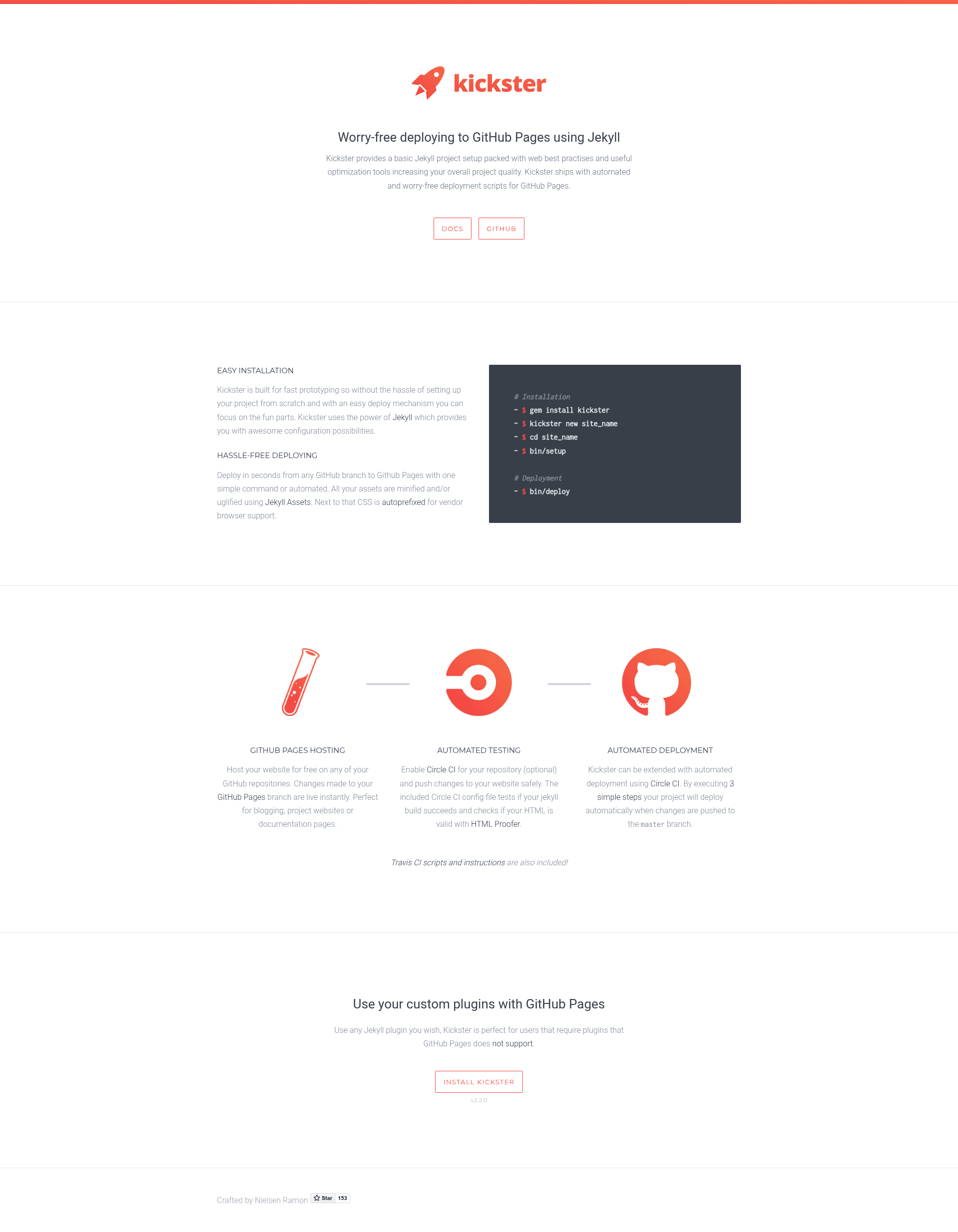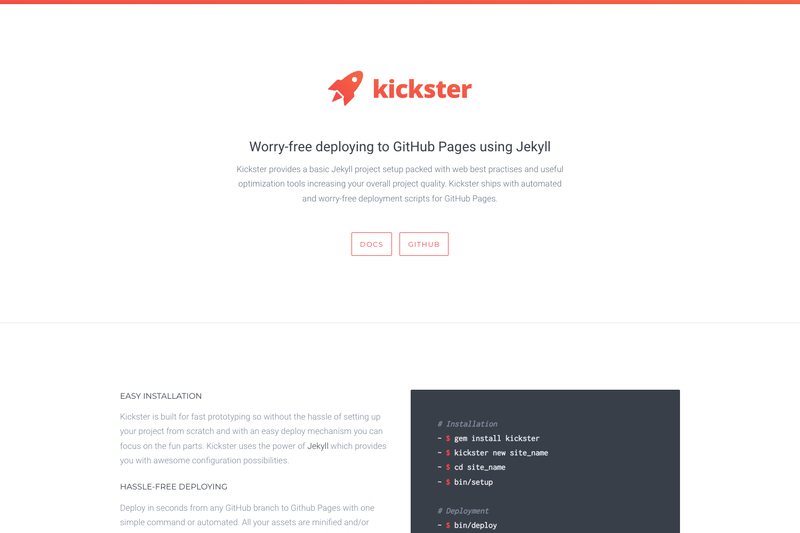
Kickster is a Ruby gem that scaffolds a Jekyll static site with built-in web best practices and automated deployment scripts for GitHub Pages, including optional Circle CI integration.
What is Kickster?
Kickster is a command-line tool that creates a complete Jekyll project setup through the command kickster new site_name. It takes a site name as input and outputs a ready-to-run Jekyll folder containing a bin/setup script, a bin/deploy script, and configuration files for GitHub Pages deployment. Created by Nielsen Ramon, Kickster is open-sourced under the MIT License and has 153 stars on GitHub.
Key Features
- One-command scaffold — Run
kickster new site_nameto generate a Jekyll project;bin/setupthen installs all Ruby and Node dependencies. - GitHub Pages deploy script —
bin/deploypushes your site to GitHub Pages from the project root; forsitename.github.iorepositories, use a branch other thanmaster. - Automated Circle CI deployment — Copy the provided
automatedscript intobin, replacecircle.ymlwith the snippet, set your GitHub username and email, and deployments trigger when code merges into master. - Pre-installed optimization tools — The scaffold includes Autoprefixer for CSS vendor prefixes, Jekyll Assets for asset pipeline, Jekyll Sitemap for sitemap generation, and html-proofer for broken link checks.
- Travis CI support — A separate
snippets/travisfolder contains equivalent automated deployment setup for Travis CI users. - Reusable deploy scripts — You can copy the
binscripts into an existing Jekyll project if you don't need the full Kickster scaffold. - Web best practices — The project is influenced by HTML5 Boilerplate and uses Yarn for package management, providing a modern foundation.
Who is it for?
- Jekyll developers who want a pre-configured project with autoprefixing, asset handling, and sitemap generation without manual setup.
- GitHub Pages users who want to deploy with a single command and optionally automate deployments through Circle CI.
- CI/CD hobbyists who want to learn or use automated static site deployment with read/write deployment keys.
What can you do with Kickster?
- Static site developers: Scaffold a new Jekyll site, run
bin/setup, and immediately start writing content with sitemap and asset pipeline already configured. - GitHub Pages site owners: Run
bin/deployto publish the site without remembering git commands or branch switching. - Automated deployment enthusiasts: Set up Circle CI using the provided scripts and enable hands-off deployments whenever master is updated.
How does Kickster work?
Installation requires Ruby and Node.js (via Homebrew on macOS or installers on Windows). After gem install kickster, run kickster new site_name, then cd site_name and bin/setup. For deployment, execute bin/deploy. For automation, copy the automated script, update circle.yml with your GitHub credentials, and generate a read/write SSH deployment key on Circle CI.
FAQ
Is Kickster free?
Yes, Kickster is released under the MIT License, so it is free to use and modify.
Does Kickster work with Travis CI?
Yes, the repository includes a snippets/travis directory with scripts and instructions for setting up automated deployments via Travis CI instead of Circle CI.
Can I use only the deploy scripts without the full scaffold?
Yes, the README notes that you can copy the scripts from the bin folder into an existing Jekyll project.
What are the system requirements?
You need Ruby and Node.js (for npm) installed. The README suggests installing them via Homebrew on macOS or using the Ruby and Node installers on Windows.
When do automated deployments run?
The Circle CI automated deployment only triggers when your code is merged into the master branch.