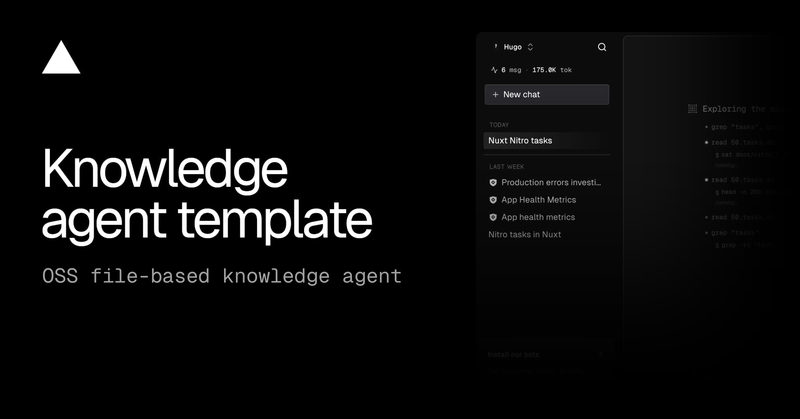
Knowledge Agent Template is an open-source template from Vercel Labs for building file-system and knowledge-based AI agents that search your sources with grep, find, and cat instead of embeddings or vector databases. It ships as a full-stack Nuxt application that you can fork, customize, and deploy on Vercel in one click, or self-host locally.
What is the Knowledge Agent Template?
Knowledge Agent Template is a boilerplate project that turns a set of file-based sources into an AI agent capable of answering questions with deterministic, explainable results. It takes sources — GitHub repositories, YouTube transcripts, custom APIs — and produces a chat interface plus optional GitHub and Discord bots that share the same agent and knowledge base. The project runs on Nuxt, uses the Vercel AI SDK for model integration, and relies on Vercel Sandbox for isolated command execution. Vercel Labs maintains it under an MIT license.
Key Features
- File-based search — The agent executes grep, find, and cat inside an isolated Vercel Sandbox, with no vector database, chunking pipeline, or embedding model required; results are deterministic and instant.
- Multi-platform bots — One agent definition deploys to the web chat, GitHub Issues, and Discord, with Slack and Linear planned, using the Vercel Chat SDK and a single adapter file per platform.
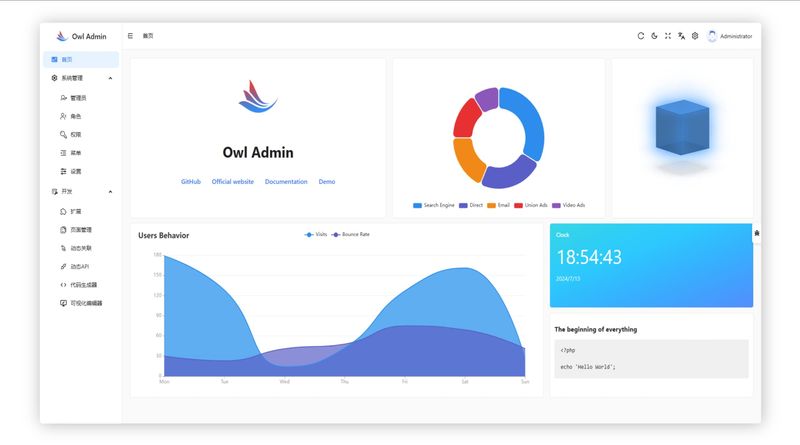
- Built-in admin panel — The /admin route includes usage stats, error logs, user management, source configuration, and content sync controls, removing the need for external monitoring dashboards.
- AI-powered admin agent — Operators can ask natural-language questions about the app itself, such as which endpoints are slowest or token usage by model, using internal tools like query_stats, query_errors, run_sql, and chart.
- Smart complexity router — Each incoming question is classified and routed to a cheap fast model or a larger, slower model, optimizing cost automatically without manual rules.
- Real-time tool visualization — The chat UI shows which files the agent reads, which commands it runs, and how long each step takes, so the reasoning is never a black box.
- Shareable conversations — Any conversation can be converted to a public read-only link with the full exchange and metadata like author and title.
- Shared sandbox pool — Sandboxes are pooled across users and conversations, so new chats attach to an already-running sandbox in under 100 ms; read-only access blocks dangerous commands.
Who is it for?
- Developers building knowledge agents — You get a working reference implementation with SDK packages, a chat UI, and bot adapters to modify rather than starting from scratch.
- Teams that want internal docs Q&A — Point the agent at GitHub repos or YouTube transcripts and deploy a searchable assistant that answers questions about that content.
- Bot maintainers — The GitHub and Discord bots respond to mentions and continue threads, letting you offer support inside your existing issue tracker or server.
- Startups evaluating RAG alternatives — If you want explainable, file-based search without the operational burden of a vector database, this template demonstrates that approach.
What can you do with it?
- Codebase support agent: Connect a GitHub repository as a source and let users ask questions like "How do I configure authentication?" in the chat UI or GitHub issues.
- Content aggregator assistant: Sync YouTube transcripts or custom API content into the snapshot repo, then search across all of it with plain-language questions.
- Operational Q&A: Use the admin agent to query your own app's stats, errors, and slowest endpoints in natural language instead of reading logs manually.
- Custom tool playground: Follow the included AI-assisted skills (add-tool, add-source, add-bot-adapter, rename-project) to extend the agent with new capabilities.
How does it work?
Sources are stored in SQLite via NuxtHub and managed from the admin UI. A Vercel Workflow syncs those sources into a snapshot GitHub repository. When the agent needs to search, the API creates or recovers a Vercel Sandbox with the snapshot cloned, and the SDK's bash and bash_batch tools run grep/find/cat commands inside it. Those tools are compatible with the Vercel AI SDK, so any AI SDK–compatible model can drive the search loop.
FAQ
Does Knowledge Agent Template require a vector database?
No. It searches files directly with grep, find, and cat inside isolated sandboxes, so there is no vector DB, no chunking pipeline, and no embedding model to operate.
Which bot platforms are supported out of the box?
GitHub and Discord. The GitHub bot responds to mentions in issues and PRs using a GitHub App, and the Discord bot responds to mentions and continues conversations in threads. Slack and Linear adapters are planned.
What sources can I connect?
GitHub repositories, YouTube transcripts, and custom APIs are listed as source types. You add them through the admin interface at /admin and trigger a sync, or list them programmatically with the SDK.
Is Knowledge Agent Template open source?
Yes, it is released under the MIT License and maintained by Vercel Labs, with a public repository you can fork and deploy.
Can I deploy it myself?
Yes. You can self-host by cloning the repository, running bun install, copying apps/app/.env.example to apps/app/.env, and starting the app with bun run dev. There is also a one-click deploy button for Vercel that sets the required environment variables.