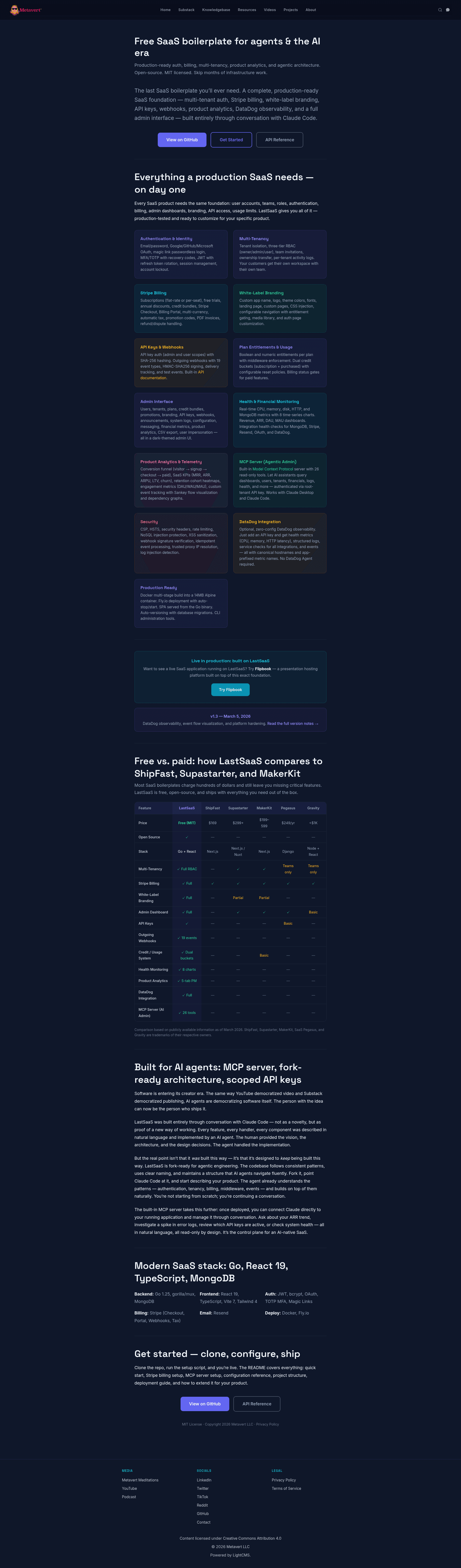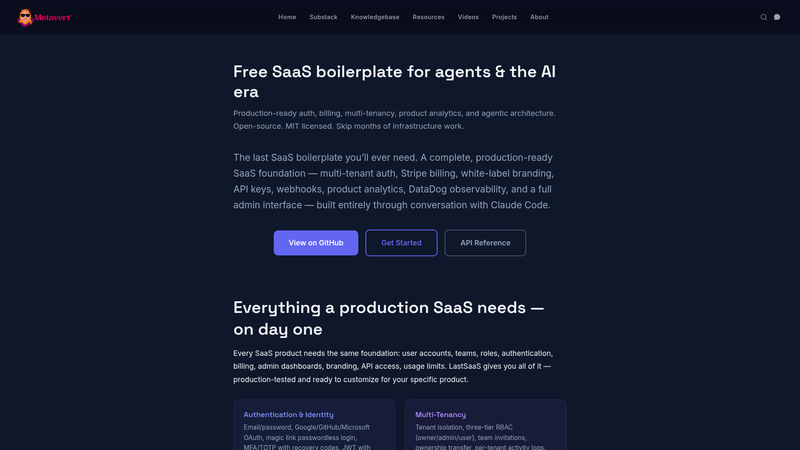
LastSaaS is a free, MIT-licensed SaaS boilerplate that delivers a complete multi-tenant product backend and admin interface — authentication, RBAC, Stripe billing, webhooks, API keys, analytics, health monitoring, and an MCP server — engineered from day one for AI-assisted development with Claude Code.
What is LastSaaS?
LastSaaS is an open-source SaaS starter kit that pairs a Go 1.25 backend with a React 19, TypeScript, Vite 7, and Tailwind CSS 4 frontend, using MongoDB for storage. It takes environment variables for database, JWT secrets, OAuth credentials, Resend, and Stripe, and produces a running SaaS foundation with a customer-facing app, a full admin interface, and built-in API documentation. The project is maintained by Metavert LLC and distributed under the MIT license.
Key Features
- Genuine multi-tenancy — tenant-scoped data isolation with three-tier RBAC roles (owner/admin/user), team invitations, ownership transfer, and per-tenant activity logs.
- Authentication and identity — email/password with bcrypt, JWT access tokens (30 minutes) with refresh token rotation (7 days), Google/GitHub/Microsoft OAuth, magic-link passwordless login, TOTP MFA with recovery codes, email verification via Resend, and session revocation.
- Stripe billing and credits — subscription plans with monthly/annual billing, per-seat pricing, trials, credit bundles, dual credit buckets (subscription + purchased), Stripe Checkout and Billing Portal, promotion codes, and invoice PDF generation.
- White-label branding — custom app name, logo, theme colors with auto-generated shade palettes, fonts, custom landing pages, custom CSS and head HTML injection, favicon upload, and entitlement-gated navigation.
- API keys and outgoing webhooks —
lsk_-prefixed API keys with admin/user scopes and SHA-256 hashed storage, plus 19 webhook event types with HMAC-SHA256 signing and delivery tracking. - Admin interface and dashboards — user and tenant management with impersonation, plan/credit/promotion management, financial metrics (revenue, ARR, DAU, MAU), product analytics (conversion funnel, retention cohorts, engagement), and system health monitoring with 8 real-time charts.
- AI-native MCP server — a built-in Model Context Protocol server gives AI assistants read-only, natural-language access to admin data via API-key authentication.
- Production-ready deployment — Dockerized multi-stage build producing a ~14MB Alpine container that serves the SPA directly from the Go binary, with Fly.io config included.
Who is it for?
LastSaaS targets technical founders and solo developers who want to skip weeks of auth, billing, and admin plumbing. It also suits development teams building multi-tenant B2B products that need white-labeling and customer-facing API keys, and engineers who want to develop their product by conversing with an AI agent instead of hand-writing boilerplate.
What can you do with LastSaaS?
- Solo founders: launch a subscription SaaS with Stripe billing, trials, and credit-based usage tracking without writing billing code from scratch.
- B2B platform teams: offer white-label workspaces, scoped API keys, and 19 webhook events so each customer gets an isolated, integrable environment.
- AI-assisted developers: fork the repository, point Claude Code at it, and extend data models, handlers, routes, and frontend pages using the documented extension points in the project structure.
How does LastSaaS work?
You clone the repo, run the interactive scripts/setup.sh to generate a .env file (database name, MongoDB URI, JWT secrets, optional OAuth/Resend/Stripe credentials), start the backend with go run ./cmd/server and the frontend with npm run dev, then run lastsaas setup to create the root tenant and owner account. After that you can create Stripe plans in the admin UI; Stripe products and prices are generated automatically at checkout.
Pricing
LastSaaS is free and open source under the MIT license. The README compares it to paid boilerplates ShipFast ($169), MakerKit ($199–599), Supastarter (from $299), and SaaS Pegasus ($249/year), noting LastSaaS has no license fee and is fork-ready.
Alternatives
The README names ShipFast, Supastarter, MakerKit, SaaS Pegasus, and Gravity as competing SaaS boilerplates. ShipFast is a Next.js starter with no multi-tenancy; SaaS Pegasus uses Django; Gravity is Node + React; LastSaaS differentiates with true tenant isolation, white-label branding, outbound webhooks, and an MCP server.
FAQ
Is LastSaaS free?
Yes. LastSaaS is MIT-licensed, so you can fork it, ship it commercially, and never pay a license fee. The README explicitly contrasts this with paid boilerplates that cost from $169 up to nearly $1K.
What tech stack does LastSaaS use?
The backend is Go 1.25 with gorilla/mux, the frontend is React 19 with TypeScript, Vite 7, and Tailwind CSS 4, and data is stored in MongoDB. Email goes through Resend, billing through Stripe (stripe-go v82), charts use Recharts, and deployment is Docker/Fly.io.
Does LastSaaS include billing?
Yes, Stripe billing is built in: subscriptions, per-seat pricing, trials, credit bundles, multi-currency, Stripe Tax, promotion codes, invoices as PDFs, and a Billing Portal. It is optional — without Stripe keys, LastSaaS works as a free-tier-only platform.
What is the MCP server?
It's a Model Context Protocol server built into the CLI that gives AI assistants like Claude read-only access to your admin data — users, tenants, financials, logs, health, plans, webhooks — using an API key. It runs locally via stdio and works with Claude Desktop and Claude Code.
What do I need to run LastSaaS?
You need Go 1.25+, Node.js 22+, MongoDB (Atlas free M0 tier or local), and Git. Optional services are Resend for email, Google/GitHub/Microsoft OAuth apps, a Stripe account for billing, and Fly.io for deployment.