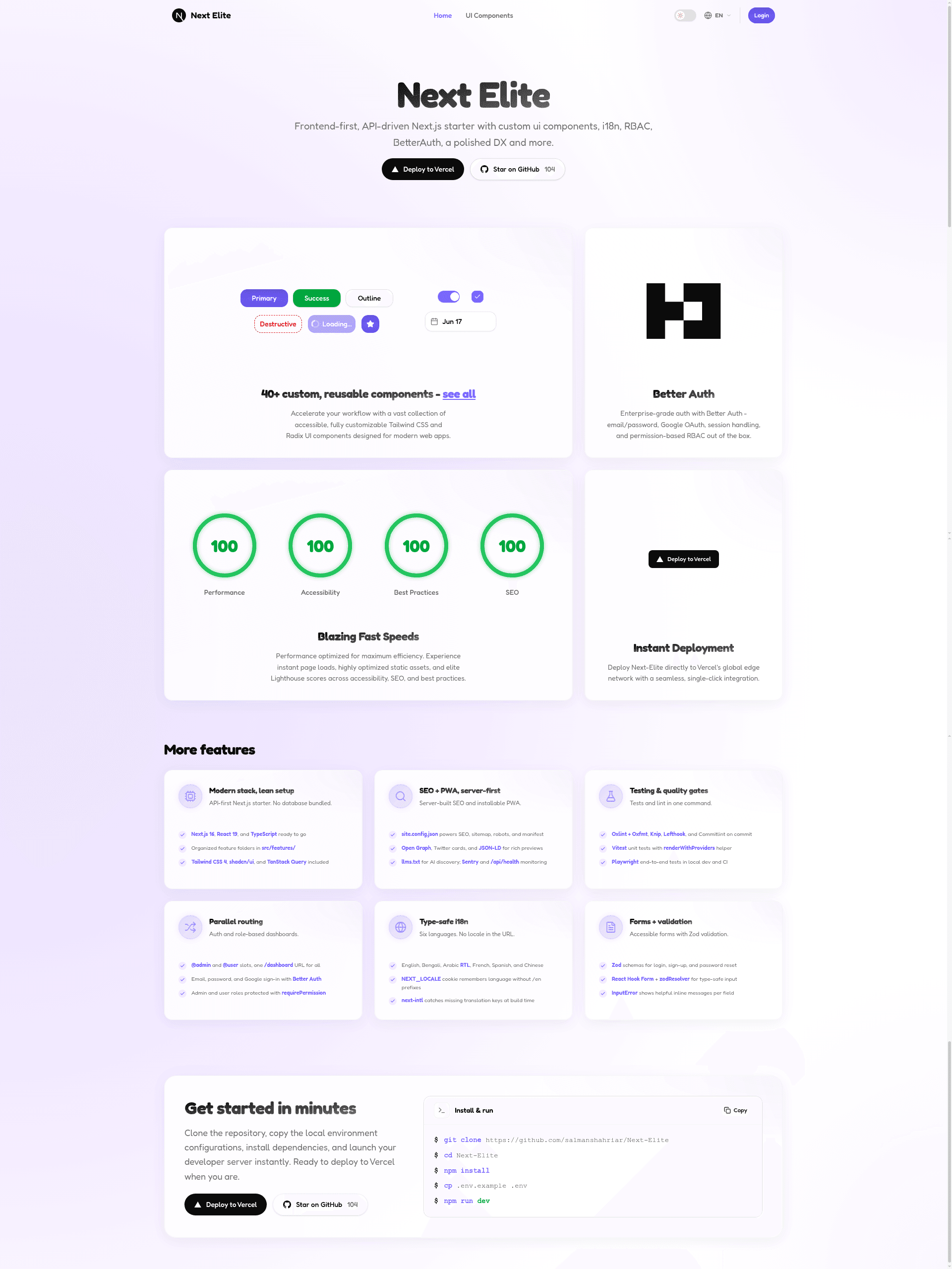
Next Elite is an open-source, production-ready Next.js boilerplate (MIT-licensed) that scaffolds a frontend-first SaaS app with BetterAuth, RBAC, i18n, and a shadcn/ui design system out of the box.
What is Next Elite?
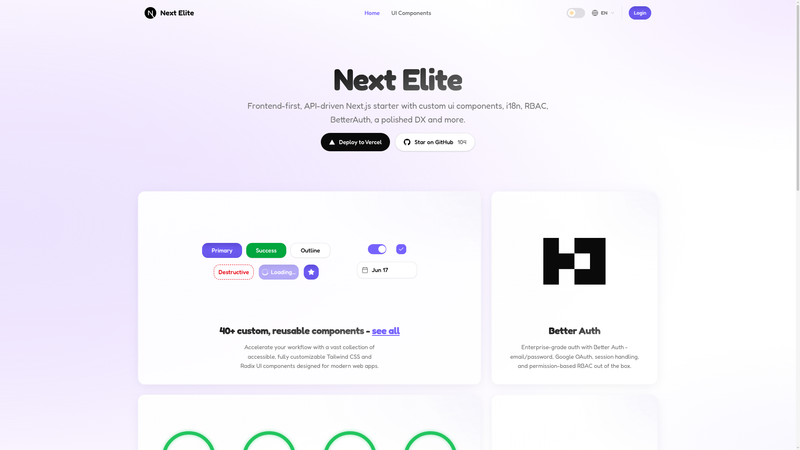
Next Elite is a frontend-first Next.js 16 boilerplate for teams that consume existing REST, GraphQL, or BFF backends instead of managing their own database. It runs on Node.js 22 with TypeScript 6, and ships a complete SaaS starter: login and registration pages, role-based dashboards, a marketing page, and a UI component page. The project is maintained by Salman Shahriar in the GitHub repository salmanshahriar/Next-Elite and currently has 104 stars. It includes 40+ custom and reusable UI components built on shadcn/ui, plus a preconfigured project structure under src/features/.
Key Features
- BetterAuth authentication — email/password and Google OAuth via
/api/auth/*route handlers; admin emails are set throughAUTH_ADMIN_EMAILSorNEXT_PUBLIC_AUTH_ADMIN_EMAILS. - Role-Based Access Control —
userandadminroles with server-side guardsrequireUser()andrequirePermission(), plus parallel route slots@adminand@userfor role-based layouts. - Type-safe internationalization — next-intl with cookie-based locale detection (no URL prefix) supporting English, বাংলা, العربية (RTL), Français, Español, and 简体中文; invalid translation keys fail at compile time.
- Tailwind CSS 4 + shadcn/ui — utility-first styling via
@tailwindcss/postcssandtw-animate-css, with Radix UI and CVA-based components and a light/dark theme toggle. - TanStack Query data fetching — pre-configured
QueryClientProviderinsrc/app/providers.tsxwith sensiblestaleTime,gcTime, and retry defaults for REST, GraphQL, or BFF calls. - Sentry + health checks — client and server error tracking via
instrumentation.tsand a/api/healthendpoint for load balancer and container health checks. - Testing and quality gates — Vitest and React Testing Library for unit tests, Playwright for E2E, Oxlint and Oxfmt for fast linting/formatting, Knip for dead code detection, and Lefthook + Commitlint git hooks.
- Deployment flexibility — one-click Vercel deploy, a Dockerfile with multi-arch ARM64/AMD64 builds via Buildx, Docker Compose, and Dokploy support with HEALTHCHECK.
Who is Next Elite for?
- SaaS teams building multi-role products — use the admin and user dashboard slots with permission guards to ship role-aware interfaces without writing auth infrastructure.
- Frontend teams with an existing backend — point the boilerplate at a REST, GraphQL, or BFF API and get auth, i18n, and UI without owning a data layer.
- Internationalized product teams — start with six locales including RTL and type-checked translations.
- Developers who want a strong default toolchain — get preconfigured CI workflows, testing, linting, formatting, and dependency updates via Renovate.
What can you do with Next Elite?
- Launch a multi-lingual SaaS MVP — deploy to Vercel in one click and use the seeded demo accounts (
[email protected]/[email protected], password12345678) to explore RBAC and dashboard slots immediately. - Add authentication to an API-first project — configure BetterAuth environment variables and have email/password plus Google OAuth working without writing auth code.
- Self-host on ARM hardware — build the multi-arch Docker image and run it on Oracle Cloud, a Raspberry Pi, or any ARM server via Docker or Dokploy.
How does Next Elite work?
The rendering model is server-first: pages are Server Components, auth and role checks run server-side, and live data is fetched on the client. When a user opens a page, requireUser() or requirePermission() reads the BetterAuth session and redirects to /login or /unauthorized if access is missing; the server sends HTML with translations from the messages/ folder, and TanStack Query hooks such as useQuery fetch API data in the browser. Local setup is four steps: clone the repo, run npm install, copy .env.example to .env, and run npm run dev on port 6767.
Pros and cons
Pros
- MIT-licensed and free to use, with an active GitHub repository.
- Includes 40+ shadcn/ui components, six locales, RBAC, and preconfigured CI/CD.
- One-click Vercel deployment plus multi-arch Docker support for self-hosting.
Cons
- Requires Node.js 22.12 or later and npm.
- The README notes it is overkill for single-page landing sites and apps that need a tightly-coupled database layer.
Pricing
Next Elite is free and open source under the MIT license.
Alternatives
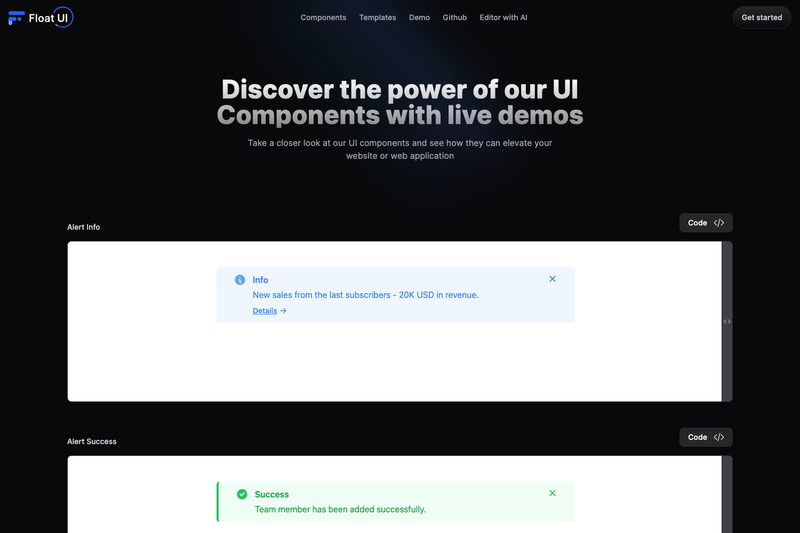
- create-t3-app — a CLI-based Next.js starter that scaffolds a full-stack T3 app with tRPC and Prisma, unlike Next Elite's API-only, frontend-first approach.
FAQ
Is Next Elite free?
Yes, Next Elite is free and open source under the MIT license. You can clone the repository, use the template, and deploy it commercially without licensing fees.
What authentication does Next Elite use?
Next Elite uses BetterAuth with email/password and Google OAuth. Admin emails are configured through AUTH_ADMIN_EMAILS or NEXT_PUBLIC_AUTH_ADMIN_EMAILS, and the auth routes live under /api/auth/*.
Which languages does Next Elite support?
It supports six locales: English, বাংলা, العربية (RTL), Français, Español, and 简体中文. Locale is selected via a cookie with no URL prefix, and translation keys are type-checked.
Does Next Elite require a database?
No. Next Elite is frontend-first and designed to consume existing REST, GraphQL, or BFF backends. It does not include a database layer, so it is best suited for projects that already have an API.
What are the demo login credentials?
When NEXT_PUBLIC_DEMO_MODE=true, the login screen shows a quick-fill panel with [email protected] and [email protected], both with password 12345678. For production, set the flag to false or delete the src/features/auth/demo/ module.