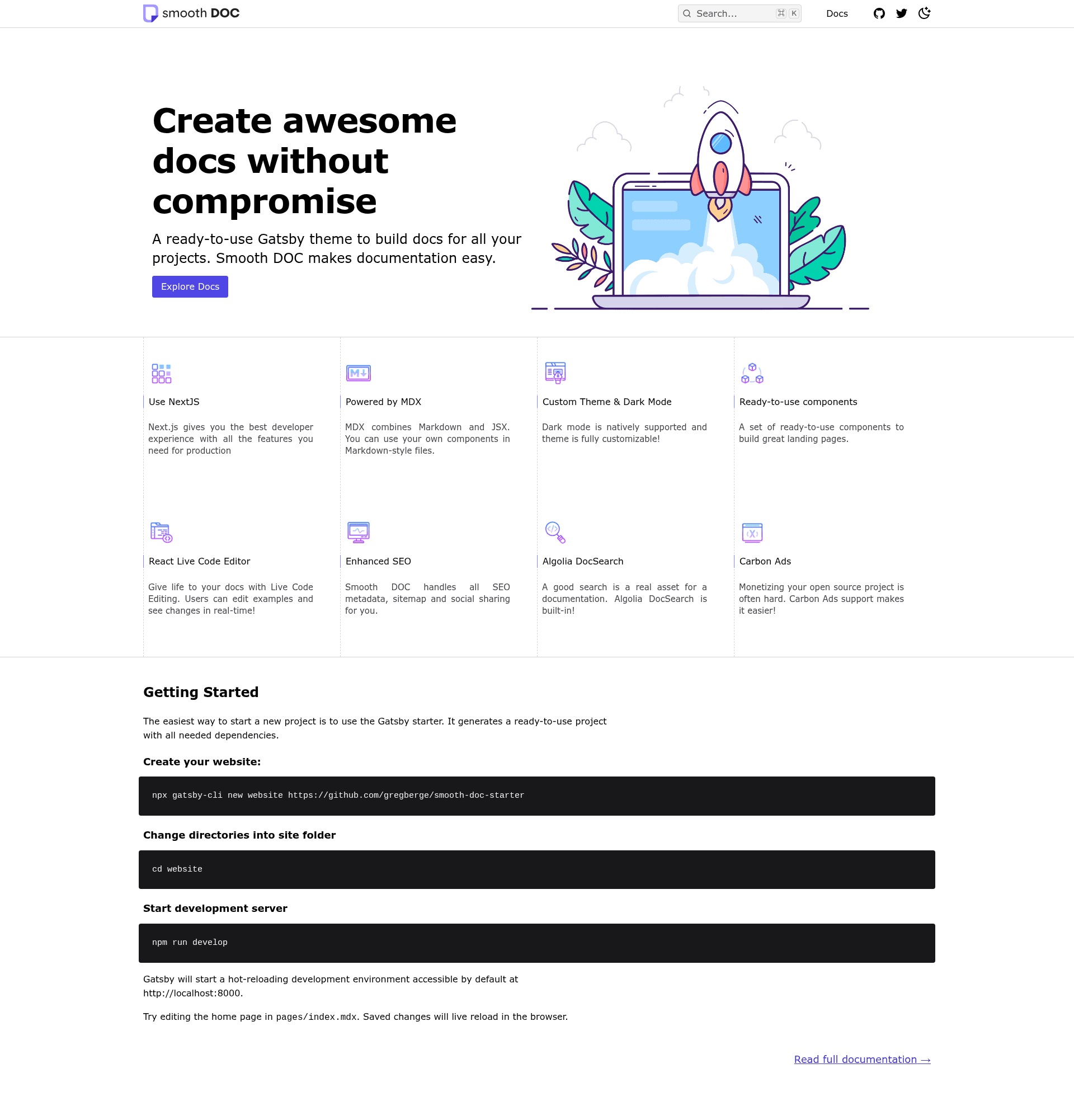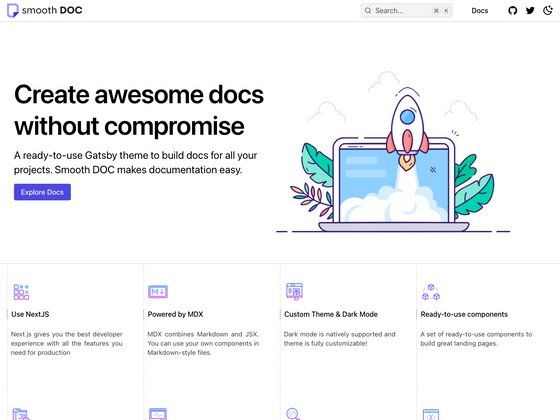
Next Smooth Doc is a minimal documentation site generator that reimplements the Gatsby-based smooth-doc project on top of Next.js and MDX, producing server-rendered documentation from Markdown content. The repository is a direct port created in four days, and it reports a significantly smaller dependency footprint (455 packages for Next.js versus 1,413 for Gatsby.js).
What is Next Smooth Doc?
Next Smooth Doc is an open-source documentation site generator built specifically for the Next.js framework. It takes MDX and Markdown files as input and outputs a server-rendered documentation website, as indicated by its repository topics: documentation, mdx, nextjs, server-rendering, and site-generator. The project was migrated from the original smooth-doc, which is Gatsby-based, and serves as a Next.js implementation of that tool. At the time of writing, the GitHub repository has 42 stars.
What makes Next Smooth Doc stand out?
- Next.js foundation — Runs on Next.js, bringing its file-based routing, server-side rendering, and static generation to documentation sites.
- MDX support — Docs are written in Markdown with the option to embed JSX components through MDX.
- Lower dependency count — The author's comparison shows Next.js installs 455 packages versus 1,413 for Gatsby.js, reducing install time and potential security surface.
- Direct smooth-doc migration — The project was converted from the original smooth-doc in four days, so it shares a similar structure but uses the Next.js ecosystem.
- Server-rendered output — Tagged as server-rendering and site-generator, it generates HTML at build time or on the server rather than client-side only.
- CMS integration potential — The repository lists "cms" among its topics, suggesting it is designed to work with content management systems.
Who is it for?
- Next.js developers who want to build a documentation site without leaving the Next.js ecosystem or pulling in a second framework.
- Existing smooth-doc users who prefer Next.js over Gatsby and want to migrate, following the author's example of a four-day port.
- Documentation maintainers who value a minimal dependency footprint and faster installs for their project's docs.
What can you do with Next Smooth Doc?
- Create project documentation: Write MDX files and get a server-rendered docs site without configuring a separate Gatsby pipeline.
- Migrate from smooth-doc: Port an existing smooth-doc site to Next.js, as the author did, to benefit from the smaller package count.
- Embed docs in a Next.js app: Because it is Next.js-native, the docs generator can be integrated into a larger Next.js application as a section rather than a standalone site.
Alternatives
- smooth-doc — The original documentation generator this project reimplements, based on Gatsby.js with a much larger dependency tree.
FAQ
Does Next Smooth Doc use MDX?
Yes. The project is described as "a minimal doc generator based on Next.js & mdx", so documentation content is written in Markdown with MDX component support.
Why would I use Next Smooth Doc instead of smooth-doc?
If you prefer Next.js to Gatsby, Next Smooth Doc gives you the same documentation-site functionality with roughly one-third the dependency count (455 vs 1,413 packages). It is a direct port, so the feature set is similar.
What known issues does Next Smooth Doc have?
The repository reports a server/client mismatch warning for the className prop, where server-rendered class names (for example, "sc-dbzIES bVQWvb") do not match client-rendered names. This suggests a CSS-in-JS styling mismatch to resolve in your own deployment.