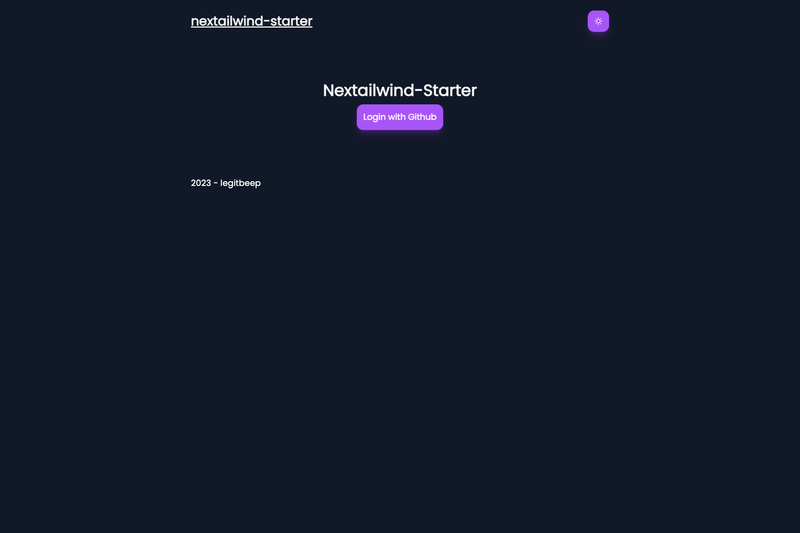
Nextailwind Starter is a Next.js boilerplate that pairs TypeScript with Tailwind CSS and ships with linting plus optional integrations for authentication, PWA, SEO, sitemap, and theming.
What is Nextailwind Starter?
Nextailwind Starter is an open-source starting point for building Next.js applications. It takes a standard create-next-app project and adds TypeScript, Tailwind CSS, and a full linting setup, giving you a type-safe, utility-styled codebase from the first command. The template runs on Node.js, includes an API route example at /api/hello, and is documented for deployment on the Vercel Platform. Its repository topics reference next-auth, next-pwa, next-seo, next-sitemap, and next-theme as the intended feature stack.
Key Features
- TypeScript — The entire project is written in TypeScript, with typed page files such as
pages/index.tsxand API routes inpages/api/hello.ts. - Tailwind CSS — Styling relies on Tailwind utility classes, configured with PostCSS and Autoprefixer.
- Linting included — The description states "all linting included", so ESLint comes preconfigured for clean code.
- Authentication — next-auth is listed, enabling sign-in and session management with major providers.
- Progressive Web App — next-pwa integration supports offline access, caching, and installable app behavior.
- SEO management — next-seo simplifies per-page meta tags, Open Graph data, and structured content.
- Sitemap generation — next-sitemap automatically builds sitemap.xml files for search engines.
- Theme switching — next-theme provides light/dark mode toggles with system-preference detection.
Who is it for?
Nextailwind Starter is built for developers who want to skip initial project configuration and start with a modern Next.js stack. Frontend developers get TypeScript type safety and Tailwind styling out of the box. Teams planning a production app can rely on the included SEO, sitemap, PWA, and auth integrations. It is also a small, approachable repository for Hacktoberfest contributors looking to add features or improve documentation.
What can you do with Nextailwind Starter?
- Developers: scaffold a new app with
npm run devand immediately edit the typed home page with hot reload. - SEO specialists: manage page titles, descriptions, and social sharing via the next-seo setup.
- Product teams: implement authentication, offline support, and sitemap generation using the integrated libraries.
- API builders: add new serverless functions by placing files in
pages/api, which are mounted automatically at/api/*.
How does Nextailwind Starter work?
The template mirrors a standard create-next-app structure. Run npm run dev or yarn dev to start the development server at http://localhost:3000. The home page lives in pages/index.tsx and hot-reloads on save. API routes go in the pages/api directory and become endpoints under /api/. For production, the README recommends deploying through the Vercel Platform.
FAQ
Is Nextailwind Starter free?
Yes, the repository is open source and free to use. The readme is the default create-next-app readme, and the source is available on GitHub for anyone to clone, modify, and contribute to.
What does Nextailwind Starter include?
It includes a Next.js project with TypeScript and Tailwind CSS already configured, plus ESLint for linting. Repository topics additionally point to next-auth, next-pwa, next-seo, next-sitemap, and next-theme as part of the intended feature set.
How do I deploy Nextailwind Starter?
The readme points to the Vercel Platform as the easiest deployment option, linking to the standard create-next-app deployment flow. The Next.js deployment documentation covers other hosting options as well.
Does it support TypeScript?
Yes, TypeScript is a core part of the template. Page and API files use the .ts/.tsx extensions, and the project is configured for type checking during development and builds.
Can I use it for a production app?
It is designed as a starter, so it includes SEO, sitemap, PWA, and auth integrations that are commonly needed for production. The template itself is minimal, so you would add your application code on top.