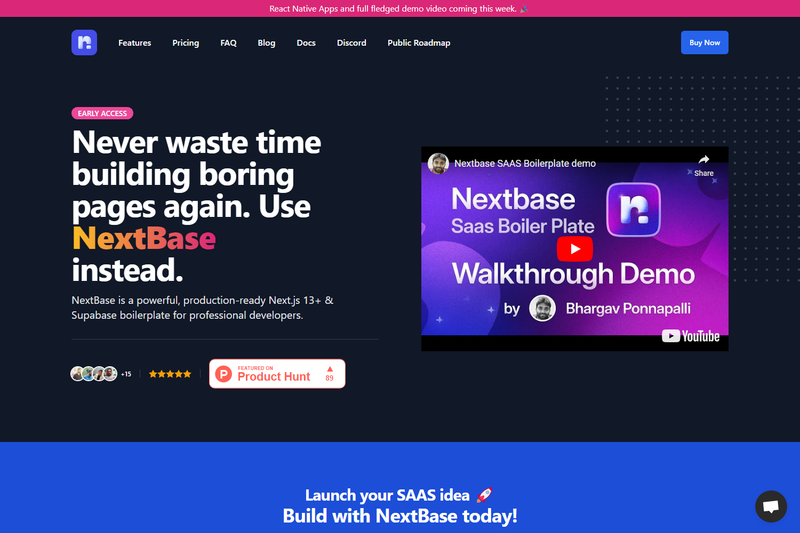
NextBase Starter is a free, MIT-licensed Next.js 16 + Supabase boilerplate that gives SaaS teams a production-grade foundation with authentication, Row Level Security, typed server actions, and caching already wired together.
What is NextBase Starter?
NextBase Starter is the open-source baseline of the NextBase family of kits, maintained as a public GitHub repository. It takes a fresh Supabase project and a Next.js 16 app and produces a Turborepo monorepo with apps/web (the Next.js application) and apps/database (Supabase migrations and tests). The starter includes working sign-up, sign-in, magic link, OAuth, forgot-password, and update-password flows, a dashboard shell, and a reference CRUD page protected by RLS. The codebase assumes professional TypeScript fluency and is designed to be audited line by line.
Key Features
- SSR-correct Supabase auth —
@supabase/ssrclients for browser, server components, server actions, and middleware, so cookies survive every render boundary in Next.js 16 without breaking after refresh or deploy. - RLS-by-default database layer — Versioned timestamped SQL migrations under
apps/database/supabase/migrations, with every user-owned table shippingSELECT/INSERT/UPDATE/DELETEpolicies keyed offauth.uid(). - Typed server actions with
next-safe-action— All mutating endpoints are validated with Zod, and theauthActionClientinjectsctx.userIdand refuses unauthenticated calls. - Next.js 16 Cache Components —
cacheComponents: trueenables static-by-default rendering with surgicaluse cacheboundaries, plus a written guide atdocs/NEXTJS_CACHE_COMPONENTS.md. - shadcn/ui and Tailwind CSS v4 — 40+ Radix UI components (dialogs, command palettes, sidebars, sheets, toasts, OTP input) pre-installed, styled with Tailwind v4 via
@tailwindcss/postcss, including Forms and Typography plugins. - Turborepo monorepo — pnpm workspaces, shared TypeScript config, pipelined
build,lint,test,typecheck,gen-types, andtest:e2etasks, plus Changesets-driven release automation. - Tested at multiple layers — Vitest + Testing Library for unit tests, Playwright for E2E, and a pgTAP-style test harness for asserting RLS policies and constraints.
Who is it for?
NextBase Starter is for founders, indie hackers, and small teams shipping a SaaS on Next.js and Supabase who want to compress weeks of plumbing into a weekend of customization. It is also for senior engineers who want a credible, auditable reference architecture for RLS, SSR cookies, and Cache Components. Teams already on Supabase can use it as a consistent pattern for server actions, data access, and monorepo layout instead of maintaining three subtly different conventions.
What can you do with it?
- SaaS founders: Clone the repo, set up Supabase, and have an authenticated dashboard with a CRUD reference page running in under an hour.
- Indie hackers: Use the local Supabase stack (
pnpm database#start) with generated types for a fast MVP loop, then deploy to Vercel with Node 22+. - Client project builders: The MIT license permits commercial and client work, and the monorepo structure scales to larger team codebases.
How does it work?
After copying .env.local.example and .env.development.local.example into place, you provision the database either locally with pnpm database#start and pnpm gen-types-local, or against a hosted Supabase project with pnpm supabase db push and pnpm gen-types. Then pnpm dev starts the app at localhost:3000. The project ships with Playwright and Vitest configs already wired into Turbo pipelines.
Pricing
The NextBase Starter is free and MIT-licensed, with no purchase required. The premium NextBase kits (Stripe billing, teams and organizations, RBAC admin, transactional emails, multi-tenancy, and AI starter kits) are commercial products sold at usenextbase.com; the starter remains free.
FAQ
Is NextBase Starter really free?
Yes, the starter is MIT-licensed. You can use it for personal projects, client work, internal tools, or commercial products without paying.
What's the difference between the starter and premium kits?
The starter covers the foundation: Supabase auth, RLS, typed server actions, Cache Components, monorepo, and tests. Premium kits add Stripe billing, teams, RBAC and admin, transactional emails, multi-tenancy, and AI starter flows on the same architectural patterns.
Why Supabase instead of Clerk or Firebase?
Supabase bundles Auth, Postgres, RLS, and Storage in one vendor with real SQL migrations and a real SQL surface. NextBase is opinionated about that choice, so you avoid stitching three separate SDKs together.
Can I rip out shadcn, Tailwind, or TanStack Query?
Yes; the architecture does not depend on any one UI or data-fetching library. You can replace or remove them and keep the rest of the data-access and caching structure intact.