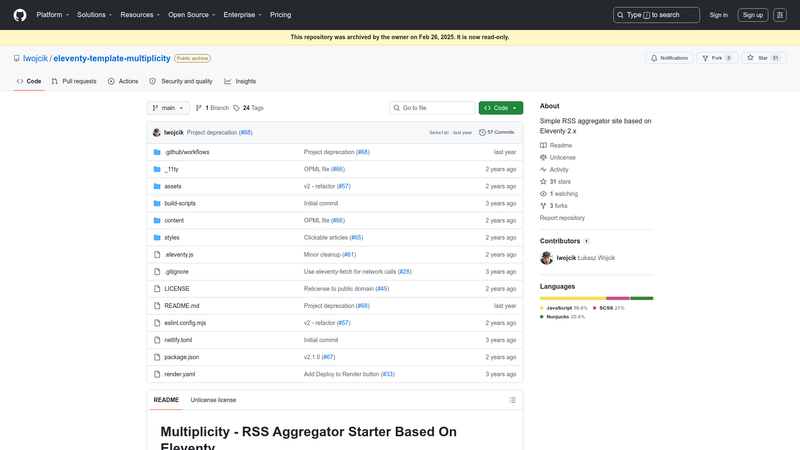
Multiplicity (also known as m10y) is an open-source Eleventy-based starter template for building a self-updating RSS aggregator site that pulls articles from multiple RSS and JSON feeds and presents them on a static website.
What is Multiplicity?
Multiplicity is a starter kit built on the Eleventy static site generator (11ty) that creates a feed aggregator site. It takes a list of feeds defined in content/sites/ as input and generates a static HTML site that lists articles from those feeds. The template includes a GitHub Action for scheduled builds, letting the aggregator refresh itself automatically without manual intervention. It is released under a public-domain license, so there are no usage restrictions.
What makes Multiplicity stand out?
- Eleventy-based static output — Uses Eleventy 2.x to generate a fast, dependency-free static site with no server-side runtime.
- RSS and JSON feed support — Each site entry in
content/sites/can specify either an RSS or JSON feed URL, and the build fetches and parses the articles. - Automated scheduled builds via GitHub Actions — A preconfigured workflow (
.github/workflows/scheduled_build.yml) can be wired to a Netlify or Vercel build hook, so the site rebuilds on a schedule. - Local avatar asset handling — Favicons or avatars for each feed are downloaded, resized, and served locally during the build process.
- Configurable site list — A
siteConfig.jsfile controls site metadata, and each feed entry can be hidden from the public Sites page using thehideFromSiteListproperty to avoid duplicate names. - Translation-ready static phrases — All static UI text is centralized in a
phrases.jsfile, making it easy to translate the interface. - Cache persistence support — Built on the
@11ty/eleventy-fetchplugin, the template can persist its cache folder on hosts like Netlify or Vercel to reduce repeated network requests during builds.
Who should use Multiplicity?
- Developers who want a lightweight, code-first alternative to hosted RSS readers — they can fork, configure, and deploy a personalized aggregator in minutes.
- Blog owners with multiple sites or co-author collaborations who want to display a unified feed of their latest posts on one static page.
- Netlify or Vercel users who prefer scheduled static rebuilds via GitHub Actions and need a minimal, flexible starting point.
What can you do with Multiplicity?
- Personal reading dashboard: Aggregate your favorite blogs, news sites, and other RSS/JSON sources into one self-hosted static page, refreshed automatically by the scheduled GitHub Action.
- Shared team link board: Curate a set of RSS/JSON sources relevant to a team or community and share the resulting aggregator site publicly.
- Unified brand feed: If you maintain several websites or publication channels, combine their feeds under one domain and hide duplicates with the
hideFromSiteListflag.
How does Multiplicity work?
- Fork the repository and edit
siteConfig.jsto set your site name and metadata. - Add or modify feed entries in the
content/sites/folder, each with a name, URL, avatar, and feed link. - Deploy the site to Netlify or Vercel and create a build hook URL.
- Save that URL as a GitHub secret (for example
NETLIFY_BUILD_HOOK_URL) and enable thescheduled_build.ymlworkflow. - The GitHub Action runs on a schedule, calls the build hook, and triggers a fresh Eleventy build that fetches and caches the latest feed articles using
@11ty/eleventy-fetch.
FAQ
Is Multiplicity free to use?
Yes. The template is released without a license, explicitly placed in the public domain. You can fork, modify, and deploy it for personal or commercial use with no strings attached.
What feed formats does Multiplicity support?
It accepts both RSS and JSON feeds. Each entry in content/sites/ specifies a feed URL, which the build process fetches with @11ty/eleventy-fetch and parses into the aggregator page.
Does Multiplicity require a server?
No. It is a pure static site generator. The output is static HTML that you can host on any static hosting platform, including Netlify or Vercel, which are mentioned in the setup instructions.
How do I keep my aggregator up to date automatically?
The included GitHub Action workflow is designed to run on a schedule. You create a build hook URL on your hosting provider, store it as a GitHub secret, and the workflow calls that URL to trigger a rebuild whenever it executes.