Next.js Blog Boilerplate is an open-source starter template by CreativeDesignsGuru that scaffolds a production-ready blog on Next.js 12 and Tailwind CSS 3, handling Markdown content, SEO metadata, and static-site deployment.
What is Next.js Blog Boilerplate?
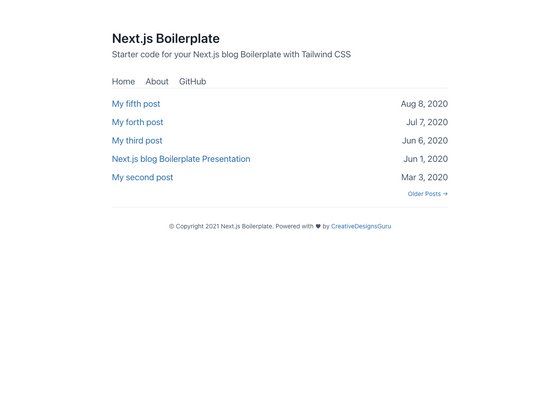
This boilerplate is a starter codebase for creating a blog with Next.js 12+ and Tailwind CSS 3.0. It takes Markdown files placed in the _posts directory as input and generates a static blog with pagination, Prism.js syntax highlighting, and SEO metadata as output. The project runs on the Next.js static site generator, uses TypeScript for type checking, and is styled through Tailwind CSS processed by PostCSS. It is maintained by CreativeDesignsGuru and released under the MIT License.
Key Features
The boilerplate bundles a deliberately small but practical set of features for blogging.
- Prism.js syntax highlighting — Code blocks inside Markdown posts are highlighted with Prism.js out of the box.
- SEO metadata and Open Graph tags — Next SEO injects meta tags and social sharing tags for better search and link previews.
- JSON-LD structured data — Included to help search engines index the blog content more richly.
- Pagination support — Blog listing pages are paginated to handle large numbers of posts.
- Minimalist blog theme — A free theme is included in
src/templates/Main.tsx, customizable with Tailwind CSS. - Markdown-based content — Posts are written in Markdown under the
_postsfolder; the template renders them automatically. - Tailwind CSS 3 integration — Utility-first styles are processed by PostCSS, and unused CSS is purged in production builds.
- Developer experience tools — The starter configures TypeScript, ESLint, Prettier, and a Bundler Analyzer, plus Next.js built-in live reload, minification, and cache busting.
Who is it for?
The template is aimed at individual developers and teams that want a modern static blog with minimal setup.
- Independent bloggers who want a fast, SEO-friendly static blog without configuring SEO metadata and syntax highlighting by hand.
- Next.js developers looking for a minimal, production-ready reference for a Markdown-based blog with TypeScript.
- Open-source maintainers who want to spin up a project blog quickly and deploy it to Netlify with the one-click button.
What can you do with Next.js Blog Boilerplate?
The starter supports a handful of concrete content-publishing scenarios.
- Personal blogs: Write posts in Markdown and publish a static site with pagination and syntax highlighting.
- Technical documentation: Use the built-in SEO and JSON-LD support to improve search visibility for technical articles.
- Project announcements: Clone the repo, customize
src/utils/Config.tsand the theme, and deploy to Netlify or any hosting service that serves static files.
How does it work?
The workflow is clone, install, write, and build. Clone the repository with git clone --depth=1, run npm install, and start developing with npm run dev to see the blog at http://localhost:3000. Add posts as Markdown files in _posts, customize the theme and configuration, then run npm run build-prod to generate a minified static site in the dist folder ready for deployment.
Pricing
Free — the boilerplate is open-source under the MIT License, so it can be used for personal and commercial projects without cost.
Alternatives
The main comparable starter is Tailwind Nextjs Starter Blog, which also pairs Next.js with Tailwind CSS.
FAQ
Is the Next.js Blog Boilerplate free?
Yes, the project is open-source and licensed under the MIT License, meaning it is free to use and modify for personal or commercial purposes.
What do I need to run it?
The README lists Node.js and npm as the only requirements; no specific version is mentioned. After cloning, install dependencies with npm install and run npm run dev.
How do I add a new blog post?
Create a Markdown file in the _posts directory. The boilerplate automatically picks up Markdown files and renders them with syntax highlighting, pagination, and SEO metadata.
Can I deploy to Netlify?
Yes, the README includes a one-click Netlify deploy button. You can clone the repository to your GitHub account and deploy the project directly to Netlify.
What SEO features are included?
The template includes SEO metadata, Open Graph tags, and JSON-LD structured data using the Next SEO library, plus a minimalist theme designed to maximize Lighthouse scores.