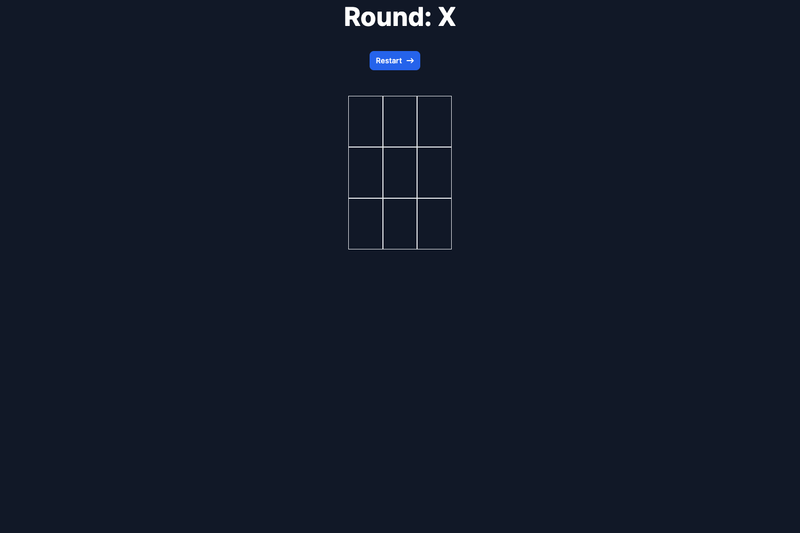
Nextjs Tic Tac Toe App is a boilerplate Next.js project that provides a simple two-player tic tac toe game, designed as a lightweight starter for React game development.
What is Nextjs Tic Tac Toe App?
Nextjs Tic Tac Toe App is a minimal web game built with Next.js 13, where two players take turns clicking squares to place X and O marks on a 3-by-3 grid. The app tracks the game state in React, checks for wins and draws, and offers a clean, browser-based interface. The repository is publicly hosted on GitHub and a live preview is deployed at https://65437bc19f92cb622421bfa2--bingulhan.netlify.app/. Source metadata indicates the project uses Tailwind CSS and PostCSS for styling.
Key Features
- Next.js 13 framework — Built on the current major version of Next.js, giving access to modern React features like the App Router or server-side rendering.
- Tailwind CSS styling — The setup includes Tailwind CSS and PostCSS, enabling utility-first, responsive design without writing custom CSS files.
- React component architecture — The game is organized into reusable React components, making it easy to read and modify the board squares, status display, and app shell.
- Classic tic tac toe gameplay — Two players take turns on the same device; the app determines wins, losses, and draws according to standard rules.
- One-click deployable — Because it is a standard Next.js app, it can be deployed to static hosts like Netlify or Vercel with minimal configuration.
Who is it for?
- Beginner front-end developers — A compact codebase for learning how React state and event handlers work in a real interactive application.
- Game developer students — A baseline tic tac toe implementation to experiment with by adding an AI opponent, score tracking, or board animations.
- Educators — A small, self-contained example to use when teaching JavaScript logic, component composition, and testing in a web environment.
What can you do with it?
- Learn the Next.js development workflow — Clone the repository, run
npm installandnpm run dev, and see the game onlocalhost:3000as you edit the components. - Extend it with new mechanics — Add a computer player, difficulty levels, sound effects, or online multiplayer using WebSockets or third-party game services.
- Deploy your own version — Push the project to a hosting platform like Netlify or Vercel to produce a shareable URL for friends, colleagues, or portfolio viewers.
How does it work?
The game runs entirely in the browser. When a player clicks a square, the React component updates the board state with that player's mark, then checks the board for three-in-a-row patterns. If no winner emerges and the board is full, the game ends in a draw. Because the template is a starter, its logic is contained in a handful of React files, making it easy to trace the flow from click to win detection.
FAQ
Is Nextjs Tic Tac Toe App free to use?
The repository is publicly available on GitHub, and the project is presented as a free template. No license or purchase information appears in the provided content, so treat it as open source unless a license is added later.
Which Next.js version does this template use?
The repository topics include nextjs13, indicating the template is built with Next.js 13. This gives you access to the App Router or Pages Router features available in that release.
How do I run the game locally?
Install Node.js, then clone the repository, run npm install to fetch dependencies, and start the development server with npm run dev. The game will be available at http://localhost:3000 in your browser.
Does the game support online multiplayer?
No, the template is designed for two players sharing the same device. It does not include server-side synchronization, databases, or real-time communication features.
Can I customize the styling?
Yes, because the project uses Tailwind CSS. You can adjust colors, fonts, and layout directly in the JSX markup by changing Tailwind utility classes, or by modifying the tailwind.config.js file if you want to extend the design system.