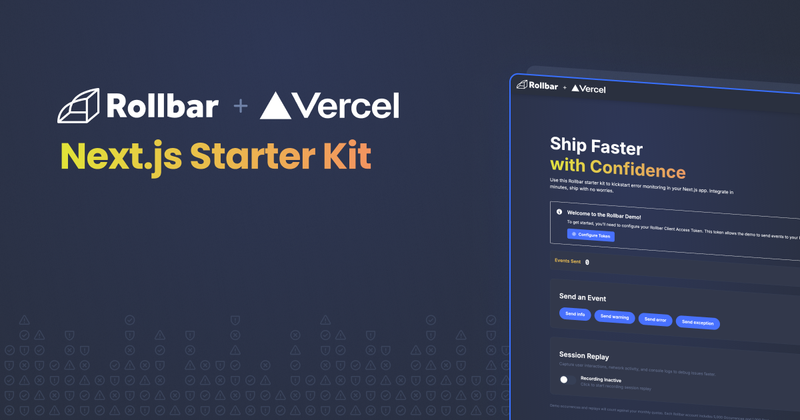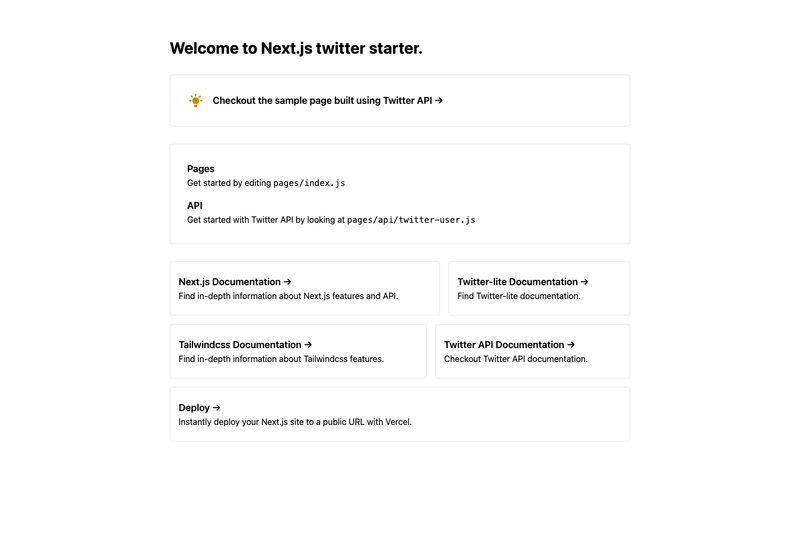
This starter template is a boilerplate for building applications that interact with the Twitter API, providing a pre-configured Next.js project with Tailwind CSS and the twitter-lite client. It includes a ready-to-use API endpoint and an example page so you can fetch and display Twitter user data with minimal setup.
What is the Next.js Twitter Starter Kit?
This is a starter kit/boilerplate that pairs Next.js with the Twitter API through the twitter-lite library. As input, it accepts a Twitter handle (via a POST request to the /api/twitter-user endpoint); as output, it returns the user's screen name, display name, and profile image URL in JSON format. The template runs on Next.js, uses Tailwind CSS for styling, and is deployed on Vercel according to the included instructions. The repository has 28 GitHub stars at the time of this analysis.
Key Features
- Next.js framework — Uses the React-based Next.js framework with file-system routing and API routes; entry pages are at pages/index.js and pages/api/twitter-user.js.
- Tailwind CSS — Utility-first styling via Tailwind CSS, pre-configured for rapid UI development.
- twitter-lite integration — Lightweight Twitter API client that handles authentication and request signing.
- Environment-based configuration — Twitter consumer key, secret, bearer token, and a test handle are stored in .env.local and read as environment variables.
- Sample API route — Endpoint at /api/twitter-user accepts JSON POST bodies with a twitterHandle field and returns user profile information.
- Example Twitter card page — The /twitter page renders a card showing profile details for the user set in TEST_TWITTER_HANDLE.
- Authentication documentation — The README explains the difference between App and User authentication, including which tokens each requires.
Who is it for?
- Web developers — Build Twitter-connected apps quickly without setting up boilerplate from scratch.
- Next.js learners — See a working example of API routes and environment variables in a real project.
- Twitter API integrators — Get a reference implementation of App and User authentication flows.
What can you do with the Next.js Twitter Starter Kit?
- Twitter profile lookup — Send a POST request to /api/twitter-user with a handle to retrieve user info as JSON, which you can integrate into a search or stats feature.
- Display Twitter cards — Use the provided /twitter page to show a user's avatar, name, and handle in a clean card layout.
- Extend the API — Use the configured twitter-lite client and environment variables to add more Twitter endpoints, such as fetching tweets or timelines.
How does the Next.js Twitter Starter Kit work?
After cloning the repository, create a .env.local file and populate it with your Twitter developer keys: TWITTER_CONSUMER_KEY, TWITTER_CONSUMER_KEY_SECRET, TWITTER_BEARER_TOKEN, and TEST_TWITTER_HANDLE. Install dependencies with yarn install, then run yarn dev to start the dev server. The sample API reads the twitterHandle from the POST body, authenticates with the bearer token, and responds with user data. The example page at /twitter renders the user specified by the test handle.
FAQ
Do I need a Twitter developer account to use this starter?
Yes, you must create a Twitter developer account and a standalone app on developer.twitter.com to obtain your consumer key, consumer secret, and bearer token, then add them to your .env.local file.
What is the difference between App and User authentication here?
App authentication uses only a bearer token and has higher rate limits, while User authentication needs consumer keys plus access token key and secret. The included example uses App authentication; the README details how to configure User authentication if needed.
Can I deploy this project to Vercel?
Absolutely. The README points to Vercel as the easiest deployment platform for Next.js apps. You'll need to set the same environment variables in your Vercel project dashboard.
How do I test the API with Postman?
Send a POST request to http://localhost:3000/api/twitter-user with the JSON body {"twitterHandle": "SDinesh91"} and set the Content-Type header to application/json. The response will include screen_name, name, and profile_image_url.