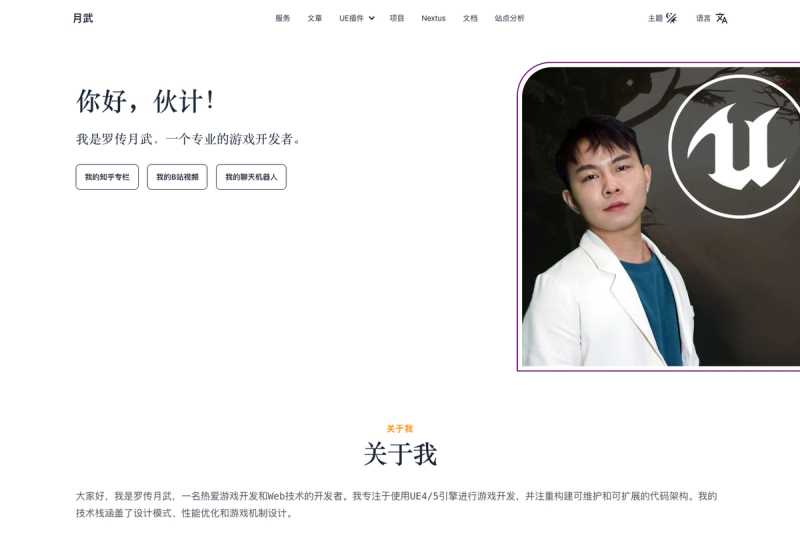
Nextus is a Next.js 13 website template paired with the Directus headless CMS that produces a multi-language site with blog, projects, page builder, forms, and search. It is open source and designed to let developers spin up a complete content-managed website by connecting a Directus backend to a ready-made frontend.
What is Nextus?
Nextus is a full-featured website template built on Next.js 13 and TypeScript, using Directus as its content backend. The template takes a configured Directus instance (cloud or self-hosted) and a set of environment variables, and renders a production-ready frontend with pages, blog posts, project listings, contact forms, and global search. It is maintained by luochuanyuewu and was originally derived from the AgencyOS template by Bryant Gillespie, then extended in its own direction.
Key Features
- Multi-language support — Ships with English and Chinese translations; languages are managed through a Directus model, and more languages can be added (though only en/zh are currently used in the frontend).
- Directus headless CMS integration — Uses the new Directus TypeScript SDK; the backend exposes REST and GraphQL APIs, and the repository includes a schema snapshot that sets up the required data models automatically.
- Dynamic Page Builder — Creates pages through Directus' M2A (many-to-any) interface, so editors assemble page sections from blocks without touching code.
- Blog and projects modules — Includes blog posts with categories and project pages; all content is authored in Directus and rendered by Next.js.
- Dynamic form generation with validation — Forms are defined in the CMS and rendered with React Hook Form, including validation rules.
- Theming and styling — Tailwind CSS with Typography and Forms plugins, plus DaisyUI themes that can be switched without changing layout code.
- Backend-managed translations — Frontend UI strings are fetched from Directus, so translators can update labels without redeploying the frontend.
- Global search — Includes a search component and API route that queries content served by Directus.
Who is it for?
- Developers who want to launch a content-driven website without building the frontend from scratch; they can fork the repo, connect Directus, and customize components and styling.
- Content teams and editors who manage blog posts, pages, navigation, and translations through Directus' no-code admin app.
- Freelancers and agencies that need a reusable multi-language site for clients, with page builder, forms, and theme switching built in.
What can you do with Nextus?
- Launch a corporate or marketing site — use the page builder to assemble landing pages, control page width from the backend, and manage main/footer navigation directly in Directus.
- Run a blog — write posts with categories in Directus, and get an SEO-ready blog page with dynamic social image generation.
- Sell access to content — the payment module supports pay-per-view articles or pages, and token-based access control protects file downloads.
- Generate content with AI — roadmap items show AI-powered content writing and image generation integrated inside Directus, so editors can create posts without leaving the CMS.
How does Nextus work?
- Set up Directus via Directus Cloud or self-hosting, and apply the provided schema snapshot (or use the nextus-docker project for automatic schema setup).
- Add required content: languages, a page with the slug "home", a top navigation with slug "main", a footer navigation with slug "footer", and global settings.
- Fork the Nextus frontend, connect it to Vercel, and configure environment variables with your Directus URL and project details.
- Content added in Directus automatically appears on the Next.js site.
FAQ
Is Nextus free?
Yes, the template is open source under an MIT-licensed Next.js foundation, and the Directus backend can be self-hosted for free or used via Directus Cloud's paid tiers. You only pay for hosting services you choose.
Does Nextus require Directus?
Yes, Directus is the content backend for Nextus. Without a configured Directus instance, the frontend cannot display pages, blog posts, or forms, since all data and translations are fetched from Directus APIs.
Which languages are supported?
The template currently includes English and Chinese. The data model supports adding more languages in the Languages model, but only en and zh are implemented in the frontend code at this time.
Can I change the theme without editing CSS?
Yes, DaisyUI provides many themes, and Nextus includes theme switching so you can swap between them without modifying Tailwind configuration. The template also uses Tailwind's Typography and Forms plugins for consistent styling.
Is there a demo site?
Yes, the README links to a live demo at nextus.vercel.app, hosted on Vercel, so you can explore the default template before setting up your own instance.