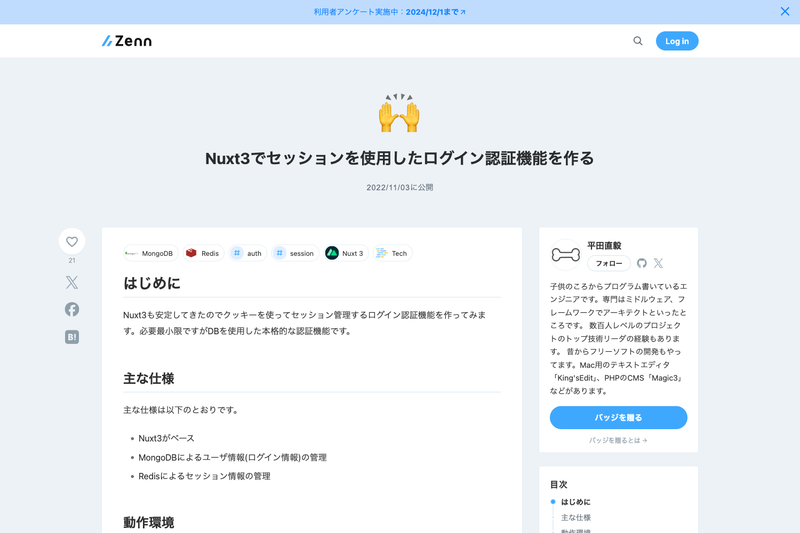
The Nuxt 3 Authentication Demo is a session-based login application that demonstrates how to authenticate users in Nuxt 3 with Redis as the session store and MongoDB as the user database.
What is Nuxt 3 Authentication Demo?
This demo project implements a login flow in Nuxt 3 using server-side sessions. It takes user credentials through a login form, validates them with vee-validate, and stores session data in Redis while user records live in MongoDB. The application runs on Node 16 and above, requires Redis 7 and MongoDB 6, and is released under the MIT license. Its repository metadata lists the stack topics: auth, daisyui, mongodb, nuxt3, redis, session, tailwind, and vee-validate.
What makes Nuxt 3 Authentication Demo stand out?
- Session-based authentication — Uses Redis 7 for session storage, giving the demo real server-side sessions rather than token-only auth.
- MongoDB user store — User records are stored in MongoDB 6, seeded from a
data/user.jsonfile viamongoimport. - Nuxt 3 framework — Built on the Nuxt 3 module system and supports
yarn devandyarn buildworkflows, with a development server at http://localhost:3000. - Tailwind CSS and DaisyUI — The UI is styled with Tailwind CSS and the DaisyUI component library, as listed in the project topics.
- vee-validate form validation — Uses vee-validate for client-side validation of login fields, a dependency visible in the project topics.
- Environment-driven configuration — Session and database connections are configured through a
.envfile withSESSION_REDIS_URLandMONGO_URLvariables.
Who is it for?
- Nuxt 3 developers wanting a working reference for implementing session-based authentication in a Nuxt 3 app.
- Full-stack developers using Redis and MongoDB who need to see how these services integrate with Nuxt 3.
- Developers evaluating auth patterns who want a minimal, MIT-licensed demo they can fork and modify.
What can you do with it?
- Learn session auth: Follow the login flow and session handling in Nuxt 3 to understand how Redis sessions protect routes.
- Seed a user collection: Use the provided
data/user.jsonandmongoimportcommand to populate a MongoDB database for testing. - Run a local auth demo: Install dependencies, set environment variables, and start the dev server at localhost:3000 to see session creation and validation in practice.
FAQ
What Node version does this demo require?
The environment section states Node v16.0 or above.
How do I set up the database?
Run mongoimport --drop --db sampleDB --collection user --file data/user.json to import the sample users, then set MONGO_URL in .env to point to your MongoDB instance.
Does the demo use JWT or sessions?
It uses session-based authentication backed by Redis. The repository meta lists session, redis, and the .env includes SESSION_REDIS_URL, confirming server-side session storage.
How do I start in production?
After yarn build or npm run build, launch with yarn start or npm start.