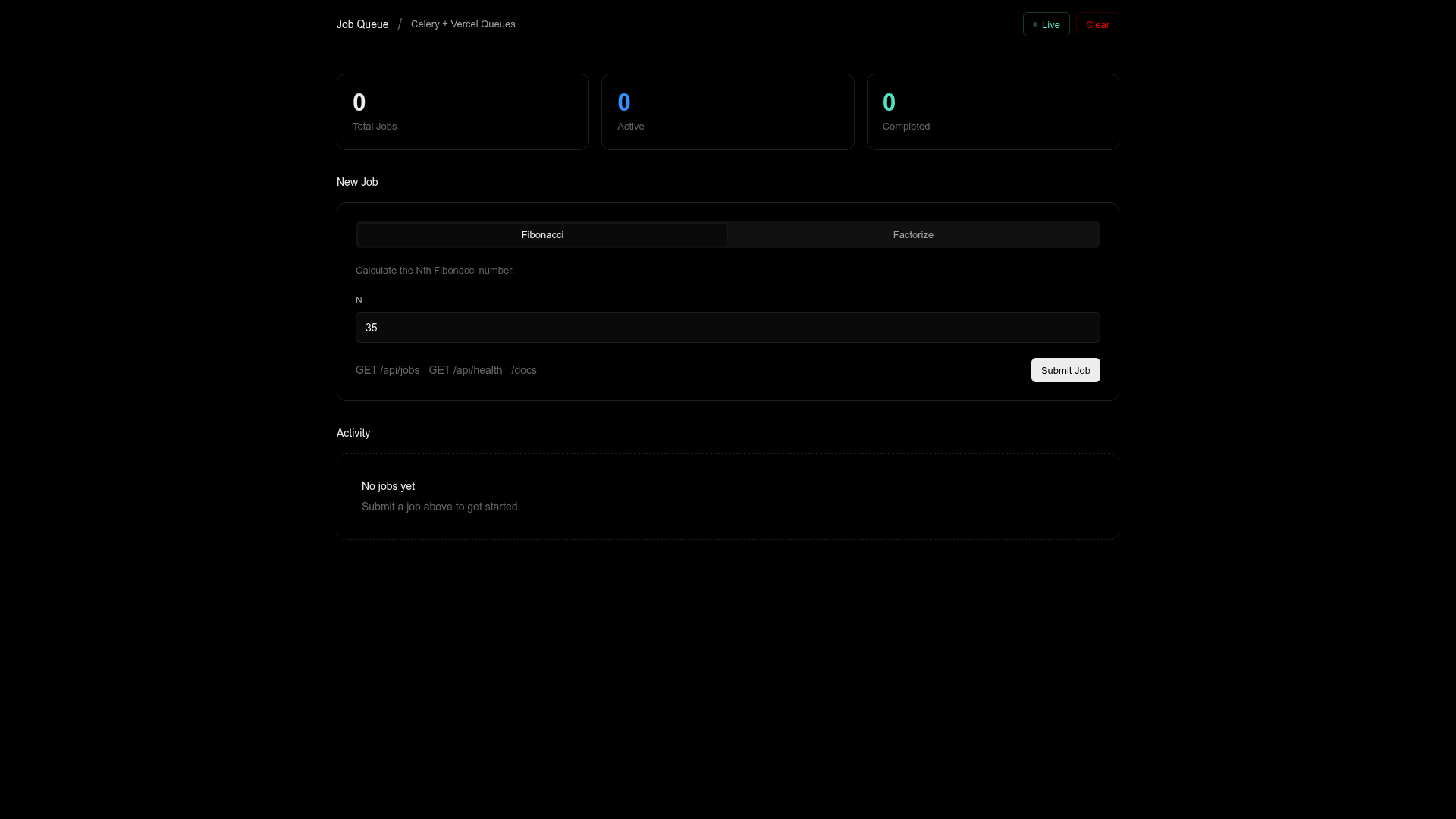
Python Celery Starter is a Vercel example template that demonstrates how to run Celery workers on Vercel's Python Runtime using Vercel Queues and Vercel Runtime Cache, with a live demo at https://vercel-plus-celery.labs.vercel.dev/.
What is Python Celery Starter?
Python Celery Starter is a boilerplate from Vercel's curated examples collection. Its core function is to show how Celery, a distributed task queue, can run on serverless Python Functions without managing a dedicated broker. The template takes Celery task definitions and delivers them through the vercel:// broker to a subscriber worker service; output is a web dashboard where jobs can be queued, monitored, and inspected. It is built by Vercel and included in the official examples repository.
Key Features
- Vercel Queues integration — Celery uses the vercel:// broker, so submitted tasks are delivered through Vercel Queues to the worker service, replacing a traditional Redis or RabbitMQ broker.
- Vercel Runtime Cache — Job status and results are stored in Vercel Runtime Cache and presented on the dashboard.
- FastAPI entrypoint — The FastAPI app is declared as the Vercel Python entrypoint in pyproject.toml, making the app deployable as serverless functions.
- Celery subscriber service — The Celery app is declared as a subscriber service for the jobs topic, a pattern you can reuse in your own serverless architecture.
- One-Click Deploy — Deploy the template to Vercel without leaving the browser by cloning the GitHub repository via the Deploy with Vercel button.
- Local development workflow — Install the Vercel CLI and run vercel dev; the Celery app is then available at http://localhost:3000.
- External broker compatibility — If you run Celery outside Vercel, set the CELERY_BROKER_URL environment variable to your preferred broker.
Who is it for?
- Python developers deploying background jobs — Use this template to run long-running tasks such as email delivery, image processing, or data aggregation on Vercel's serverless infrastructure.
- Teams already invested in Celery — The template preserves the familiar Celery API while swapping the transport to Vercel Queues, so existing task code can be ported with minimal changes.
- Architects evaluating Vercel Queues — This example provides a concrete reference implementation of a subscriber service plus Runtime Cache, so you can assess whether the pattern fits your workload.
Use cases
- Task queue demos — Queue jobs from the included dashboard and watch them progress in real time to see Celery and Vercel Queues in action.
- Serverless background processing — Offload work from request/response functions to Celery workers, storing results where the dashboard can read them.
- Local experimentation — Run the full application locally with vercel dev to test task submission and result inspection before deploying.
How does it work?
The FastAPI app is the entrypoint, and the Celery app subscribes to the jobs topic. When a job is submitted, Celery sends a message through the vercel:// broker; the worker service receives it, executes the task, and writes status and result into Vercel Runtime Cache. The dashboard polls that cache to show live progress and final output.