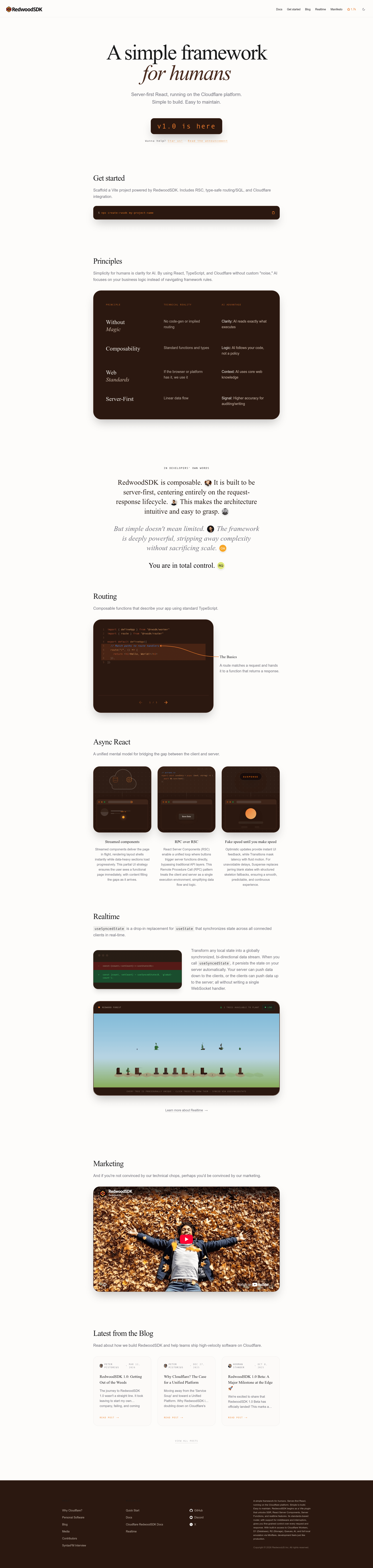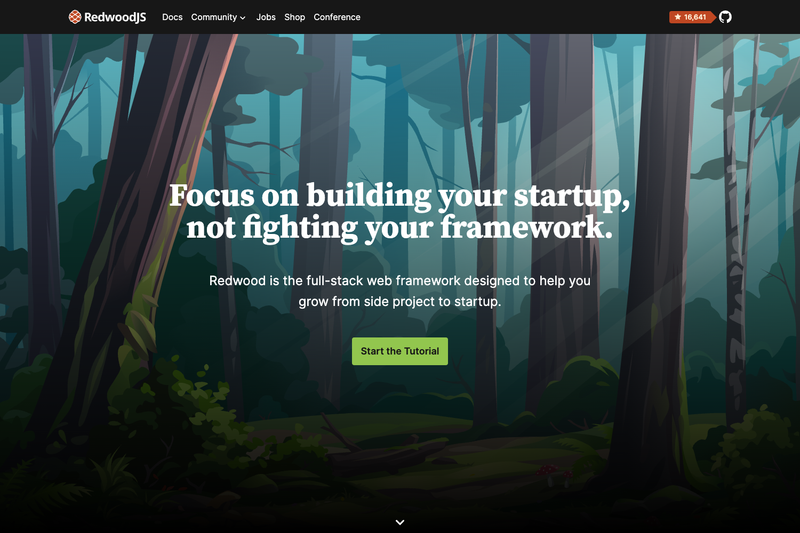
RedwoodJS is an opinionated, full-stack JavaScript/TypeScript web application framework that pairs a React frontend with a custom GraphQL API and Prisma-backed database, designed to take an app from side project to startup.
What is RedwoodJS?
RedwoodJS is an open-source web framework initiated by Tom Preston-Werner, cofounder of GitHub and creator of Jekyll and Gravatar. It takes as input a standard Redwood project created with the CLI and produces a full-stack application with a React frontend, a GraphQL API, and database integration via Prisma. The framework is built entirely with TypeScript, though JavaScript projects are supported, and it runs on both serverless providers like Netlify and Vercel and traditional servers like AWS and Render with minimal code changes.
Key Features
- Full-stack architecture — Includes a React frontend, a custom GraphQL API, and Prisma ORM out of the box, so you don't need to assemble the stack yourself.
- Declarative data fetching — Built on React Server Components and Server Actions to simplify data loading and form submission, letting you choose server or client execution for each piece of code.
- Built-in testing and logging — Jest is integrated for testing, Pino for logging, and Storybook for a UI component catalog.
- One-command setup — Authentication providers like Auth0 and CSS frameworks like Tailwind CSS can be added with a single command line invocation.
- Deployment flexibility — Deploy to serverless providers (Netlify, Vercel) or traditional servers and containers (AWS, Render) with nearly no code changes between the two.
- Optional GraphQL stack — When you use the built-in GraphQL API, the stack includes GraphQL Yoga, Envelop, and Apollo Client.
Who should use RedwoodJS?
- Startup founders — Build a full-stack MVP quickly with the Redwood Tutorial and Quick Start, focusing on features instead of configuring tools.
- Full-stack developers — Use one framework for React UI, GraphQL API, and Prisma database access with type safety from router to database.
- Hackathon participants — Get a runnable full-stack app with a couple of commands, thanks to the CLI and integrated tooling.
- Teams needing RSC — Leverage React Server Components and Server Actions for modern data fetching without assembling the pieces manually.
What can you do with RedwoodJS?
- Prototype an idea: Scaffold a complete React + GraphQL + Prisma app with the Quick Start and go through the tutorial.
- Build a data-driven application: Use transparent data fetching and the optional GraphQL API to grow your app from prototype to startup.
- Deploy to any target: Move between serverless and traditional providers without rewriting your code.
How does RedwoodJS work?
Start by installing and running a full-stack Redwood app with a couple of commands from the Quick Start guide. Next, follow the Redwood Tutorial to build a complete application. The framework's CLI handles project generation, and you can add authentication or CSS frameworks with a single invocation.
FAQ
Is RedwoodJS free?
RedwoodJS is an open-source project on GitHub, so it is free to use. You can inspect the code and contribute to the repository, which has over 250 contributors.
What is the Bighorn Epoch?
The Bighorn Epoch is the current development epoch described in the README. It focuses on declarative data fetching and simple form submission built on React Server Components and Server Actions; it has not yet had a production release, but canary versions are published for experimentation.
What technologies does RedwoodJS use?
A standard Redwood app uses React, Vite, Prisma, Jest, Storybook, and Pino. The optional GraphQL API uses GraphQL, GraphQL Yoga, Envelop, and Apollo Client.