Newsletter
Join the Community
Subscribe to our newsletter for the latest news and updates

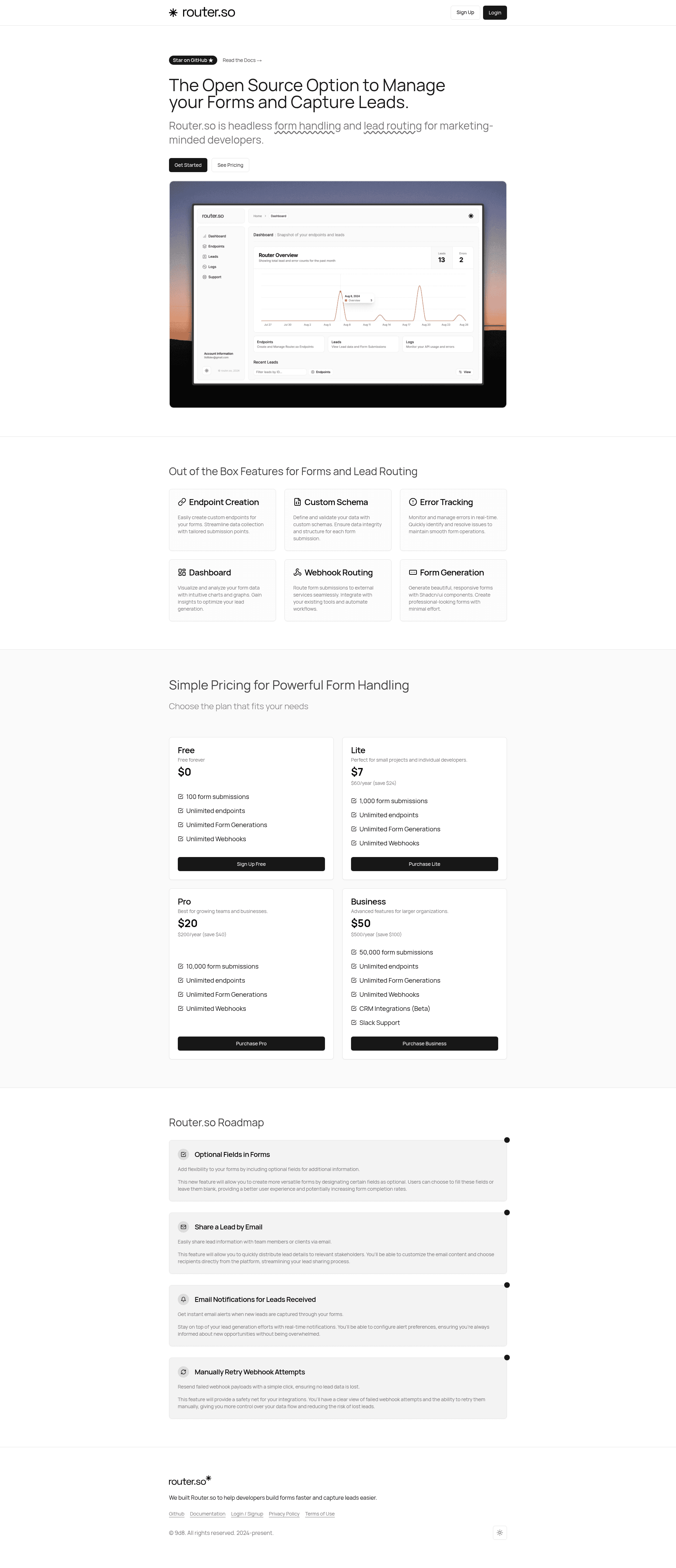
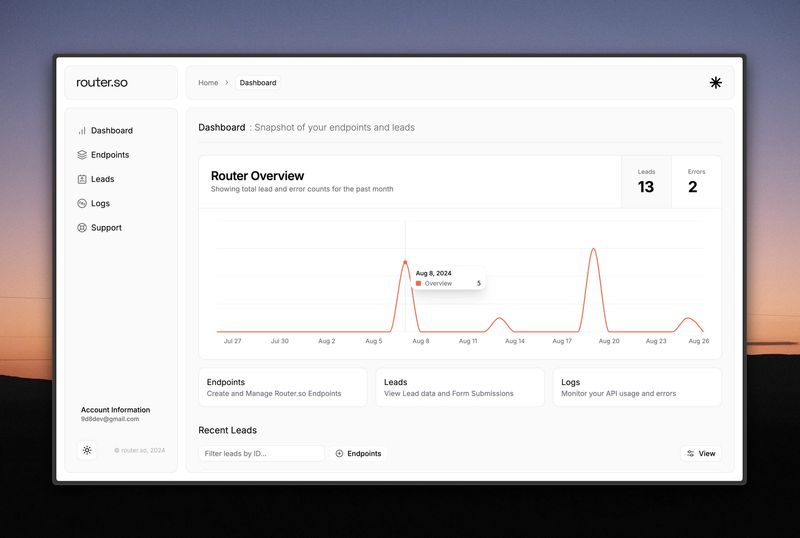
Open source, self-hostable form backend for headless form handling and lead routing, built with Next.js and PostgreSQL.
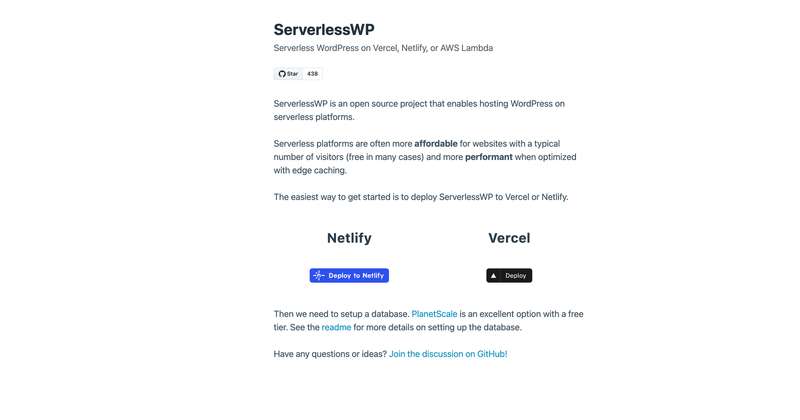
Open-source template that runs WordPress in serverless functions on Vercel, Netlify, or AWS Lambda, with a SQLite database stored in Vercel Blob or S3.

Pure-Go, no-cgo HTML-to-PDF and HTML-to-image engine with a wkhtmltopdf-style CLI, Go library, and Python bindings.
Router.so is an open source form backend that accepts form submissions on a headless endpoint contract and routes each lead onward, with optional first-class forms published at forms.router.so, embedded in an approved website, or rendered through a bundled WordPress block and shortcode.
Router.so is headless form handling and lead routing for marketing-minded developers, maintained as an open source project in the routerso/router GitHub repository. It receives form submissions through a headless endpoint and routes them as leads, using Resend to deliver email. The application runs on Next.js with a PostgreSQL database, and the repository carries roughly 382 GitHub stars.
pnpm dev starting the local development server.pnpm db:generate and applied via pnpm db:migrate.docker compose up after configuring environment variables.Self-hosting requires a Resend account, a Vercel account, and a PostgreSQL database. Configure the environment variables (RESEND_API_KEY, NEXTAUTH_SECRET, NODE_ENV, POSTGRES_URL) after copying .env.example to .env.local, then either install with pnpm install --frozen-lockfile, run pnpm db:generate and pnpm db:migrate, and start with pnpm dev, or run docker compose up. Deploying to Vercel means pushing to GitHub, connecting the repository, and setting the same environment variables in the Vercel dashboard.
pnpm.overrides, so pnpm is effectively required.Router.so is released as open source software that you self-host. The page lists no subscription tiers or paid plans; running it requires your own Resend account for email and a PostgreSQL database.
Formspree is a hosted form backend that requires no self-hosting or database, whereas Router.so is an open source app you deploy yourself.
Router.so is open source and self-hosted, with no paid tiers listed on the page. You still need accounts with Resend, a host such as Vercel, and a PostgreSQL database, so infrastructure costs are yours.
The repository requires Node.js 20.9.0 or newer. It also expects pnpm, because the pnpm.overrides block in package.json pins transitive dependencies to patched versions that npm and yarn would otherwise ignore.
Yes. Router.so ships a WordPress block and shortcode so forms can be rendered inside a WordPress site, in addition to being published on forms.router.so or embedded in an approved website.
Yes. Run pnpm install --frozen-lockfile, generate and run database migrations with pnpm db:generate and pnpm db:migrate, then start the server with pnpm dev. A Docker path exists too: docker compose up.