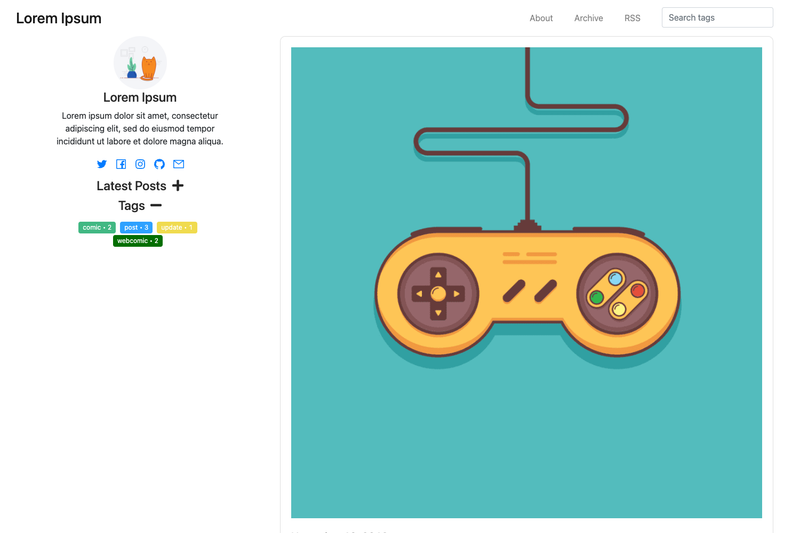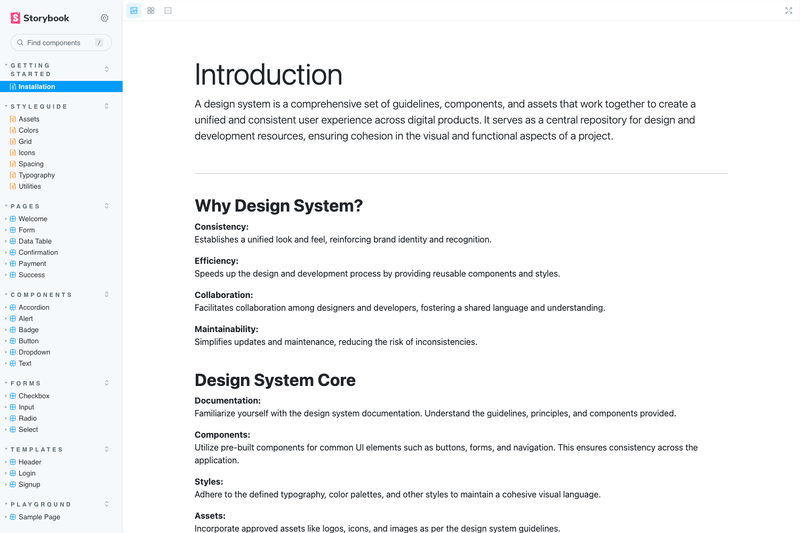
Storybook HTML is a GitHub repository template that pre-configures Storybook for building and documenting HTML, CSS/SCSS components with built-in linting.
What is Storybook HTML?
Storybook HTML is a ready-to-use repository template that demonstrates how to use Storybook for HTML and CSS/SCSS projects. It provides a fully configured Storybook environment where developers can create and document UI components in isolation. The template inputs are HTML, CSS/SCSS, and JavaScript source files, and it outputs an interactive Storybook interface that serves as a living style guide. It runs on Node.js and relies on npm for dependency management.
Key Features
- Storybook Integration — Storybook is pre-configured to work with plain HTML and SCSS, allowing component-driven development without a JavaScript framework.
- Living Style Guide — The repository is tagged as a living style guide, meaning it can serve as a central reference for design tokens, components, and patterns.
- Built-in Linting — Validation for HTML, CSS/SCSS, and JavaScript is included via HTMLHint, stylelint, and ESLint, with a single
npm run testcommand to run all checks. - Editor Support — The template documents the recommended VSCode extensions for HTMLHint, stylelint, and ESLint, enabling inline error highlighting.
- Template Reusability — The project is explicitly intended to be used as a template, so you can generate a new repository from it for each project.
- Hacktoberfest Friendly — With the hacktoberfest topic, the repository is open to contributions during Hacktoberfest.
Who is it for?
- Front-end developers who want to build a component library or design system using plain HTML and SCSS, without adopting a heavyweight JavaScript framework.
- Web designers who need a lightweight environment to prototype and document UI elements in isolation while keeping CSS/SCSS maintainable.
- Open source contributors looking for a well-structured Storybook setup to fork or extend for their own static sites or email templates.
What can you do with Storybook HTML?
- Build a living style guide: Create stories for each HTML component and let Storybook render them in an organized, searchable interface.
- Validate code quality: Run
npm run testto lint HTML, CSS/SCSS, and JavaScript in one pass, catching syntax errors early. - Speed up onboarding: Use the template as a starting point for a new project, avoiding the manual configuration of Storybook and linting tools.
How does Storybook HTML work?
First, install dependencies with npm install. Then start the Storybook development server with npm run storybook. During development, write stories for your HTML components, and Storybook serves them in a live preview. To validate the code, run npm run test which invokes HTMLHint, stylelint, and ESLint on the appropriate file types.