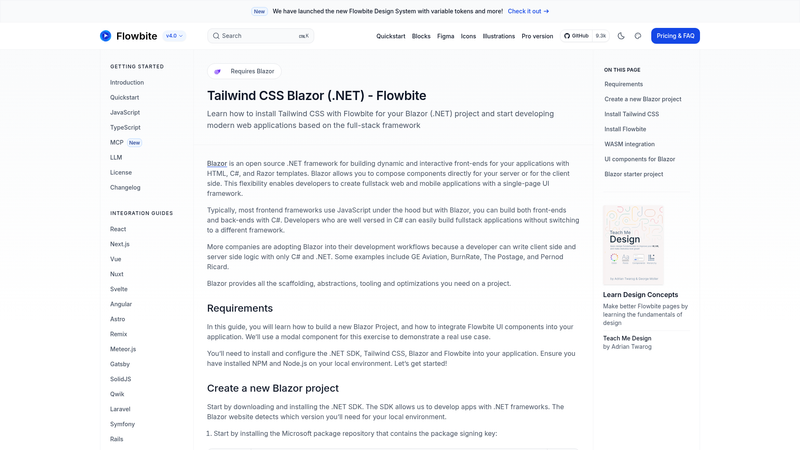
Tailwind CSS + Blazor.NET + Flowbite Starter is an open-source boilerplate that pre-configures Tailwind CSS and Flowbite UI components inside a Blazor.NET project so you can start building web applications without wiring up the front-end toolchain yourself.
What is the Tailwind CSS + Blazor.NET + Flowbite Starter?
The Tailwind CSS + Blazor.NET + Flowbite Starter is a GitHub-hosted starter project that combines the Blazor.NET framework with Tailwind CSS utility classes and the Flowbite component library. It takes a fresh Blazor project skeleton and adds the configuration files and scripts needed to compile Tailwind CSS and load Flowbite's interactive components. The output is a runnable Blazor app with a compiled CSS file and a sample dropdown component that you can edit and extend. The project is released under the MIT license and is maintained as part of the Flowbite ecosystem.
Key Features
- Blazor Server and WebAssembly support — the repository metadata lists both blazor-server and blazor-client, so the same starter works for Blazor Server apps and Blazor WebAssembly apps.
- Tailwind CSS compilation — includes a ready-to-run build command (
npx tailwindcss -i wwwroot/css/input.css -o wwwroot/css/output.css --watch) that watches your source CSS and regenerates the output stylesheet as you edit classes. - Flowbite components — ships with a working dropdown example in Pages/Index.razor that uses Flowbite's data attributes (
data-dropdown-toggleanddata-dropdown-trigger) to toggle visibility on hover or click. - NPM dependency management — front-end dependencies are installed with a single
npm installcommand; Node.js and NPM are the only JavaScript tooling required. - .NET build and watch — use
dotnet watchto launch the development server with hot reload, anddotnet buildto compile the full project and its dependencies. - MIT open-source license — the starter can be freely used, modified, and redistributed, including in commercial projects.
- Flowbite documentation links — the README points to Flowbite's Blazor integration guide and the flowbite-blazor GitHub repository for deeper customization.
Who should use the Tailwind CSS + Blazor.NET + Flowbite Starter?
This starter is aimed at .NET developers who want to adopt Tailwind CSS without manually setting up the Tailwind build process. It's also useful for Blazor developers who want ready-made, accessible UI components like navbars, buttons, and modals from Flowbite instead of writing all markup from scratch. Because it targets both Blazor Server and Blazor WebAssembly, teams that ship both hosting models can share the same base configuration. It also suits frontend developers familiar with Tailwind who are starting a Blazor project and want a minimal, well-documented foundation.
What can you do with this starter?
- Blazor developers: scaffold a new app with utility-first CSS and interactive Flowbite components by cloning the repo and running the two setup commands.
- Prototyping teams: build functional UI prototypes in C# and Razor without spending time wiring up a separate front-end build system.
- Learners: follow the included dropdown example and Flowbite's Blazor guide to see exactly how Flowbite's JavaScript-powered components work inside Razor files.
How does the starter work?
First, install Node.js and the .NET SDK on your machine. Then run npm install to fetch the front-end dependencies. In one terminal run dotnet watch to compile and serve the Blazor application, and in a second terminal run the npx tailwindcss command to watch and compile the Tailwind CSS. After that, you can open Pages/Index.razor and start editing markup; Flowbite components are added by copying their HTML into your Razor files, as demonstrated by the dropdown example.
Pros and cons
Pros:
- Free under the MIT license with no attribution or licensing fees.
- Ready-made Tailwind + Flowbite integration saves configuration time.
- Supports both Blazor Server and Blazor WebAssembly from a single starter.
Cons:
- Requires Node.js and NPM because the Tailwind CSS compilation relies on the Tailwind CLI.
- The development workflow runs two concurrently watching processes (
dotnet watchandnpx tailwindcss), which adds a little operational overhead compared to an all-in-one build.
Pricing
The starter is free and open-source under the MIT license.
Alternatives
- Blazorise — a Blazor UI component library with its own styling system and support for multiple CSS frameworks.
- MudBlazor — a Material Design-based component library for Blazor that provides a large set of ready-made UI components.
FAQ
Is the Tailwind CSS + Blazor.NET + Flowbite Starter free?
Yes, the project is released under the MIT license, so it is free to use, modify, and redistribute, including for commercial applications.
What prerequisites do I need to run it?
You need Node.js and NPM installed to handle front-end dependencies, and the .NET SDK to build and run the Blazor application. Both are required for the npm install, dotnet watch, and npx tailwindcss commands.
Does it work with Blazor WebAssembly?
Yes. The repository's topics include blazor-client, which refers to Blazor WebAssembly, alongside blazor-server. The starter's configuration is hosting-model agnostic, so the same setup works for both Blazor Server and Blazor WebAssembly.
How do I add a Flowbite component?
Copy the component's markup from the Flowbite documentation into your Razor file. The starter includes a dropdown as an example, and you can import other components by adding the corresponding HTML and data attributes to your pages.
How do I compile the Tailwind CSS?
Run the command npx tailwindcss -i wwwroot/css/input.css -o wwwroot/css/output.css --watch from the project root. This watches the input CSS file and regenerates the output stylesheet whenever you change classes.