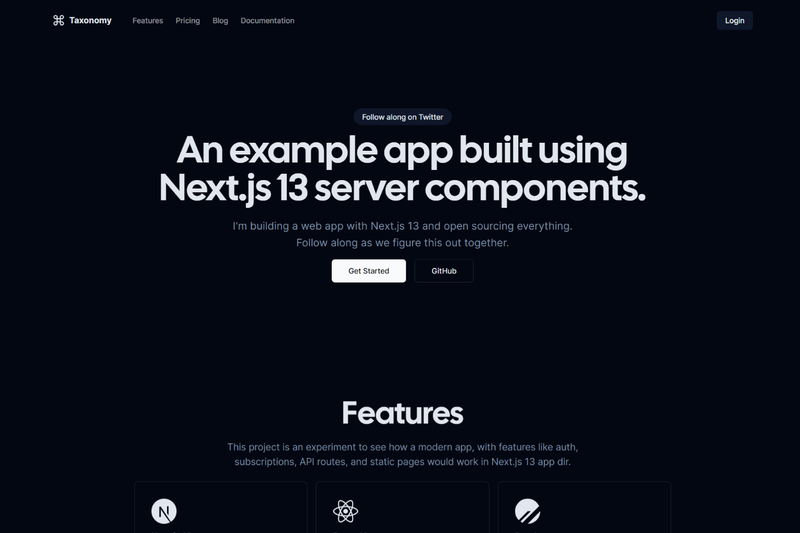
Taxonomy is an archived open-source Next.js 13 boilerplate that demonstrates the App Router, server components, and a complete SaaS stack including authentication, subscriptions, and MDX content.
What is Taxonomy?
Taxonomy is an open-source application built by shadcn to explore the Next.js 13 App Router and server components. It takes environment variables for configuration and produces a full-stack web app with marketing pages, documentation, a blog, user authentication, and Stripe subscriptions. The project is written in TypeScript and is released under the MIT license. The repository has over 19,000 GitHub stars.
Key Features
- App Router — Uses the new
/appdirectory with routing, layouts, nested layouts, layout groups, loading UI, and route handlers. - Authentication — NextAuth.js integration for user authentication, with email-based login as a workaround for GitHub auth issues noted in the readme.
- Database and ORM — Prisma ORM connected to a PlanetScale MySQL database.
- Subscriptions — Stripe integration for handling subscriptions and payments.
- Styling — Tailwind CSS for utility-first styling, with UI components built on Radix UI primitives.
- Content — MDX documentation and blog managed with Contentlayer, and Open Graph images generated with
@vercel/og. - Validation — Zod for schema validation in API routes and forms.
- Metadata and APIs — Metadata files, API routes, middleware, and both server and client components.
Who is it for?
- Next.js developers — Learn how the App Router, server components, and data fetching are organized in a realistic application.
- SaaS founders — Use a starting point that already includes authentication, a database, and Stripe billing.
- Technical writers — See how to structure MDX content with Contentlayer for docs and blogs.
What can you do with Taxonomy?
- Build a SaaS starter — Set up authentication, a PlanetScale database, and Stripe subscriptions with minimal additional work.
- Create a marketing site with blog and docs — The template includes pre-built marketing pages, an MDX blog, and documentation sections.
- Experiment with Next.js 13 patterns — See how layouts, loading UI, route handlers, and server components work together in a non-trivial codebase.
How does Taxonomy work?
Run it locally with pnpm. First install dependencies with pnpm install, then copy .env.example to .env.local and set your environment variables, and finally start the development server with pnpm dev. It is deployable to Vercel as a standard Next.js application.
Pros and cons
- Pros: MIT licensed, demonstrates a wide range of Next.js 13 features, integrates a full SaaS stack, and has substantial community recognition.
- Cons: The repository is officially archived and will not receive updates; the code may contain deprecated APIs and is not recommended for production environments.
Pricing
Taxonomy is free and open source under the MIT license.
FAQ
Is Taxonomy still maintained?
No. The project has been officially archived and will not receive updates. The author recommends checking Vercel's Next.js templates directory for current Next.js starters.
What stack does Taxonomy use?
It uses Next.js 13 with the App Router, TypeScript, Tailwind CSS, Radix UI, Prisma, PlanetScale, NextAuth.js, Stripe, Contentlayer, and Zod.
Can I use Taxonomy in production?
It is not recommended. The code does not reflect current best practices and may contain deprecated APIs or patterns.
Does Taxonomy include authentication and payments?
Yes. It integrates NextAuth.js for authentication and Stripe for subscriptions.