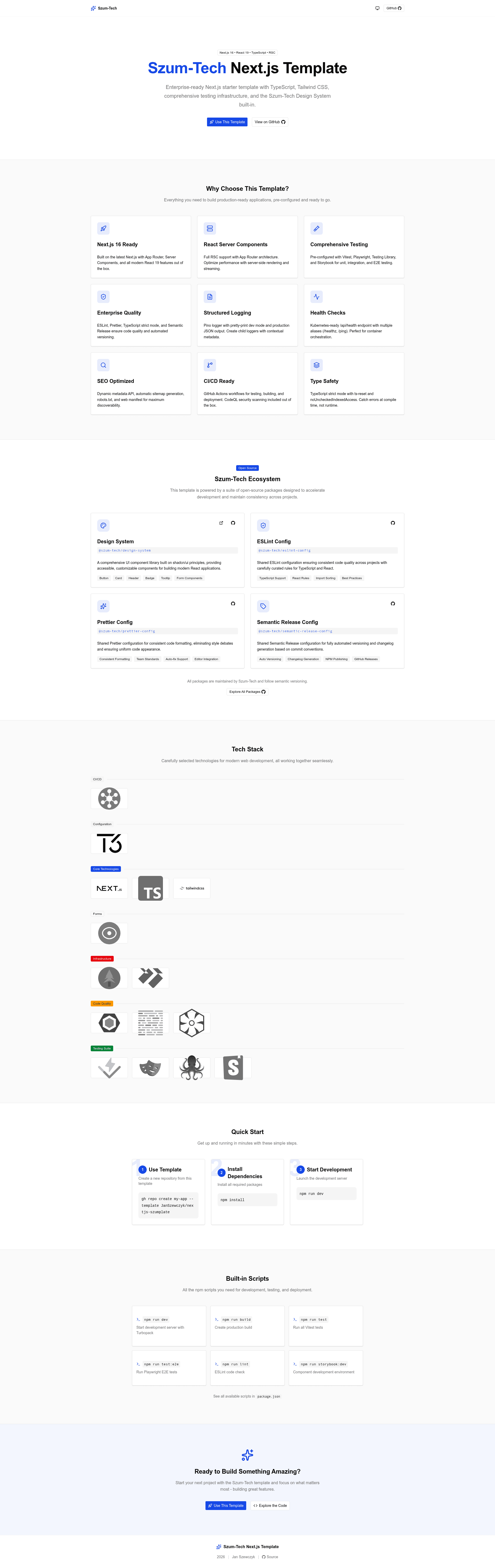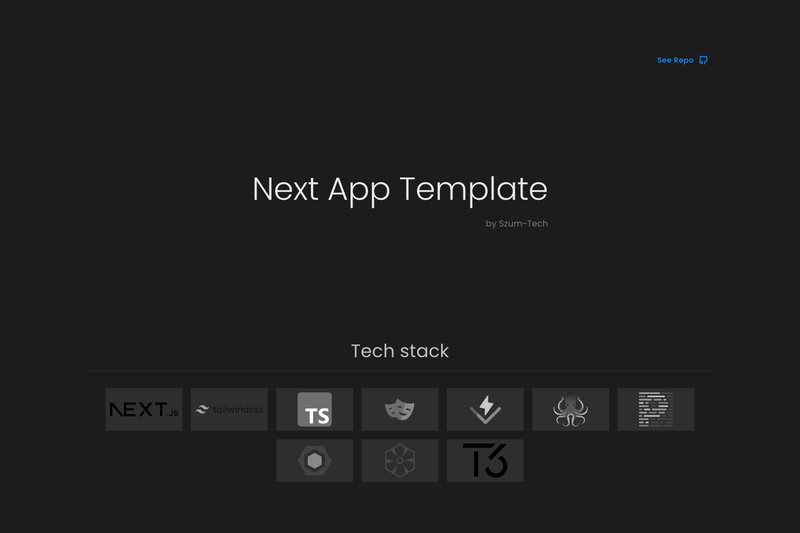
Next.js Szumplate is an open-source, enterprise-ready boilerplate built on Next.js 16 that bundles React 19, TypeScript, Tailwind CSS, and a complete testing and CI/CD toolchain into a single starter repository.
What is Next.js Szumplate?
Next.js Szumplate is a production-grade starter template created by Szum-Tech for building and scaling web applications. It scaffolds a Next.js App Router project with Server Components, Server Actions, and Turbopack builds, and comes pre-wired with typed environment variables, structured logging, health checks, and automated release workflows. The template is licensed under MIT and includes a one-click Deploy with Vercel button for launching the app directly from a GitHub repository.
Key Features
- React 19 with React Compiler — Automatic memoization removes the need to manually write useMemo, useCallback, or memo in app code.
- Tailwind CSS and Szum-Tech Design System — Utility-first styling with a CSS-first Tailwind config, plus an accessible Radix UI-based component library using an OKLCH semantic color palette.
- Type-safe environment variables — T3 Env and Zod validate server and client variables at build time; invalid configuration stops the build with a clear error instead of failing at runtime.
- Full testing stack — Vitest for unit tests, React Testing Library for component queries, Playwright for end-to-end tests, and Storybook with interaction tests and an accessibility addon, all exposed as dedicated npm scripts.
- CI/CD pipeline — GitHub Actions workflows run build, lint, type-check, unit, E2E, and Storybook tests on every pull request, plus CodeQL security scanning and dependency review.
- Semantic Release — Automated version bumps, CHANGELOG generation, and GitHub Release creation from Conventional Commits when code merges to main.
- Structured logging — Pino JSON logs with request ID tracking via the proxy middleware, client-side console fallback, and built-in logging in error boundaries and the health check route.
- Developer experience — Biome replaces ESLint and Prettier, the
~/path alias keeps imports clean, and next-themes handles dark, light, and system theme switching.
Who is Next.js Szumplate for?
Next.js Szumplate is aimed at development teams and individual developers who want a production-ready foundation instead of a minimal starter. Engineering teams can use it to enforce consistent code style, type safety, and security scanning from the first commit. Indie hackers and startups can ship a Vercel-hosted app quickly without configuring CI, testing, and releases manually. Frontend developers building component libraries will find the Storybook environment, accessible Radix-based components, and interaction tests already set up.
What can you do with Next.js Szumplate?
- Launch a new SaaS or internal tool: start from a Next.js 16 app that already has health check endpoints at /api/health, structured logging, and build-time environment validation.
- Build a design-system-driven interface: use the Szum-Tech components, Tailwind tokens, and Storybook stories to create accessible UI and document it as you go.
- Automate quality assurance and releases: every pull request triggers linting, type checking, unit, E2E, and Storybook tests, and merging to main can publish an automatically versioned release.
How does Next.js Szumplate work?
The repository requires Node.js version 24 or higher, npm, and Git. After cloning, you install with npm ci, copy the sample environment variables into .env.local, and start the dev server with npm run dev. A middleware file logs each request, separate routes expose health checks, and server-only guards fail the build if server code is imported into a client component.
Alternatives
Other Next.js starters exist for similar purposes. Create Next App is the official minimal scaffold from Vercel. Create T3 App focuses on type-safe full-stack applications with tRPC and Prisma. Next.js Szumplate differentiates itself with its bundled testing suite, semantic release automation, and a maintained design system.
FAQ
Is Next.js Szumplate free?
Yes. The project is open source under the MIT License, so it can be used freely in commercial and personal projects, modified, and redistributed.
What Node.js version is required?
Node.js 24 or higher is required, alongside npm and Git. The template relies on modern Next.js and React capabilities that need recent Node.js releases.
What testing tools are included?
Vitest, React Testing Library, Playwright, and Storybook. Each has separate npm scripts for unit, component, interaction, and end-to-end tests, with coverage reporting and CI mode support.
How do I deploy Next.js Szumplate?
Use the Deploy with Vercel button in the repository, connect your GitHub repository, configure required environment variables, and the app will be live with automatic CI/CD. The configuration also supports other hosting targets that run Next.js.
Does the template include a component library?
It integrates the Szum-Tech Design System, which provides accessible Radix UI components, an OKLCH semantic color palette, utility functions, and its own Storybook documentation site.