Tersa is an open-source AI workflow canvas that lets you drag, drop, connect, and run nodes to build AI-powered workflows, powered by the Vercel AI SDK Gateway.
What is Tersa?
Tersa is a visual AI playground that runs as a web app built on Next.js 15 with React 19. It takes a visual node graph as input and executes it as an AI workflow, sending data through text, image, or video models from over 25 providers via the Vercel AI SDK Gateway. The project is created by Hayden Bleasel and published under the Vercel Labs organization on GitHub, released under the MIT license.
Key Features
- Visual Workflow Builder — Create AI workflows by connecting nodes on a drag-and-drop canvas powered by ReactFlow.
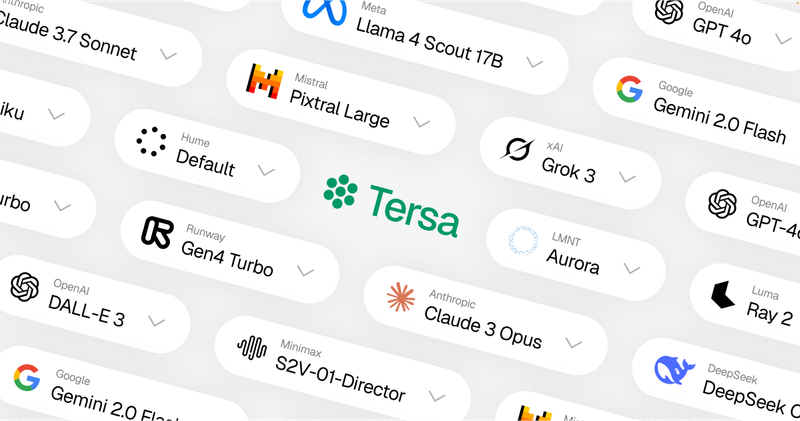
- Multi-Model Support — Access text, image, and video models from over 25 providers through the Vercel AI SDK Gateway.
- Cost Indicators — See relative pricing across models at a glance to compare provider costs.
- Reasoning Extraction — View model reasoning output for supported providers.
- Streaming Responses — Real-time text generation with streaming supported.
- Local Storage — Canvas state persists in the browser automatically, so your work survives page reloads.
- Tech Stack — Built with Next.js 15 (App Router, Turbopack), React 19, Tailwind CSS, shadcn/ui, Kibo UI, and Radix UI components, with TipTap for rich text editing and Vercel Blob for media storage.
Who is it for?
Tersa is for developers and builders who want to prototype AI workflows without writing custom orchestration code. AI engineers can quickly assemble multi-model pipelines to test provider performance. Product teams can use the visual canvas to communicate workflow logic to stakeholders. Indie hackers and educators can deploy Tersa as a free, open-source standalone tool for experiments or teaching.
What can you do with Tersa?
- AI engineers: Build and test multi-step AI pipelines by connecting nodes on the canvas, then run them with streaming responses to inspect model output.
- Product teams: Compare text, image, and video models from over 25 providers, using the built-in cost indicators to evaluate trade-offs before committing to a provider.
- Educators and learners: Use the visual node graph to demonstrate how AI workflows chain together, with local storage preserving example canvases between sessions.
How does Tersa work?
To run Tersa locally, clone the repository from GitHub, install dependencies with pnpm, create a .env.local file with AI SDK Gateway credentials and any provider API keys, and start the dev server with pnpm dev. In the app, add nodes from a toolbar, connect them by dragging from outputs to inputs, select a model, and run the workflow to process data through the AI models.
FAQ
Is Tersa free?
Yes. Tersa is open-source and released under the MIT license, so you can use, modify, and distribute it freely. You only pay for the AI provider API usage when you run workflows with your own keys.
What providers does Tersa support?
Tersa supports text, image, and video models from over 25 providers through the Vercel AI SDK Gateway. Exact provider availability depends on your AI SDK Gateway configuration and which API keys you have stored in your environment.
Do I need API keys to use Tersa?
Yes, to run workflows you need AI SDK Gateway credentials and API keys for the providers you want to use. These are stored in a local .env.local file when running the app yourself.
Can I save my Tersa workflows?
Yes, Tersa automatically saves the canvas state to your browser's local storage, so your workflow persists across page reloads.