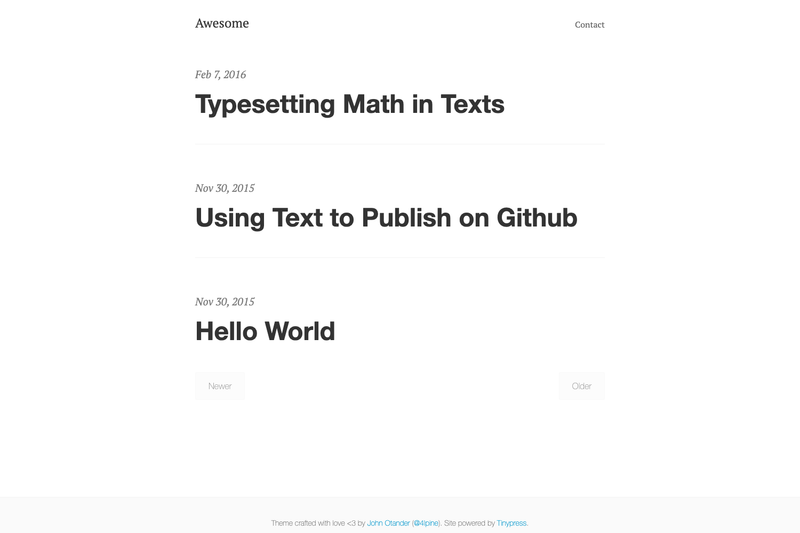
Tinypress is a Jekyll-based blog template for GitHub Pages, built from the Tinypress publishing service and created by GitHub user ishu3101. This static-site blog uses CSS for styling, includes three sample posts, and is intended to be hosted on GitHub Pages for free.
What is Tinypress?
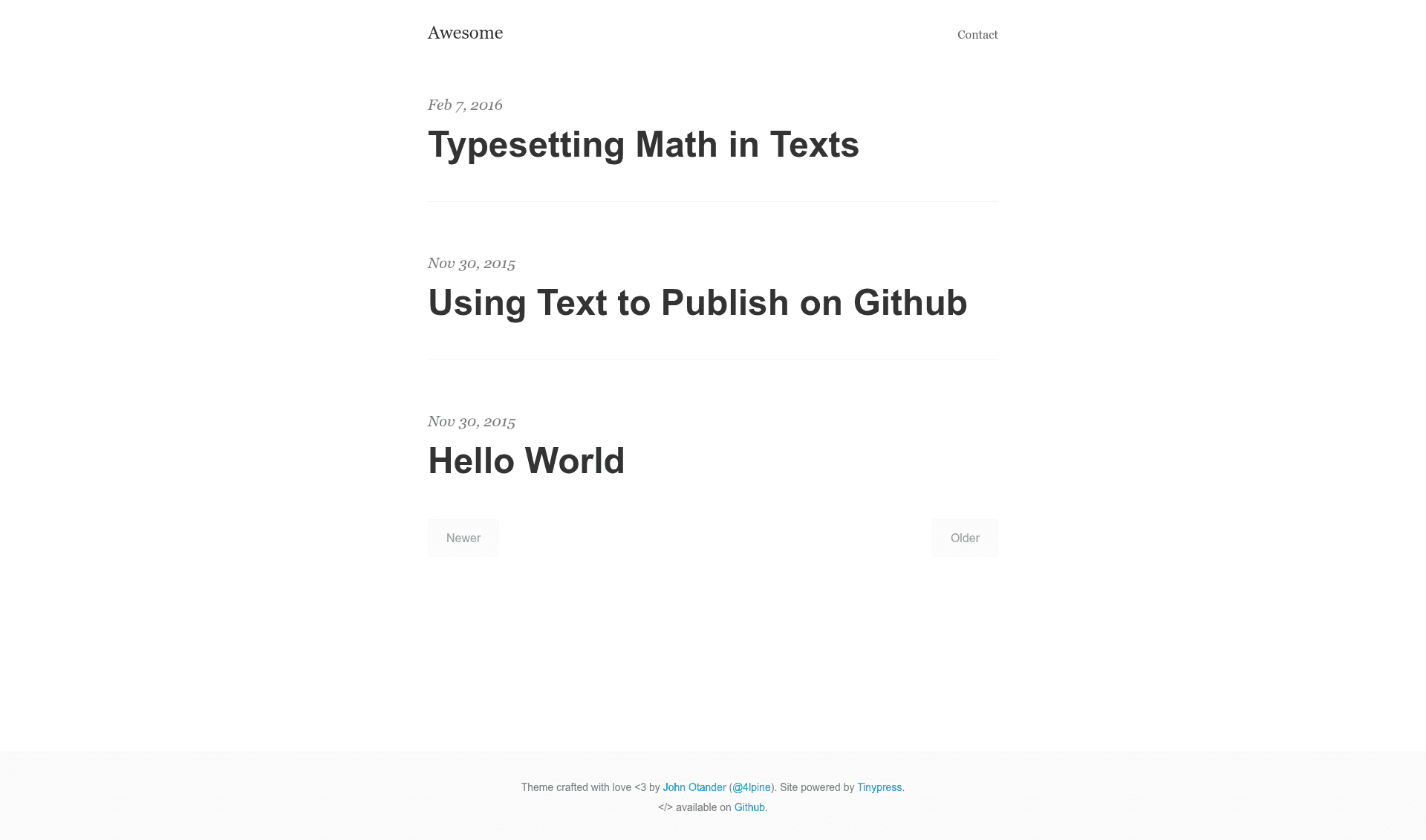
Tinypress is a static site blog template that runs on Jekyll, the Ruby-based static site generator, and deploys to GitHub Pages. The repository, named ishu3101/tinypress, is a live blog with posts from late 2015 and early 2016, including "Hello World", "Using Text to Publish on Github", and "Typesetting Math in Texts". It takes Markdown posts as input and generates a styled HTML site as output. The primary language in the repository is CSS, indicating custom stylesheet work beyond Jekyll's defaults.
Key Features
- Jekyll-powered static generation — Uses Jekyll to convert Markdown content into static HTML files, which are served directly from GitHub Pages without a database or server.
- Free GitHub Pages hosting — The blog is configured for GitHub Pages, allowing deployment by pushing content to the repository and relying on GitHub's automatic build process.
- CSS-based styling — The repository's primary language is CSS, meaning the visual design is implemented with custom stylesheets rather than a front-end framework.
- Sample content included — Ships with three dated blog posts demonstrating typical Jekyll post format, including one about typesetting mathematical formulas.
- Minimalist setup — With only the essential Jekyll files, this template offers a clean starting point for developers who want a no-frills blogging platform.
Who is it for?
- Developers who want a lightweight, serverless blog hosted on GitHub Pages with minimal dependencies.
- Technical writers who need to publish content in Markdown and are comfortable using git for posting.
- Tinypress users who want a reference implementation of a blog generated by the Tinypress service, showing how posts appear in Jekyll.
What can you do with Tinypress?
- Personal blogging: Publish articles by writing Markdown files and pushing them to the GitHub repository; the blog updates instantly with each commit.
- Technical note-taking: Use the existing post structure to document coding projects, including mathematical notation as demonstrated in the "Typesetting Math" sample post.
- Learning Jekyll: Study the repository's layout and CSS to understand how a minimal Jekyll theme is structured and customized.